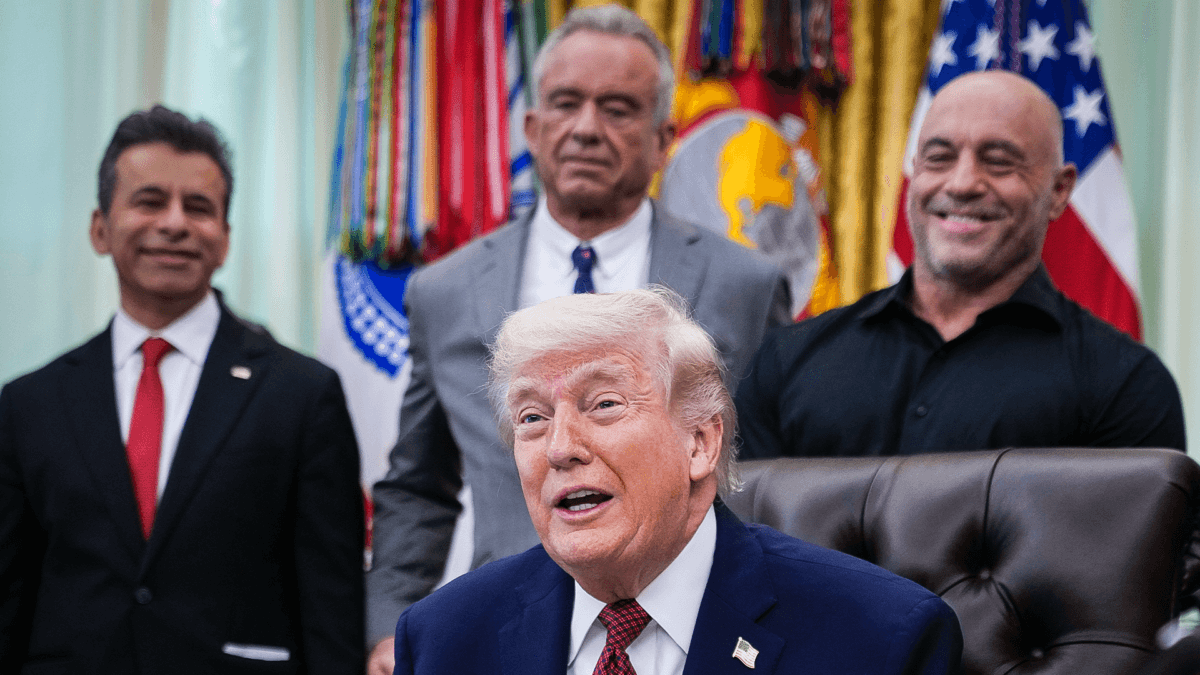
This is the way the drug war starts to end, not with a bang or a whimper, but with an executive order signed by a president who must surely be the least-psychedelic occupant ever of the Oval Office, even when you think about characters as glum and dour as Millard Fillmore and Calvin Coolidge. In recent weeks, Donald Trump has picked figurative and literal fights with everyone from the Pope to Iran's ayatollah. Last year, he released an animated video of himself in a fighter plane dropping feces on "No Kings" protestors.
If there is an American alive over the age of 30 who has never listened to Sgt. Pepper's Lonely Hearts Club Band all the way through, it's Trump. But there he was this past Saturday, flanked by, among others, a pumped-up podcast host known for smoking weed on the air (Joe Rogan), an ibogaine evangelist (Bryan Hubbard), and a Cabinet member who has bragged about snorting cocaine off toilet seats (Robert F.
Kennedy Jr.). The president was eagerly putting his John Hancock on "Accelerating Medical Treatments for Serious Mental Illness," an executive order that fast-tracks "innovative research models and…drug approvals to increase access to psychedelic drugs that could save lives and reverse the crisis of serious mental illness in America." The order calls for expedited approval of "psychedelic drugs, including ibogaine compounds," that "show potential in clinical studies to address serious mental illnesses for patients whose conditions persist after completing standard therapy."
A president who famously ingests nothing more psychoactive than Diet Coke is now pushing ibogaine—dubbed the "Mount Everest of psychedelics" because of the intensity of the trips it induces and its immense potential to reverse brain damage—into respectability. What's next? Ayahuasca in juice boxes for K-12 cafeterias?
The people present at the signing show how drug policy reform springs from a mix of popular-culture discussion and hardcore, in-the-trenches policy work. Trump himself thanked Rogan for calling his attention to psychedelics and ibogaine, and RFK Jr. wrote on Instagram, "Thank you, [Joe Rogan] for helping bring national attention to these potentially life-saving treatments for veterans and others living with mental illness, and for pushing this conversation into the mainstream." Rogan has used his immensely popular podcast for years to tout psychedelics and a wide array of conventional and unconventional therapies, supplements, and protocols (some more credible than others).
Without him and his show, Saturday's signing just doesn't happen. Whatever else one might think of him, Rogan embodies better living through chemistry and self-directed experimentation with all sorts of drugs, exercise programs, and ways of creating a personalized life plan. When Reason Senior Producer Zach Weissmueller and I interviewed RFK Jr. in 2023 as he was running for president, he told us that he "would definitely decriminalize psychedelics" if he got elected, partly as a wind-down to the drug war in general and because psychedelics are particularly promising as treatments for various sorts of addictions and mental health issues.
Kennedy, a former heroin addict who hails from a family as synonymous with substance abuse as politics, has long reflected the majority of Americans who think addicts aren't criminals. The hulking redhead at the signing ceremony is Hubbard, a lawyer who speaks with a booming, folksy Southern accent and who first became acquainted with ibogaine as a treatment for addiction in 2022. Back then, he told Reason a couple of years ago, he was the head of Kentucky's Opioid Abatement Advisory Commission.
His job was to invest hundreds of millions of dollars that the commonwealth got from a national settlement with opioid makers. When he found out about ibogaine, which is derived from an African shrub, from a journalist named Julia Blum, a light switched on. The research was so promising, he knew he had found his life's mission.
As he told journalist Rachel Nuwer for Reason during a 2024 trip to New York: If someone had told me as a 25-year-old man—a staunchly straight-laced, square, institutionalist Republican—that I would have undergone a transformation which would result in me being in New York City for the advancement of God's medicine to heal God's people, I would have told you that I had gone insane and something catastrophic must have happened in my life. When his Kentucky gig ended due to internal state politics, he was unleashed to pursue activism far beyond the confines of the Bluegrass State. Others at the signing ceremony included Food and Drug Administration Commissioner Marty Makary, a medical doctor who spent much of his career at Johns Hopkins, who was happy to announce the coming of the "first-ever human trials in the United States" involving ibogaine (patients currently must go out of the country, often to Mexico, for treatment). And then there was Matt Zorn, a Houston-based attorney who only a c