LONDON — The “Blob” can bite back, it turns out. Days after Keir Starmer sacked him as the Foreign Office’s top civil servant, Olly Robbins, spoke for the first time Tuesday about a row over the vetting of Peter Mandelson to be Britain’s ambassador to the U.S. The row centers on Robbins’ decision to unilaterally grant Mandelson full “developed vetting,” a security clearance, despite a vetting officer recommending it should be denied.
Starmer sacked Robbins last Thursday for not telling him of the recommendation. But Robbins hit back, accusing the government of a “generally dismissive attitude” toward the entire vetting process as time ticked down to Donald Trump’s inauguration in January 2025. The risks were “well known and had been made clear to the Prime Minister,” he argued.
The testimony creates yet another moment of political danger for Starmer, who is battling the discontent of voters and his own MPs over the Mandelson appointment — despite insisting that it was Robbins, not him, in the wrong. The details played out over two and a half hours in a stuffy room hosting the Commons’ Foreign Affairs Committee, where Robbins drank his way through three 750ml bottles of water and ranged from drama, to jokes, to tedious arguments over process. POLITICO rounds up the main takeaways. 1.
Robbins threw No. 10 under the bus Robbins waxed lyrical about due process and insisted: “I’m not here to attack the prime minister.” Yet he had a stream of revelations that he knew would damage the PM — including a pre-planned bombshell. Robbins revealed people in No. 10 had wanted to secure a plum “head of mission” diplomatic job for Starmer’s then-Director of Communications, Matthew Doyle. This is particularly wounding for Starmer because Doyle, like Mandelson, has since been embroiled in a scandal over his past association with a pedophile. (Mandelson resigned over the depth of his friendship with the late convicted pedophile Jeffrey Epstein in September, while Doyle campaigned in 2017 for a friend who had been charged with child sex offenses, and was later convicted.) It was in March 2025, when Robbins was making large numbers of career civil servants redundant in a restructure.
He told MPs he was “under strict instruction” from No. 10’s private office not to discuss the offer with then-Foreign Secretary David Lammy. “I felt quite uncomfortable about it and I kept giving advice that I thought this would be very hard for the office, and was hard for me personally to defend,” he added. “I don’t know what the origin of the suggestion was, and I don’t know who exactly was behind it or how serious it was,” he went on.
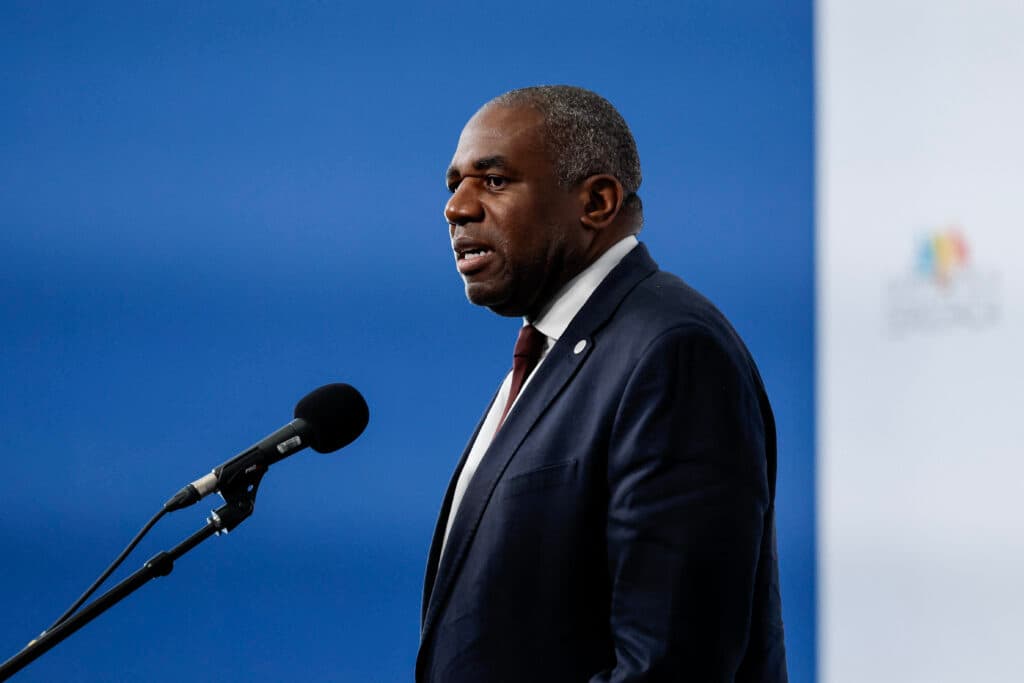
David Lammy speaks to reporters before a “Meeting in Defence of Democracy,” a gathering of leftist leaders seeking to rally against the threat to democracy from the far right in Barcelona on April 18, 2026. | Oscar Del Pozo/AFP via Getty Images Doyle said after Robbins’ testimony that he had been unaware of any such discussion. “I have never sought any Head of Mission, Ambassador or any equivalent leadership-type posting,” he said in a statement Tuesday. “I was never aware of anyone speaking to the FCDO about such a role for me.
My desire after leaving No10 was to stay in UK politics.” Robbins aimed several other jibes at the PM, albeit in diplomatic language. He sought to correct Starmer’s insistence that Mandelson “failed” vetting, saying it was not that binary. “Apologies, chair, but others have [said it],” said Robbins pointedly.
He appeared to insinuate that someone in No. 10 leaked the vetting row to a newspaper. “The first I heard of this deep concern and briefing of it to the prime minister was only really hours before it appeared in The Guardian,” he said, with pursed lips. And he said the leak itself was a “grievous breach of national security” that should trigger prosecutions and would mean the entire process of security vetting would never be the same.
“This system does not work if candidates for it don’t understand that this is an entirely different category of protection … that trust, once gone, cannot be got back.” 2. Officials ‘thought there was no need’ to vet Mandelson Robbins put his most damaging claim in his first paragraph — that parts of Starmer’s operation felt there was no need to give Mandelson security vetting at all. This is a direct challenge to Starmer, who has claimed he would not have given Mandelson the job if he had known a vetting officer recommended he should be denied clearance.
“A position taken from the Cabinet Office was that there was no need to vet Mandelson; he was a member of the House of Lords, he was a privy counsellor,” said Robbins. “In the end, the [Foreign Office] insisted and put its foot down. I understand my predecessor had to be very firm in person, but that was a live debate at the point of announcement.” Robbins did not produce any evidence for his claim, and it is unlikely he will be able to do so. He only started his job as Foreign Office permanent under