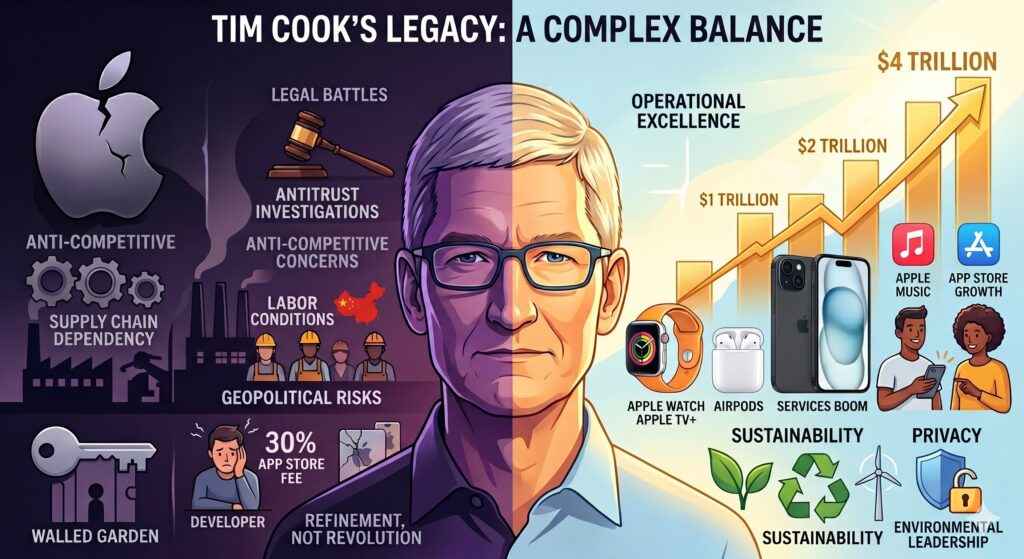
Apple has confirmed that Tim Cook will transition to executive chairman, with John Ternus set to take over as CEO from September 1, 2026. While there were strong rumours about his retirement this year, the announcement is still head-turning to the tech industry as it closes a 15-year chapter that reshaped Apple from a product-led […]
Apple has confirmed that Tim Cook will transition to executive chairman, with John Ternus set to take over as CEO from September 1, 2026. While there were strong rumours about his retirement this year, the announcement is still head-turning to the tech industry as it closes a 15-year chapter that reshaped Apple from a product-led innovator into a scale-driven, services-heavy, globally dominant business. Cook stepped in as CEO in 2011, following Steve Jobs, at a time when Apple’s identity was closely tied to Jobs’ product vision, which involved taking bold risks and thinking differently.
Cook’s approach was arguably in contrast to this. He stabilised operations and mainly focused on scaling what already worked. This meant more predictable product cycles, and for the company, it resulted in steady, compounding growth.
Survey Thank you for completing the survey! Under Cook’s tenure, Apple expanded into new categories, largely thanks to his mastery of global supply chains, financial optimisation, and operational discipline. And several defining moments capture both the gains and gaps of his leadership.
Here are some of them: Building the world’s strongest supply chain Cook’s background in operations became a defining strength. Apple refined its global manufacturing and logistics to deliver products like the iPhone at a massive scale with consistent quality. Under Cook’s leadership, China became the backbone of Apple’s manufacturing, which has acted as both the company’s strength and long-term risk.
In the book Apple in China by Patrick McGee, the author points out that Apple’s operations helped accelerate China’s own tech capabilities and manufacturing ecosystem. Meanwhile, Apple is now heavily dependent on China for its supply chain efficiency. This efficiency is Apple’s biggest competitive advantage, but it will have to find alternatives.
Apple Watch and AirPods The introduction of the Apple Watch in 2015 marked Apple’s first major new category under Cook. Initially, it was positioned as a fashion-tech and failed to define its function and focus. But, over time, it evolved into the world’s most popular health and fitness wearable.
It is now a practical part of the Apple ecosystem due to its value offering in health tracking, safety features and integration with iPhone. On the other hand, the removal of the headphone jack from iPhones, followed by the launch of AirPods, kind of created the wireless audio category. It was also initially criticised for design and pricing, but AirPods are now valued for their everyday convenience, seamless pairing, and ecosystem features.
This category became a mass-market success and drove Apple’s wearables business into a multi-billion-dollar segment. Also Read: ‘Legend’: Sam Altman and other leaders react as Tim Cook steps down as Apple CEO Services expansion as a major revenue engine Under Cook’s leadership, Apple aggressively expanded services such as Apple Music, Apple TV+, iCloud, and Apple Fitness+. So, Apple is no longer just a hardware-centric brand; rather, it has a hybrid model with recurring revenue.
Even if hardware growth slows, services are there to stabilise things. For Apple users, this made the Apple ecosystem more useful with connected services that handle music, storage, fitness, payments, and entertainment. They don’t have to rely on third-party services.
But this also means ecosystem lock-in. They are locked in the Apple walled garden, and may also suffer from growing subscription fatigue. Apple silicon transition Apple started moving from Intel processors to its own chips, with the M1 silicon in 2020.
The in-house chips benefit from vertical integration and offer improved performance, battery life, and efficiency. This has reshaped the Mac lineup and is now a benchmark for the competition. Representational image Apple Car cancellation Apple’s long-rumoured electric vehicle project was eventually shelved after years of development.
This is one of Cook’s most visible failures in terms of resource allocation. It highlighted Apple’s difficulty in entering highly complex, capital-intensive industries outside its core strengths. For observers, it reinforced the idea that Apple under Cook prefers controlled expansion rather than high-risk bets.
And some other bets haven’t really paid off yet. Vision Pro and Apple Intelligence Apple Vision Pro was one of the most ambitious product bets of Cook’s era. It launched in 2024 and was positioned as a spatial computing device that blends augmented and virtual reality.
While it is technologically advanced, it is also extremely expensive and niche. So, the initial fanfare died down, and Apple hasn’t openly announced a successor. The bigger question is long-term adoption.
And the industry wonders what’s going to be the next big thing from Apple that reflects both Apple’s ambition and high-end approach to new categories. Then there is Apple Intelligence. Apple has taken a relatively measured approach to artificial intelligenc