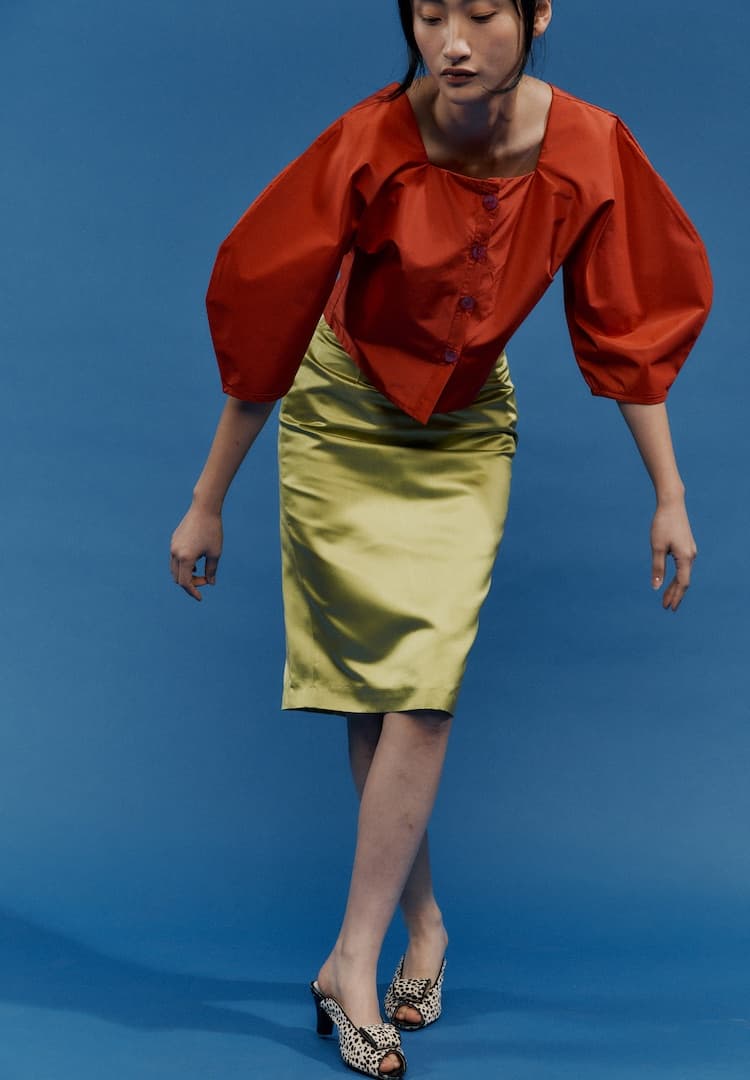
Melbourne-based slow fashion label Kateri’s garments aren’t just designed with the wearer in mind. Made in-house by Ruby Farley-Steere, they’re created with a long-term vision: to be worn and loved, of course, but to one day become heirlooms as well. Kateri’s collections, which exist on a made-to-order basis, are what Ruby calls “quiet statement” pieces.
Balancing structure and ease, they feel sculptural yet soft and, importantly, wearable. “They don’t demand attention but they hold it,” she says. For more fashion news, shoots, articles and features, head to our Fashion section.
From the label’s Moon Dress, which features a low-back silhouette, side split and mint waist tie, to its signature v-neck Honey Blouse, a large part of Ruby’s inspiration comes from the fabrics themselves. “I love materials that can hold shape while still feeling soft against the body,” she says, adding that her preferred materials typically consist of organic cottons, silk and dupion. Having existed in the space since 2020, being independent and staying true to a slower model of production will always be a defining part of Kateri.
“I’m most proud that Kateri has grown slowly and honestly, without compromising on how the pieces are made.” View this post on Instagram A post shared by KATERI (@katerithelabel) Fashion Journal: Hi Ruby! Tell me a little about yourself. What’s your fashion background?
Ruby: I’m a designer and seamstress based in Melbourne. I grew up in Warrnambool, Victoria and later moved to Melbourne to study fashion, where I developed a strong interest in pattern-making and garment construction. I’ve worked across both retail and studio environments, including with Melbourne couture designer Linda Britten, which really shaped my appreciation for craftsmanship and detail.
During that time, I worked closely alongside her pattern-maker, Thomas Bluett, and having that one-on-one exposure to such a skilled maker was incredibly formative. Alongside running Kateri, I also work in eCommerce and digital marketing, which has given me a broader understanding of how a brand lives and communicates beyond the garment itself. How did Kateri begin?
Can you walk us through the process and any early challenges? Kateri began around five years ago, initially as a collaborative project. A few years later, I moved back to Melbourne and began running the brand independently, which is when it really took shape in its current form.
From there, it became a way for me to create pieces slowly and intentionally, outside of traditional production models. I was working from my one-bedroom apartment, designing, cutting and sewing everything myself while also working full-time alongside building the brand. The early challenges were largely around capacity, learning how to balance time, cost and demand as a one-person studio.
It’s a demanding way to work and there’s a vulnerability in putting something so personal into the world. But that closeness to the process has also become the strength of the brand. View this post on Instagram A post shared by KATERI (@katerithelabel) What were you trying to achieve with your label when you started and how has this evolved?
At its core, Kateri is about creating garments that are made to be worn, loved and passed on. There’s a focus on longevity, both in construction and in emotional connection. Clothing feels like a kind of quiet ritual to me.
It has the ability to shape your day, to influence how you feel and how you move through the world. That idea has always sat at the centre of the brand, even as it continues to evolve. How would you describe the brand’s aesthetic or ‘feel’ to someone discovering it for the first time?
Sculptural, soft and considered. There’s a balance between structure and ease, pieces that feel refined but still wearable. I often think of them as quiet statement pieces.
They don’t demand attention but they hold it. View this post on Instagram A post shared by KATERI (@katerithelabel) What inspires you most when you’re designing? A lot of my inspiration comes from textiles themselves, how a fabric holds shape, how it moves, or how it reacts when gathered or structured.
I’m also deeply inspired by my family and where I grew up. I was raised in a small country home in Warrnambool that’s never really changed and it holds so many memories for me. That sense of familiarity and permanence often finds its way into the work.
I think Kateri sits somewhere between that world and my life now in Melbourne; there’s a balance between something grounded and something more refined. I’m also drawn to heirlooms and the idea of garments being kept and passed down. All your pieces are made by you in Melbourne – what are the benefits and challenges of keeping production local for you?
The biggest benefit is control and connection. I’m involved in every step, from pattern to final stitch, which allows me to maintain the integrity of each piece and stay close to the process. View this post on Insta