AI is reshaping industries, roles and economies both globally and across Southeast Asia far sooner than expected. What we predicted might take until 2032 has arrived six years ahead of schedule. Cognizant’s latest study reveals that 93 per cent of jobs today could be impacted by AI in some way. Governments and companies are investing […] The post AI’s real challenge? Closing the skills gap appeare
AI is reshaping industries, roles and economies both globally and across Southeast Asia far sooner than expected. What we predicted might take until 2032 has arrived six years ahead of schedule. Cognizant’s latest study reveals that 93 per cent of jobs today could be impacted by AI in some way.
Governments and companies are investing heavily in platforms, infrastructure and automation. But technology alone won’t deliver results without people who can use it effectively and responsibly. As organisations race to implement AI, a widening gap is emerging between the demand for AI skills and the supply of people confident and proficient enough to use these tools in their day-to-day work.
This gap will define success in the coming years. By 2030, Southeast Asian business leaders expect workplace core skills to be disrupted more than the global average, with 96 per cent saying proficiency in AI and big data will be essential (compared with 90 per cent globally), according to the World Economic Forum. Yet only 30 per cent of Southeast Asian executives believe their employees are proficient in these skills.
This gap between ambition and capability underscores the urgency with which businesses need to act. Making skills development a core strategic priority Confronting these realities demands a fundamental rethink of how skills are developed and valued. Upskilling can no longer be an individual task left to employees.
In the age of AI, skills development must be a strategic priority, aligned with organisational planning and competitiveness. Organisations that will succeed are those already treating continuous learning as infrastructure, embedding access to tools, real-world challenges and practical learning into daily workflows. Rather than just training, they will build adaptability into the very core of the organisation.
Also Read: The missing link in Singapore’s AI strategy These organisations will be forward-looking and proactive, understanding that bridging the skills gap will keep them ahead of the curve, preparing for today’s demands and future growth. As AI, big data, networks and technology literacy rise in strategic importance, those that invest early in their people will capture a greater share of the economic benefits as demand for these capabilities intensifies. Investing in people at the same pace as AI ensures the benefits of technological progress are broadly shared.
Keeping pace with AI by building agile learning infrastructures AI is developing at such a rate that training curricula cannot be designed and approved fast enough to keep up. Skilling infrastructure must be designed to immediately bridge the gap between a new tool’s potential and the employee’s current practice. This shifts the focus of learning from broad role-based certifications to precise task-based adjustments.
In healthcare, for example, clinicians shouldn’t have to retrain across their entire discipline as AI diagnostics evolve. Instead, they need rapid, practical guidance on how to interpret specific agents’ outputs and communicate those findings to patients. This continuous recalibration means professionals constantly add new layers of technical competence as AI advances.
Simultaneously, studies have shown that human skills like judgment, empathy and trust-building remain essential and are more resistant to automation. By integrating both digital and human skill development into real-time learning, organisations can ensure their workforce evolves alongside technology, ready to leverage AI while anchored by uniquely human strengths. Why AI skills must go mainstream and empower every worker Digital skilling shouldn’t be limited to technologists.
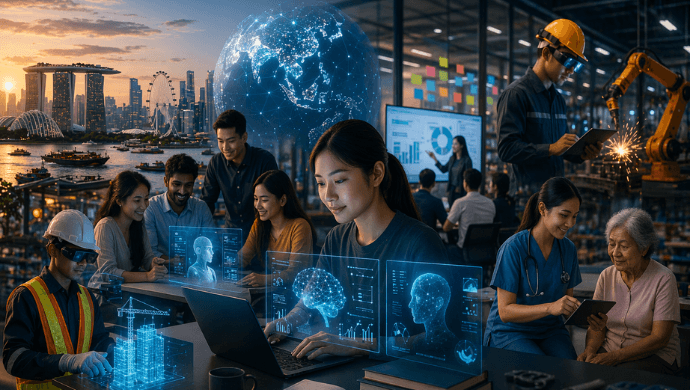
Cognizant has found that AI’s impact spreads far beyond office automation and technical roles, now influencing hands-on jobs once considered ‘safe’ from AI disruption. For example, AI can help construction workers interpret blueprints, and similar human-AI collaboration is redefining tasks in sectors like healthcare, logistics and manufacturing. Even now, the idea that a car mechanic could use AI-augmented glasses to assist in locating a faulty engine part seems far from science fiction.
Also Read: Right to explanation in systems that can’t fully explain themselves As AI reaches workers across industries and roles, parts of the workforce risk being left behind, pushing companies to design learning programmes beyond just technical teams. One example is Cognizant’s Synapse initiative, which focuses on large-scale skilling across its workforce, clients, and communities, with a goal of reaching millions globally by 2030. In ASEAN, related efforts such as its AI for Impact programme have included hands-on workshops for students, professionals, and underserved groups, reflecting a broader industry shift toward more inclusive and applied approaches to workforce readiness. We’ve found the AI skills gap is universal, from senior leaders to frontline workers, many seek practical ways to apply AI in