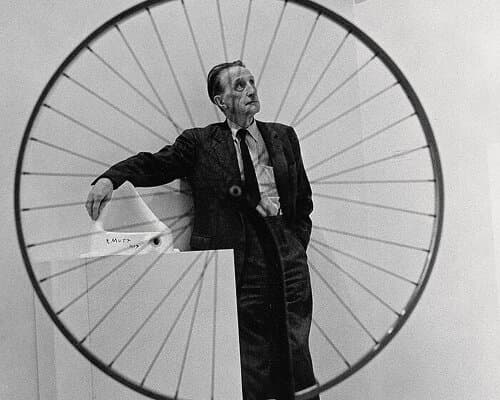
marcel duchamp’s readymades reappear as unresolved questions, reactivating debates around authorship, value, and the role of the viewer. The post what the readymade still asks: marcel duchamp returns to new york at MoMA and gagosian appeared first on designboom | architecture & design magazine.
Marcel Duchamp and the object, reactivated Marcel Duchamp’s bicycle wheel, its spokes spinning above a wooden kitchen stool with no destination in mind, is arguably the most consequential non-artwork in the history of art. Not a sculpture in the traditional sense, not quite an object either, it hovers in a suspended state between utility and thought, action and speculation. Paired with Fountain (1917), a porcelain urinal rotated ninety degrees and signed with the pseudonym R.
Mutt, these objects inaugurated a shift in how form, authorship, and meaning are understood that has never fully resolved itself. What Duchamp initiated was a slow-release mechanism, a way of thinking that drifts, mutates, and reappears across time, activating new meanings each time it is encountered. Now, more than a century after their making, two concurrent exhibitions in New York, a major retrospective at Museum of Modern Art, and a focused presentation of the 1964 Schwarz editions at Gagosian, bring the readymades back into focus, not as historical relics, but as what they have always been: productive, unresolvable provocations.
Alfred Stieglitz. Fountain (photograph of readymade by Marcel Duchamp). New York, 1917. Gelatin silver print.
Box in a Valise Archive, private collection, USA. © Association Marcel Duchamp / ADAGP, Paris / Artists Rights Society (ARS), New York 2026 readymades and The grammar of displacement Duchamp identified two mechanisms that transform an ordinary manufactured object into a conceptual event: displacement and designation. Displacement removes the object from its functional environment and deposits it in the gallery, where its ‘useful significance’ evaporates. A urinal on a pedestal is no longer plumbing; it is a proposition.
Designation is the sovereign act that makes this possible, the artist’s choice, not their hand, constitutes the creative gesture. Whether or not Duchamp fabricated the object is entirely beside the point. The fact of selection, the act of pointing and naming is what elevates the object to the dignity of a work of art.
If displacement and designation are the structural mechanisms of the readymade, language is its volatile accelerant. The titles Duchamp assigned to his objects were instructions for misreading. In Advance of the Broken Arm (1915) anchors a static snow shovel in a future narrative of accident and consequence.
Trébuchet (1917), a coat rack nailed to the floor, borrows a chess term for a pawn positioned to trip an opponent while simultaneously punning on trébucher, to stumble, making the object a physical and linguistic trap for the unsuspecting visitor. L.H.O.O.Q. (1919), in which a mustache drawn on a Mona Lisa postcard conceals a crude French phonetic joke, performs what Duchamp called a ‘rectified readymade’, a desacralization of high culture through the mechanism of the vulgar pun. Marcel Duchamp Porte-chapeaux (Hat Rack), 1964 (after 1917 lost original) Wood, 9 × 18 × 13 inches (23 × 45.7 × 33.3 cm), “Ex Arturo” (1 of 2 AP) + edition of 8 + 2 HC © Association Marcel Duchamp/ADAGP, Paris/Artists Rights Society (ARS), New York 2026.
Photo: Rob McKeever The indifferent eye Central to Duchamp’s methodology is the deliberate suspension of aesthetic taste in the selection of objects. The choice of a bottle rack, a snow shovel, or a comb was made on the explicit condition that neither attraction nor repulsion played a role. By evacuating the object of conventional beauty, whether good taste or bad, Duchamp forces the viewer to confront a more fundamental question than ‘Is this beautiful?’ The question becomes, simply, ‘Is this art?’ That question, deceptively direct, turns out to have no stable answer.
It keeps regenerating, shifting shape with every new context in which the work appears, and it is precisely this inexhaustibility that gives the readymade its structural resilience across more than a century of institutional, critical, and cultural change. The 1964 Schwarz editions complicate the readymade’s logic in ways that Duchamp almost certainly anticipated with satisfaction. Produced in collaboration with the Italian gallerist Arturo Schwarz, these are replicas of works that, in many cases, no longer physically exist, artisanal reconstructions of objects that had themselves been industrially produced.
An original copy of a copy, made by hand to resemble something made by machine, circulating in a market organized around the myth of uniqueness. These editions do not undermine the readymade’s authenticity; they extend its argument. If the first gesture declared that choice, not craft, was the condition of art, the Schwarz editions declare that the concept, not the physical object, is where authenticity resides.
The work survives its own disappearance. Marcel Duchamp. Bottlerack, 1961 (replica of 1914 original). Galvanized iron, 23 3/8 x 21 1/4″ (59.4 x 54 cm). Philadelphia Art Museum: Gift of Jacqueline, Paul, and Peter Matisse in memory of their mot