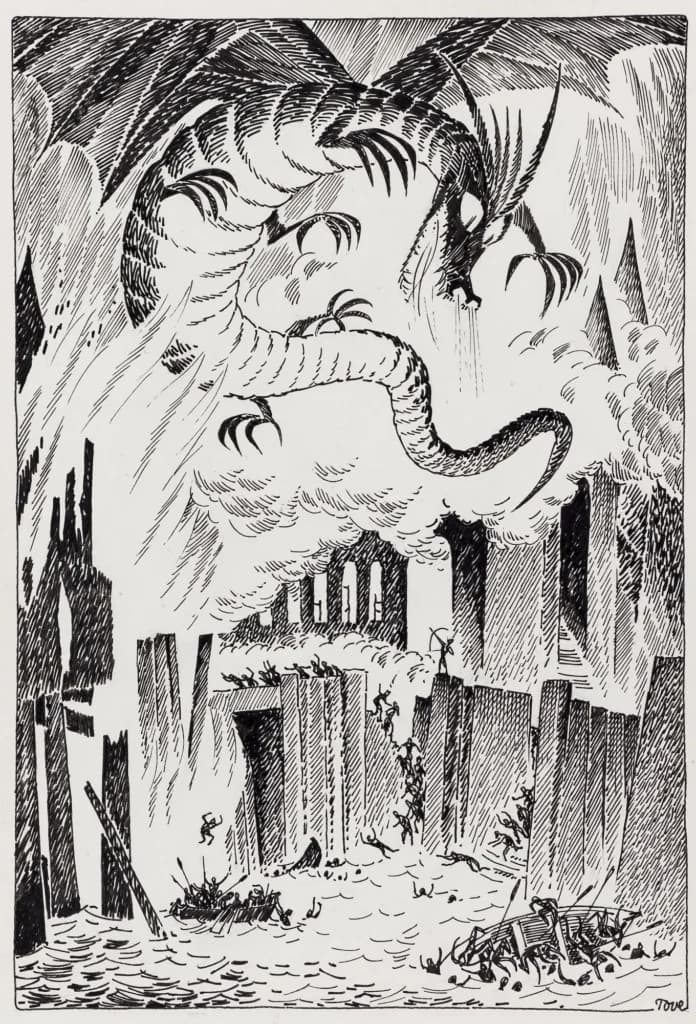
Illustration from the Swedish translation of The Hobbit, by Tove Jansson, 1962 [A previous version of this essay appeared on Asking the Wrong Questions in October 2010] The most that can be said for the dwarves is this: they intended to pay Bilbo really handsomely for his services; they had brought him to do a nasty job for them, and they did not mind the poor fellow doing it if he would; but they would have done their best to get him out of trouble, if he got into it, as they did in the case of the trolls at the beginning of their adventures before they had any particular reasons for being grateful to him. There it is: dwarves are not heroes, but calculating folk with a great idea of the value of money; some are tricky and treacherous and pretty bad lots; some are not, but are decent people like Thorin and Company, if you don’t expect too much.
Last week’s news that the long-beleaguered production of The Hobbit is finally getting on its way sent me back to the book itself for the first time in nearly a decade. I reread The Lord of the Rings every few years, but The Hobbit is less dear to my heart and thus less frequently returned to. What brought me back this time was the desire to gain some grounding in the text from which to wonder how Peter Jackson and Philippa Boyens were going to adapt the novel, which in my recollection was childish and episodic, into something of a piece with their Lord of the Rings trilogy.
Tolkien’s celebrated affinity for worldbuilding means that The Hobbit and The Lord of the Rings clearly take place in the same invented world, but it’s precisely at those points that the two works overlap that the differences between their Middle Earths are most apparent. There is danger in The Hobbit, and the characters face many merciless, amoral foes. But evil, which drives the antagonists in The Lord of the Rings, is absent from the book.
Its villains are merely bad. There is, as well, no sense of grandeur in The Hobbit, nor of the high stakes that are perpetually in the background, and finally the foreground, of The Lord of the Rings. Nowhere is the gulf between the two books’ tones more apparent than in the chapter “Riddles in the Dark,” which Tolkien rewrote when the idea for The Lord of the Rings began germinating in him.
In the chapter’s original version, Gollum bets the One Ring willingly and accepts its loss with merely some loud complaints. The new version not only changes the manner of Bilbo acquiring the Ring, but the nature of Gollum and the Ring itself, to fall more in line with what they are in the later novel. Reading it, one feels very much as if Bilbo has temporarily stepped into another novel, one whose stakes, both physical and moral, are much higher.
Gollum’s corruption by the Ring, and the role the Ring itself plays in abandoning him and taking up with Bilbo, are darker themes that don’t quite fit with the rest of The Hobbit. Combined with the cavalier way in which Bilbo uses the Ring later in the story, this change leaves the novel feeling a bit wobbly. Once Bilbo returns to his party and resumes the journey to the Lonely Mountain, the novel reasserts its own preoccupations, which are something quite different from what we’ve learned to associate with Tolkienian fantasy.
Characters in The Hobbit don’t seem to care about the same things that characters in The Lord of the Rings do. They don’t want to save the world; they’re not interested in vanquishing evil; they just want to get paid. The whole novel is driven by money, and the desire to gain or regain it.
The quest driving the novel could easily be reconfigured as one for revenge, or to reclaim a lost birthright. But the dwarves themselves leave no doubt that what they’re after is the legendary treasure of Thror. As Bilbo himself points out late in the novel, to defeat Smaug would take a hero, whereas the dwarves have brought with them a burglar. (It has been pointed out many times that this depiction of the dwarves as greedy and concerned primarily with money has problematic implications—all the more so because of the acknowledged influence of Semitic languages on the language of the dwarves.
But I am even more struck by how the most obvious change one could make to the story in order to ameliorate this problem—changing the dwarves’s intentions from regaining a treasure to regaining their lost homeland—has its own real-world resonances.) The villain of the piece is a dragon, which many myths and fairy tales link with avarice and possessiveness. This is not always the case in Tolkien’s other writing—the dragons, or “worms” in The Silmarillion are creatures of Morgoth, more concerned with doing mischief to the elves than their own enrichment. Thousands of years later, however, their priorities appear to have changed. Smaug’s reaction to the theft of a single item from his enormous hoard is “the sort of rage that is only seen when rich folk that have more than they can enjoy suddenly lose something that they have long ha