This article was originally published as part of the Undark series “What I Left Out.” In this installment, journalist Beth Gardiner shares a story that didn’t make it into her recent book, Plastic Inc.: The Secret History and Shocking Future of Big Oil’s Biggest Bet. It is reproduced here as part of the Climate Desk collaboration. Tropodo is […]
This article was originally published as part of the Undark series “What I Left Out.” In this installment, journalist Beth Gardiner shares a story that didn’t make it into her recent book, Plastic Inc.: The Secret History and Shocking Future of Big Oil’s Biggest Bet. It is reproduced here as part of the Climate Desk collaboration. Tropodo is a pretty village of narrow streets and brightly colored houses, set amid lush green fields in the eastern part of Java, Indonesia’s most populous island.
Tall chimneys puffing streams of black smoke jut up behind many of its homes, but they’re only noticeable from a distance, so they hardly mar the town’s rustic feel. Penguin Random House While most of my reporting has focused on where plastic comes from—the oil and petrochemical companies that are pushing ever more of it into our lives—I’ve come to Tropodo to see where some of the hundreds of millions of tons produced every year end up. About 12 percent of plastic waste is burned globally, according to a landmark study based on data through 2015.
Even when done in incinerators equipped with air scrubbers and filters, such burning is linked to higher rates of premature birth, congenital abnormalities including heart and neural tube defects, and may increase cancer risk for those living nearby, studies have found. But when plastics—which a Nature study last year found can contain any of more than 16,000 different chemicals, a quarter of which may pose health concerns—are burned in low-tech furnaces lacking any pollution-reduction technology, the dangers are far greater. That’s exactly what happens in Tropodo, a tofu production center where informal backyard factories use plastic as a fuel for making the soy-based staple.
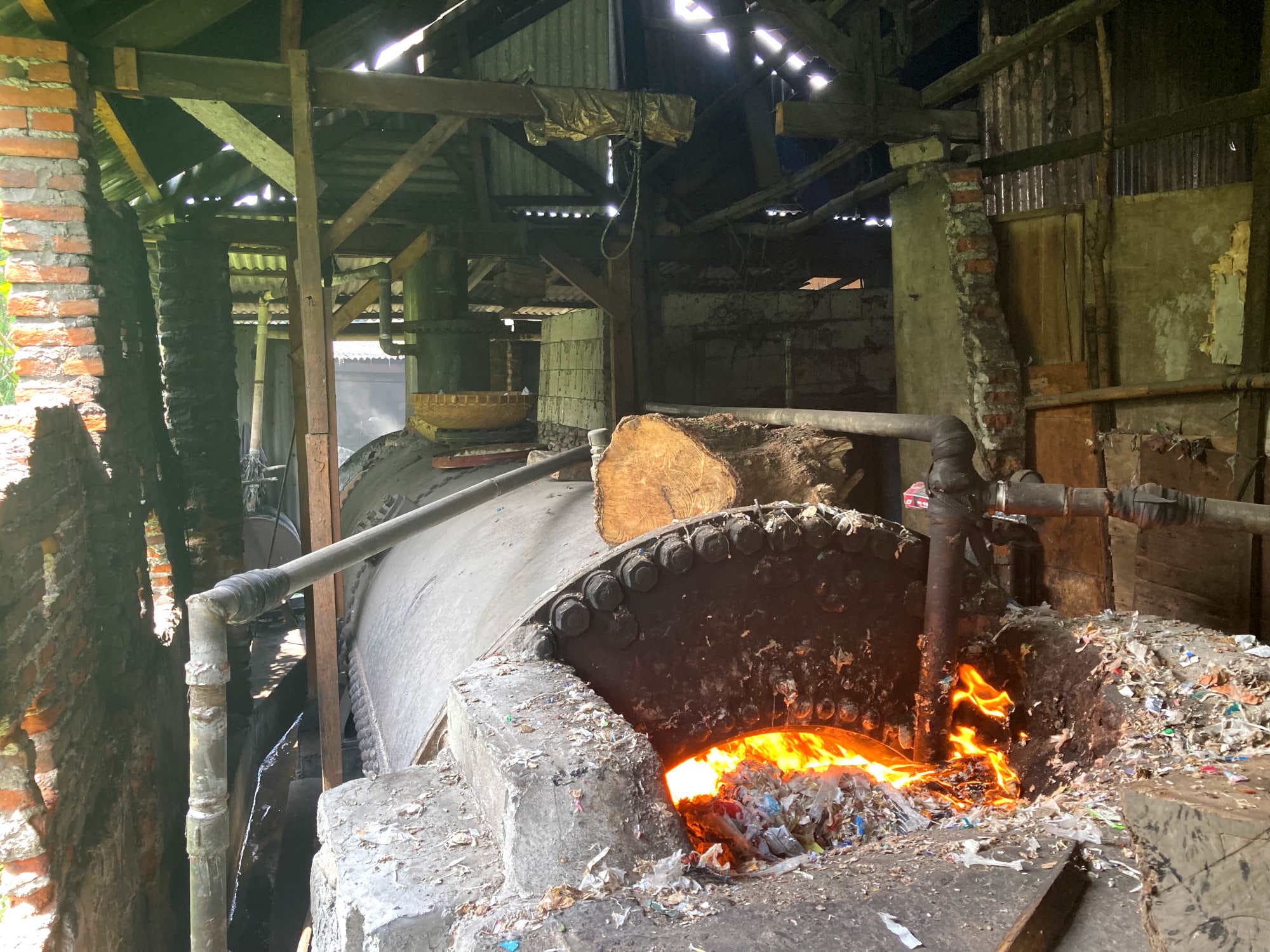
In Muhammed Gufron’s Tropodo, Indonesia, tofu factory, a plastic-fueled furnace heats water into steam that is used in the production process. Beth Gardiner/Undark Muhammad Gufron, a solidly built man with a wispy moustache, is the owner of a local tofu factory. He greets me in front of a mint green house, and a moment later I’m following him down a long alleyway, past laundry hanging in the sun, into a building whose brick walls have big gaps that give it an open-air feel.
Gufron, who’s in a powder blue T-shirt, navy shorts, and sandals, starts the tour of his factory by pointing me toward several small rooms where shredded plastic, faded to near-colorlessness, is heaped against walls and stuffed into sacks. All around this region, I’ve seen waste sorters spreading plastic in the sun, to dry it for use as fuel. I hadn’t really understood the need for that, but as Gufron leads me toward his furnace, it begins to make more sense.
Intense heat is coming off the blaze inside the black metal cylinder, and when he stuffs a batch of scrap in with a wooden stick, it crackles audibly. The steam this fire helps generate is used in the production process. After a few minutes in Gufron’s factory, I already feel a headache building behind my eyes, and as we move from the boiler room toward the tofu production area, the smoke is so thick I pull a mask out of my bag and put it on, despite the stifling heat.
There are about two dozen people working here, and with water sloshing around the concrete floor, many wear high rubber boots. Gufron shows me the machine that grinds soybeans into powder, then combines it with water to create a thick white sludge. Workers stir big vats of that mixture, and I watch as a man in a white tank top uses a metal pan to skim foam off the top, then dumps it onto the floor.
Gufron’s factory sits in a brick-walled building with an open-air feel. Workers grind soybeans into powder, combine it with water in large vats, and then scoop the resulting paste into wooden draining racks.Beth Gardiner/Undark Eventually, the paste is scooped into wooden draining racks lined with thin mesh. They’re stacked in piles, and liquid drips from them, leaving something recognizable as tofu, which women slice into chunks with metal grids.
Gufron leads me back up the alley, and we take seats on dark wooden chairs in his living room, where the pungent smell of plastic smoke drifts in through open double doors along with the bright sunshine. Speaking Indonesian, he tells me through a translator that Tropodo has been a tofu hub since the 1960s, and the village’s producers now process more than 30 tons of soybeans a day. He’s in his 50s and has owned this business—it’s called DY, his daughters’ initials—since 2007.
Most of his customers, he tells me, are in nearby Surabaya, Indonesia’s second-largest city, where he sells to markets as well as individuals. His parents were tofu-makers too, and when he was a boy, their factory burned rice husks. But they began using plastic in the 1980s, so when he started his own company, he did too.
He later switched to wood, but when his wood supplier closed, he went back to plastic. “It’s good, and cheap,” he tells me. All Tropodo’s tofu factories burn plastic, he says, and he does