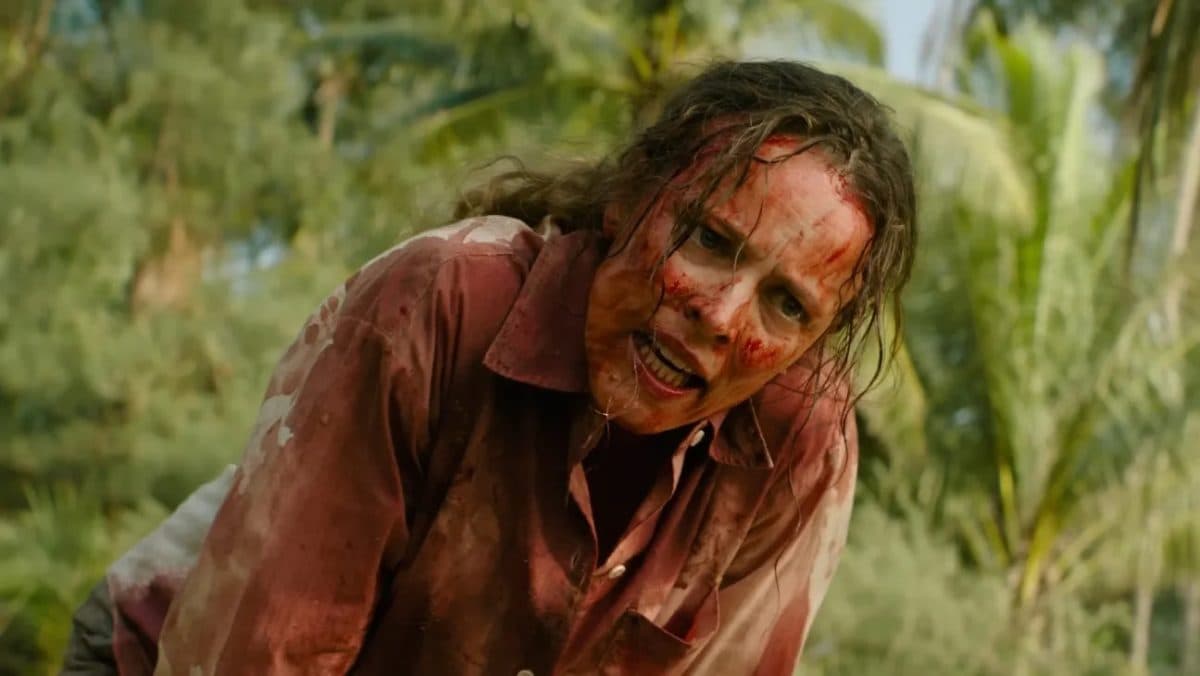
Send Help didn’t arrive with the noise of a franchise film, but it didn’t take long to get people talking. The film sees Sam Raimi back in familiar territory, leaning into violence, dark humor, and discomfort in a way only he really can. Written by Damian Shannon and Mark Swift, it takes a simple survival setup and slowly twists it into something more unsettling.
With Rachel McAdams and Dylan O’Brien at the center, the film works because of how these two performances push against each other. The response has been strong. Critics have backed it, audiences have shown up, and the numbers reflect that.
But what stays with you is not the success or even the shock value. It is the way the film builds toward its ending. What begins as a survival story turns into something colder, something that lingers after it ends.
The Plot of Send Help: A Survival Thriller That Flips the Script A still from Send Help (2026) At first, the film feels familiar. Linda is good at her job but stuck in a system that refuses to see her. She has been promised growth, recognition, a step forward that never quite comes.
Then the company changes hands, and Bradley takes over. He is young, entitled, and completely untested, but none of that matters because he inherits power. The dynamic is clear from the start.
Linda does the work. Bradley takes the credit. Even when they travel for business, nothing changes. He treats it like a vacation while she handles everything that actually matters.
Then the crash happens, and the film shifts. Stranded on an island, all the structure that once defined them disappears. Titles do not matter.
Money does not matter. What matters is survival. And in that world, Bradley has nothing to offer. He cannot adapt, cannot contribute, cannot even take care of himself.
Linda, on the other hand, changes quickly. She figures things out, builds what they need, and keeps them alive. At first, she helps him without thinking too much about it.
It feels like the right thing to do. But Bradley never adjusts. Even when his life depends on her, he keeps slipping back into the same behavior.
He talks down to her, gives instructions, acts like he is still in charge. That tension builds slowly. It is not loud, but it is always there.
You can feel it in the way they speak to each other, in the way small moments start to carry more weight. Everything changes when Linda realizes something important. They are not as cut off as they think.
Rescue is possible. But instead of acting on it, she pauses. For the first time in her life, she is the one in control. And she is not ready to give that up.
From that point, the film stops pretending to be a straightforward survival story. It becomes a quiet battle. Bradley senses something is off.
He tries to regain control, fails, and then tries again. Linda responds each time with more certainty, more calculation. The island does not just test them.
It reshapes them. The Ending Explained: How We Get There, What It Means, and Why It Feels Familiar The Narrative: From Castaway to Killer By the time the film reaches its final act, the relationship between Linda and Bradley has completely broken down. Whatever fragile balance they had is gone.
The arrival of Zuri changes the stakes. She represents everything Bradley lost and everything Linda is about to lose if things return to normal. When Linda sees her, the decision she makes is immediate and final.
It is not driven by panic. It is deliberate. From that moment, there is no going back. Bradley begins to understand what has happened piece by piece.
The truth comes together slowly, and when it does, it hits hard. The person he depended on is not just hiding things from him. She has crossed a line he cannot ignore.
Then comes the discovery that reframes everything. The mansion. It reveals that survival was never the real problem. Escape was always possible.
Linda knew that. She chose to stay. Not because she had to, but because she wanted to. That is what breaks whatever hope was left.
Bradley tries one last time to shift the situation. He softens, apologizes, even suggests a future where they are equals. But it feels hollow.
Not because he is lying, but because it is too late. Linda has already changed. When the confrontation turns violent, it does not feel sudden.
It feels like something that has been building for a long time. The golf club is not just a weapon. It carries meaning. It represents the world Bradley came from, the one that excluded Linda.
And in that moment, she turns it against him. The film does not look away. It stays with the brutality of it, forcing you to sit with what she has become.
Then it cuts forward. A year later, Linda is back in society. She is celebrated, admired, successful. She tells her story, sells it, builds a new life from it.
Everything she once wanted is now hers. But it comes with a cost the film does not try to hide. The Ending of Send Help: What Does It Mean? The ending works because it does not offer comfor