25th Biennale of SydneyRememoryMultiple locationsSydneyMar 14–Jun 14, 2026If audiences come seeking spectacle, this is not it. The 25th Biennale of Sydney, “Rememory,” rewards endurance. It unfolds in an arc that traces the edges of the city, moving through galleries across its western fringes before returning to harborside venues, and brings together works that ask the viewer to slow down and submit to each artist’s constructed world.“Rememory” opened in March as curator Hoor Al-Qasimi’s home city of Sharjah found itself overshadowed by the escalating war between Iran and the coalition of Israel and the US.
With her home region vulnerable to intensifying hostilities, her curatorial effort to examine the past in order to make sense of an unstable present felt all the more acute. Bringing together 83 artists, collaborators, and collectives from Guatemala to Taiwan, the exhibition positions shared histories as precursors to the future.For the second time, the biennale occupies White Bay Power Station, a looming structure marked by the remnants of control rooms, cavernous halls, and machinery of a bygone industrial era. The rawness of these spaces is inescapable; unlike the Tate Modern’s sanitized Turbine hall, these interiors are heavy, dusty, and suspended in time.
With such dominant architecture, ensuring works are neither overpowered by their surroundings nor diminished by the sheer scale of the site is no small feat. Yet Al-Qasimi succeeds in cultivating a sense of intimacy across the venue.Installation view of EDGAR CALEL’s Pa sutz’ xkix tzolojpe (from the fog they will return), 2025, cotton, silk and wool embroidery, beeswax, paraffin, commissioned by the Biennale of Sydney and the Fondation Cartier pour l’art contemporain, at “Rememory,” the 25th Biennale of Sydney, 2026. Photo by Document Photography.
Courtesy the artist and Proyectos Ultravioleta, Guatemala.In an elongated, dimly lit pump house, a 17-meter-long blanket glows in luminous yellow, beckoning the viewer to come closer. Guatemalan artist Edgar Calel’s Pa sutz’ xkix tzolojpe (from the fog they will return) (2025) is an invitation to consider the scars of the past within the realities of today. Anchored in the Mayan belief that the residue of fire connects the sacred and the ancestral, his monumental work is stitched, marked, and folded, then doused in beeswax and paraffin.
The resulting piece, as the title suggests, is built through layers of artistic intervention into an otherwise imperceptible form. The marks drawn across its surface appear figurative before dissolving into abstraction. The work encapsulates the concept of “Rememory,” derived from Toni Morrison’s neologism, where layers of intergenerational experience and spirituality hover intangibly close, suffusing the present.Emerging from the dark service rooms into the vast main halls, viewers encounter another textile presence.
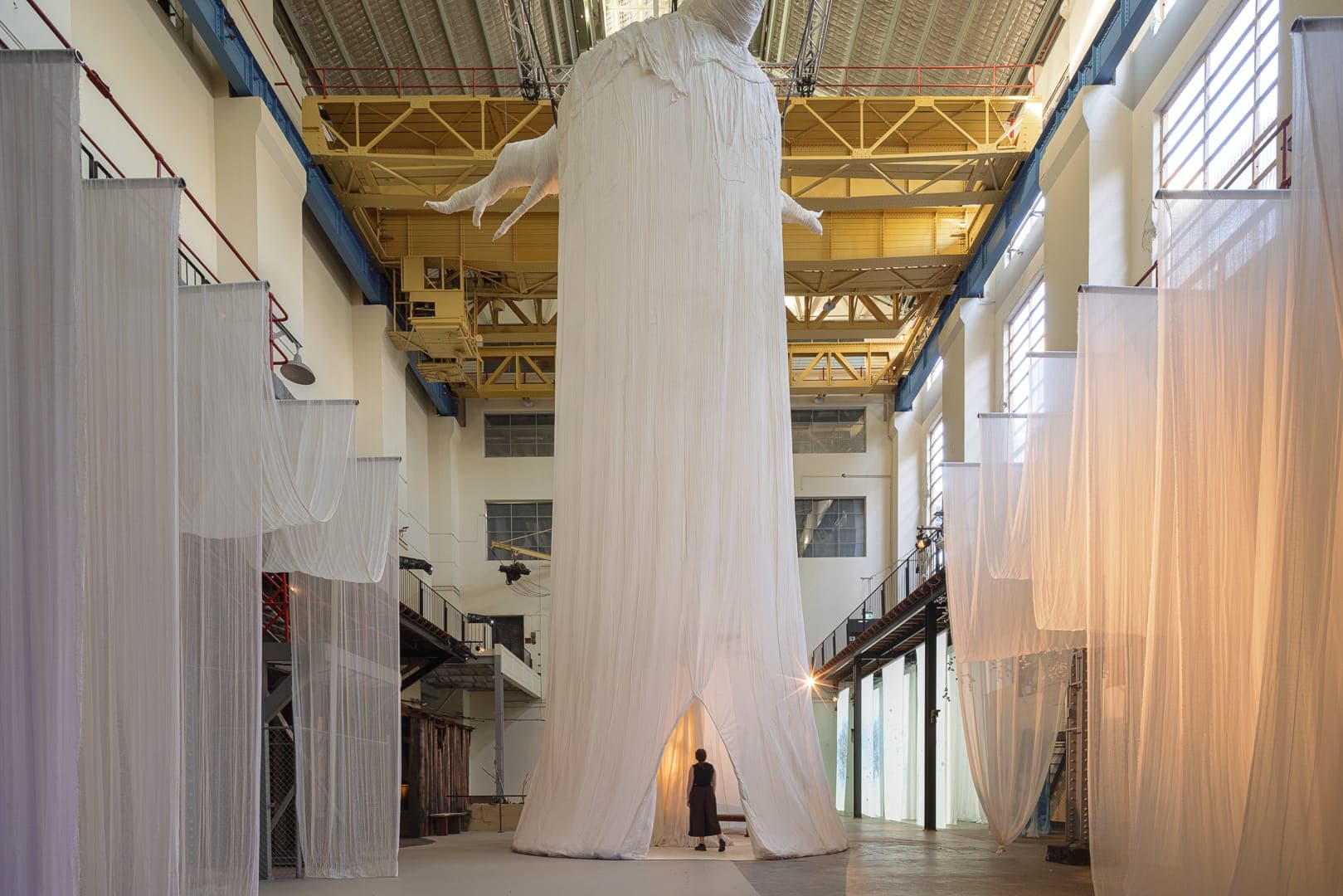
Nikesha Breeze’s Living Histories (2026) is perhaps the closest the biennale comes to the spectacular, measuring more than two stories, yet it remains deeply intimate in nature. A soaring African baobab tree stretches upward, swathed in white cotton gauze and shrouded behind a circular curtain. The viewer cannot help but be lured in, to be enveloped within the structure.While being ensconced in its billowing folds is a calm, almost dreamlike experience, the viewer comes across the remnants of a wooden cabin.
The space is lined with framed photographs, with handwritten notes scattered across tables for viewers to sift through as spoken-word recordings fill the room. In this mise en scène, Breeze recasts the viewer as researcher, inviting them, as she has, to interrogate Born in Slavery, a Library of Congress archive of more than 2,300 first-person accounts. Collected and transcribed by Federal Writers’ Project, an initiative of US president Franklin D.
Roosevelt’s New Deal program in the 1930s, these interviews remain among the only firsthand testimonies of enslavement, many drawn from life on cotton plantations.Installation view of NIKESHA BREEZE’s Living Histories, 2026, cotton gauze, wood, steel, cyanotype prints, furniture, sound, video projection, paper, commissioned by the Biennale of Sydney, at “Rememory,” the 25th Biennale of Sydney, 2026. Photo by Document Photography. Courtesy the artist.Installation view of NIKESHA BREEZE’s Living Histories, 2026, cotton gauze, wood, steel, cyanotype prints, furniture, sound, video projection, paper, commissioned by the Biennale of Sydney, at “Rememory,” the 25th Biennale of Sydney, 2026.
Photo by Document Photography. Courtesy the artist.Breeze deftly constructs a sequence of spaces that compels the viewer to confront somber histories, urging them to read more closely and listen more intently, before returning to the cotton-swathed baobab, now charged with the weight of those testimonies yet held as a sanctuary in the present—a place where reflection, mourning, and quiet reckoning can unravel.Al Qasimi’s biennale