Amazon founder Jeff Bezos is “close” to securing a $10 billion (£7.4 billion) fundraising deal from investors for his AI lab, codenamed Project Prometheus, said the Financial Times. The deal would make the company, which aims to explore how AI systems can be applied across physical industries, “one of the best-financed early-stage start-ups globally”, and marks the first time Bezos has served in an operational role since stepping down as chief executive of Amazon in 2021.Project Prometheus will propel Bezos into the ranks of the AI titans heading firms with multi-billion-dollar valuations, such as Anthropic, OpenAI and Palantir.
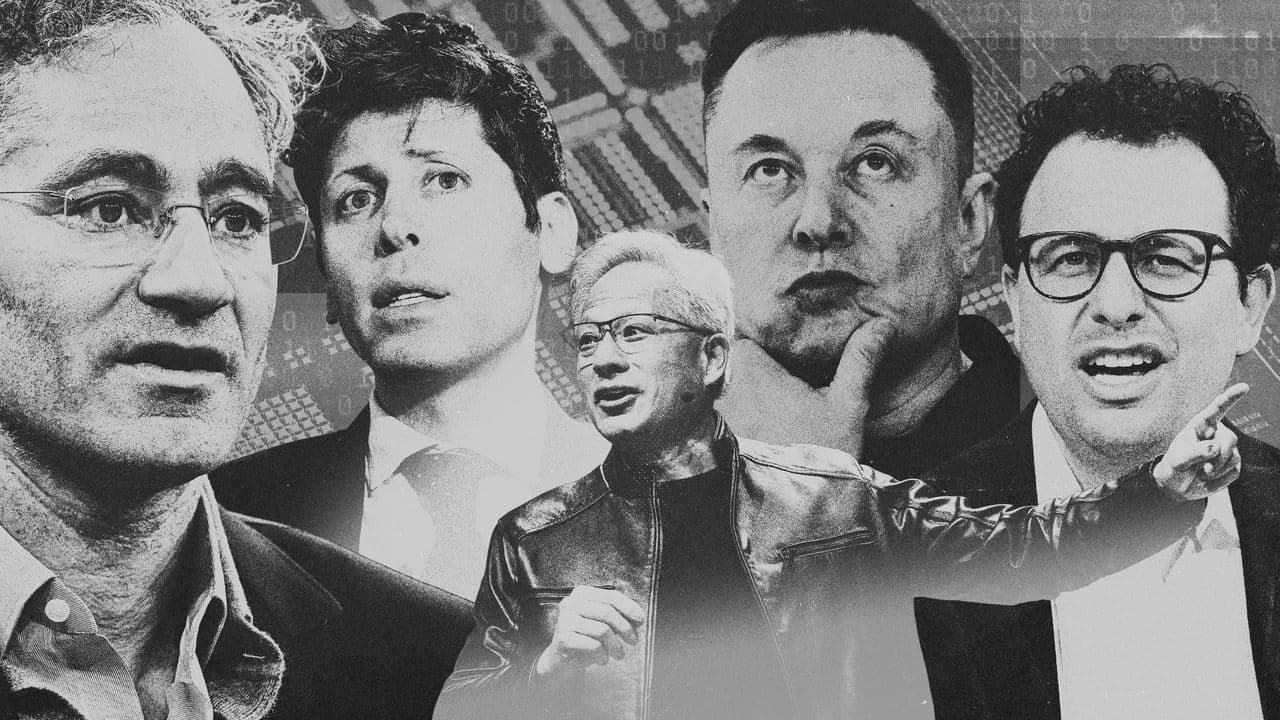
With the industry elite divided by ongoing legal feuds and conflicting political ideologies, the personalities of the individual CEOs look set to shape the course of AI as much as the technology itself. Here are the five names to watch.Sam AltmanThe OpenAI CEO is more and more becoming the “protagonist” of our times, said Lily Isaacs in The Observer. As with Faust, Victor Frankenstein and J.
Robert Oppenheimer, we are beginning to “share the uneasy feeling that enlightenment carries within it the seeds of catastrophe”.Launched by OpenAI in November 2022, ChatGPT is the chatbot that has “redefined the standards of artificial intelligence”, said Forbes. As the company nears a possible value of more than $1 trillion (£740 billion), “one of the biggest so-called risk factors” to the company is “Altman himself”, said Dave Lee in Bloomberg. Altman was fired by the board in November 2023, only to be reinstated days later.
Reading the year-and-a-half-long investigation by Ronan Farrow and Andrew Marantz in The New Yorker, the “overriding impression” of Altman is that he is a “borderline sociopath”, said Jeremy Kahn in Fortune. The piece raises questions on whether Altman “actually cares about AI safety” or whether his rhetoric is simply a “convenient pose” to win over funders and regulators.Dario Amodei“We should not deny that the disruption is going to happen” as AI use increases, Anthropic CEO Amodei told John Thornhill in the FT, but AI can only “diffuse at the speed of trust”. Trust, however, said Thornhill, is “in short supply”.
“As the current frontrunner of the AI pack, Amodei is certain to come under increasingly fierce scrutiny.”It is clear that he “wants to position himself as one of the good guys in the AI debate”, but that “grates with many Silicon Valley critics”, who argue that “his principles align with Anthropic’s commercial interests”. Amodei founded Anthropic – the creators of Claude – in 2021 alongside six other former OpenAI employees, including his sister Daniela, who is president. The company has recently raised $30 billion (£22.2 billion) at a $380 billion (£281.3 billion) valuation and is reportedly “heading for a giant stock market flotation later this year”.Central to Amodei’s brand of Anthropic is that it is “fundamentally safer than that of its rivals”, said The Wall Street Journal.
Indeed, that was one of the main reasons Amodei left OpenAI, citing “concerns about safety”. In recent months, he has also “compared the legal battle between Altman and Elon Musk to the fight between Hitler and Stalin”, as well as calling a $25 million (£18.5 million) donation by OpenAI President Greg Brockman to pro-Trump super PAC (independent expenditure-only political action committee) Maga Inc. “evil”.Jensen HuangAlthough the head of Nvidia may not be driving the AI revolution directly, his company is facilitating it, acting as the “hardware backbone” of the movement, said Business Insider.
Huang’s “chip empire” is effectively “powering the generative AI boom”.He founded the company in 1993, and has served as CEO ever since. Under his leadership, Nvidia – whose projected revenue opportunity for its artificial intelligence chips could reach $1 trillion (£740 billion) or more by the end of 2027 – has expanded partnerships with Amazon Web Services, Google Cloud and Oracle Cloud to accelerate AI development. Nvidia’s hardware and software “now sit at the centre of nearly every major foundation-model program”, said Business Insider.AI is “gonna create more jobs in the end”, Huang said during a recent panel at the Stanford Graduate School of Business, reported Fortune.
“There’ll be more people working at the end of this industrial revolution than at the beginning of it.” He has previously commented that negative commentary surrounding AI is “extremely hurtful”, said Inc.Huang is not without his quirks, having banned one-on-one meetings with staff who report directly to him, on the grounds they would “clog up his work schedule and slow him down”, said Fortune.Alex KarpFewer people will have heard of the co-founder of Palantir, but to some he is the “scariest CEO in the world”, said Steve Rose in The Guardian. The company recently released a 22-point “manifesto” summarising Karp’s recent book, “The Technological Republic: Hard Power, Soft Belief, and the Future of the West”. In it, he ex