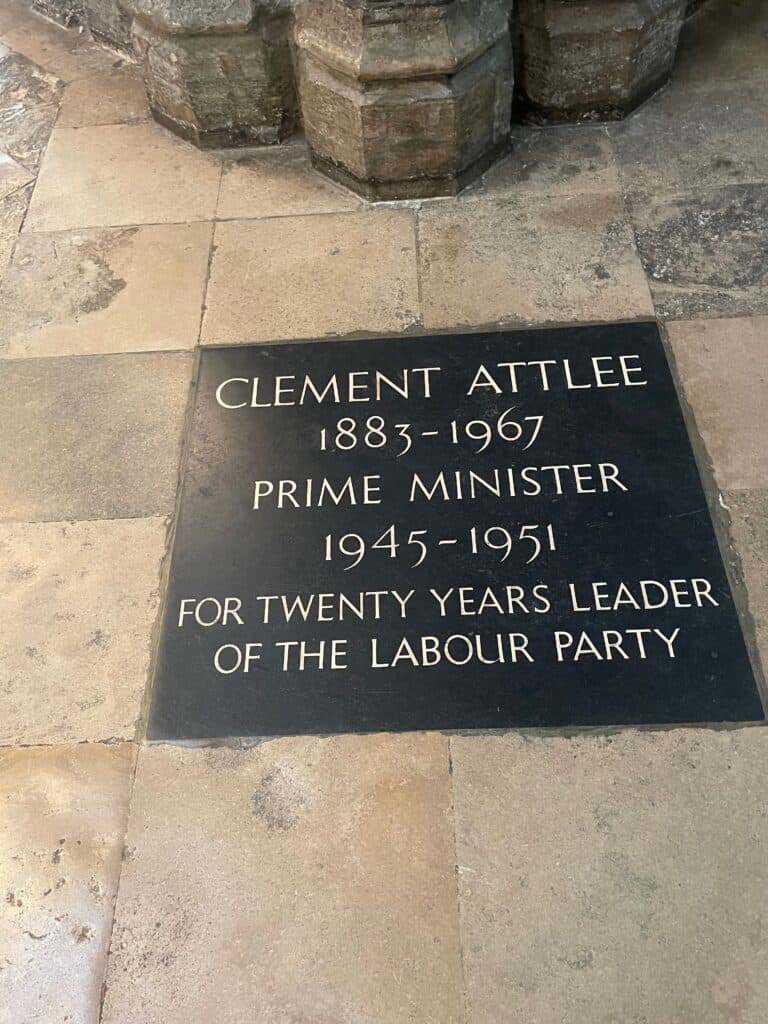
This is the grave of Clement Attlee. Born in 1883 in Putney, Surrey, England, Attlee grew up pretty wealthy. His father was a successful solicitor in London.
The young Attlee did well himself and became a barrister. But the Progressive Era was a thing in the UK as well as Britain (there were a lot of connections in Germany as well) and while the British didn’t really use this terminology, in the American context, that’s what Attlee became. He did a lot of volunteer work and really came to understand poverty.
He thought it was outrageous. Soon, he wanted to go into politics to fight against that horror. He joined the Independent Labour Party and became a lecturer in the London School of Economics, offering a very different set of lessons than the traditional British upper class indifference to the poor.
Attlee’s career was briefly derailed by World War I, but hey, he didn’t die. so that was something. When he returned, he became major of Stepney, which was really a village in the East End of London and then in 1922, the district of Limehouse, in the same part of London, sent him to Parliament. Labour was on the rise.
Ramsay MacDonald was the first big leader of the party and he became its first prime minister in 1924. Attlee joined the government. He became an important advisor to MacDonald.
In 1931, Labour got wiped out by the Tories. Labour was unfortunately in power when the Great Depression hit and the voters took it out on them. A lot of leading Labour politicians lost their seats.
I mean, the Tories ended the election with 470 seats and Labour had 52, a loss of 235 seats! But Attlee won his. So he became Labour’s deputy leader and in 1935, it’s leader.
Attlee would lead Labour for the next 20 years. He also made a good move early on. While initially following the common path of pacifism that dominated much of the western world well into the 30s, he took the Nazi threat seriously long before Neville Chamberlain and became a loud critic of Nazi appeasement by 1938, so he could rebuild a lot of support for Labour as the war began.
Because of this, Winston Churchill was happy to bring Attlee into the wartime coalition government. But Churchill did not care one whit about domestic policy and would not even discuss it with Attlee. About Attlee’s importance in postwar Britain, well, it’s hard to overstate this.
Although Winston Churchill had become a hero in the U.S., the British people had no tolerance for him outside of the very specific task of leading them through the war. As soon as that was over, almost everyone wanted him gone. He simply had no interest in domestic policy at all and the British people were demanding a robust welfare state.
Clement Attlee would provide that. It’s really astounding all that Attlee and Labour were able to do. Of course the most lasting and important and beloved institutions is the National Health Service.
No, the NHS isn’t perfect. Yes, it’s a hell of a lot better and more equitable than if you are in the U.S., unless you are super rich. The National Insurance Act of 1946 created a British version of Social Security.
The National Assistance Act was a broad based welfare law that helped out the masses of poor in Britain. Labour passed the legislation to build vast swaths of public housing. This was the cradle to grave welfare state that I sure wish we had in the United States.
Labour also engaged in a widespread nationalization program. They started with the Bank of England and the civil aviation industry, but then expanded it to coal, railroad, telephones, and steel. By 1951, the government had nationalized about 20% of the economy, going far past what could ever have been possible in the United States.
This was very much not the kind of thing that was some early 20th or early 21st century vision on the left of democratic running of the industries. It was about experts and the state dictating the economy. That’s probably good–a lot of this was pretty efficiently run.
Of course, Attlee and his government was great for unions. There was also the decline of the imperial state. India became free and that was a huge blow for the British ego.
But while it was certainly not done peacefully, at the British didn’t fight it like the French did in Vietnam and Algeria. Attlee’s government was also critical in creating Israel, which while understandable in the context of the time, has been a complete and utter disaster for those of us who oppose ethnonationalist states engaging in ethnic cleansing and genocide. Certainly not nearly enough concern was given to the Palestinians displaced in 1947 and that impact resonates to the present.
Alas, in 1951, Churchill and the Tories came back into power after 6 years in the wilderness. Attlee and his other Labour leaders were really old and there weren’t a lot of new ideas after this initial wave of nationalization. The Red Scare was a thing in the UK as it was in the US. He barely won reelection in 1950, with middle class people moving back t