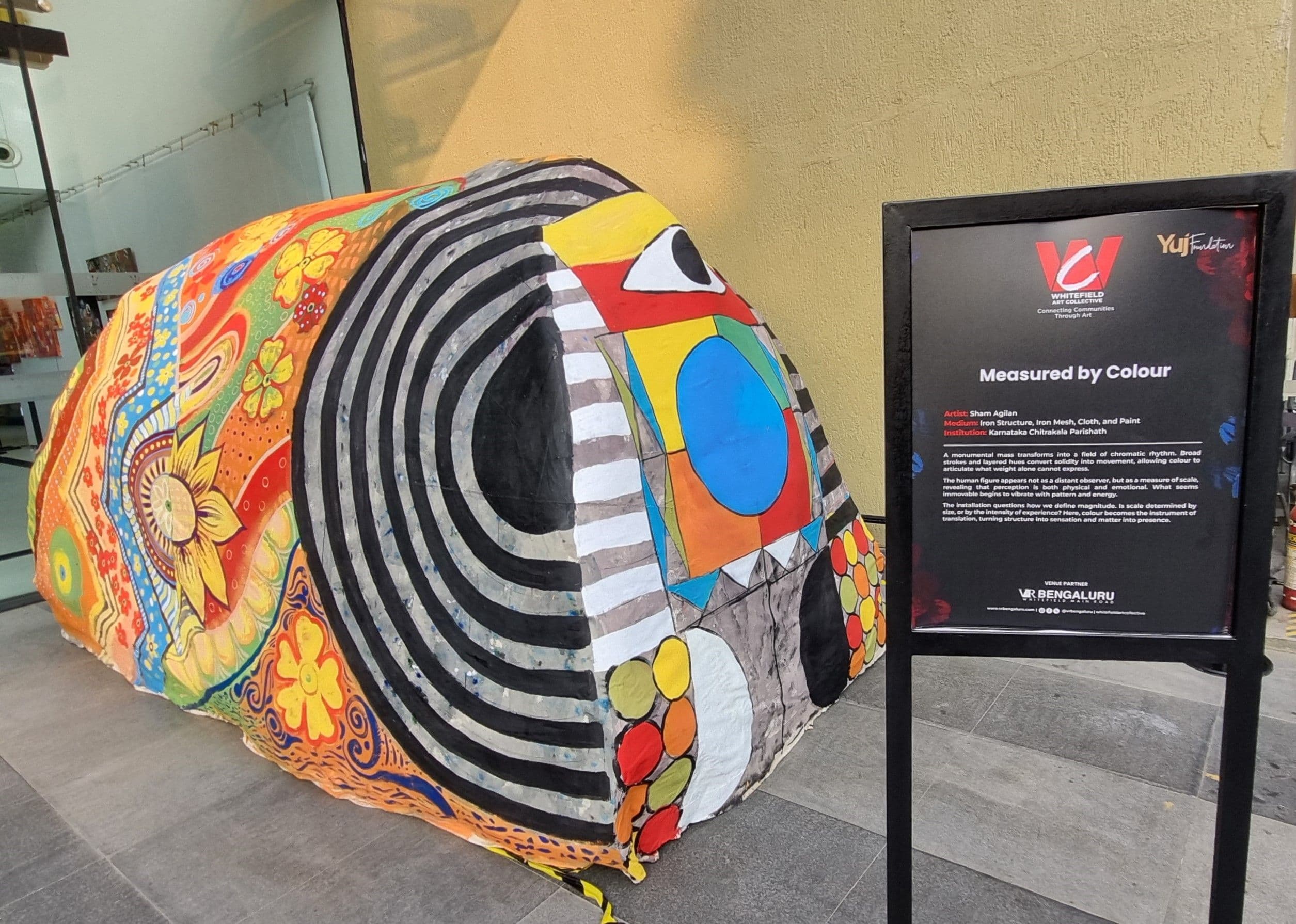
In this photo essay, we feature highlights from the Whitefield Art Collective at VR Bengaluru.
Launched in 2014, PhotoSparks is a weekly feature from YourStory, with photographs that celebrate the spirit of creativity and innovation. In the earlier 980 posts, we featured an art festival, cartoon gallery. world music festival, telecom expo, millets fair, climate change expo, wildlife conference, startup festival, Diwali rangoli, and jazz festival.This month, VR Bengaluru is host to the Whitefield Art Collective’s ninth annual visual and performing arts festival. See our coverage of the earlier editions of the Whitefield Art Collective (WAC) from 2017 onwards here.The festival included installations like Kala Car, a music concert by Grammy Award-winner Ricky Kej, a fashion showcase by designer-curator Rajini Rekha, and exhibitions by Gita Hudson (Cinema Reimagined) and Nele Martens (Elements).Also Read2026 Outlook: AI, robotics, biotech, unicorns and the road ahead“The curatorial theme this year was Tomorrow, Altered!
The theme emerged through conversations with participating institutions, faculty members, and collaborators. We collectively explored ideas reflecting the cultural, environmental and technological shifts shaping our world,” WAC curator Sumi Gupta tells YourStory. Rather than treating the future as a distant concept, the theme proposed that the future was already unfolding in the present.
“Environmental change, technological developments, and evolving social realities are actively transforming how we live and imagine what lies ahead,” Gupta says.The festival theme was positioned as a conceptual framework. It invited artists and students to respond to these shifts through their chosen mediums and perspectives. “WAC has always been built around collaborations with national and global partners.
This year’s edition continued that tradition while expanding its network of contributors,” Gupta adds.Partners included art and design institutions such as Karnataka Chitrakala Parishath, Vogue Institute of Art & Design, and JD Institute of Design. “Working with these institutions allowed the festival to nurture emerging talent while weaving academic perspectives into its programming,” she describes.A notable collaboration this year was with UNESCO. It presented the exhibition Pockets of Hope, highlighting biosphere reserves and the ecological systems and communities that sustained them.
Also ReadHow IIT Madras Incubation Cell is powering India’s next-gen deeptech startups“Another distinctive initiative was the Tesla Kala Car, where a Tesla vehicle was transformed into a moving artistic canvas. It showcased a rare intersection of art, design, mobility, and sustainability,” Gupta explains.Together, these partnerships broadened the festival’s scope, connecting art with education, environmental awareness, and technological innovation. “It also opened space for dialogue between local communities and wider cultural narratives,” she says.“Instead of a centralised jury process, WAC’s selection of artworks evolves organically once the curatorial theme has been established.
Participating institutions and their faculty members identify students and artists whose work resonated with the ideas being explored within that year’s theme,” Gupta describes.This approach brought together a diverse mix of participants, including student artists, emerging practitioners, and established creators. “Beyond artistic skill, the focus was also on how the work interacted meaningfully with public spaces,” she says.“Particular attention was given to interdisciplinary and site-responsive works, such as installations, visual art, sound-based works, performance, and mixed media practices.
Because the artworks were placed within an active public environment, the selection also considered how they invited engagement, curiosity and reflection among audiences who encountered them in the course of everyday life,” Gupta explains.In an era of increasing global conflict and climate change, she envisions renewed purpose for artists. “In times marked by global uncertainty, whether due to environmental crises, geopolitical tensions, or rapid technological change, the role of artists becomes even more significant,” she affirms.Also ReadBreaking barriers in 2025: Women’s progress at work and what the road ahead demands“The exhibited art translated complex global concerns into experiences that were emotional, reflective and accessible to a wider public.
Artists often act as interpreters of their time, offering perspectives that challenge assumptions, draw attention to overlooked realities, and invite people to reconsider their relationship with the world around them,” Gupta explains.Through installations, photography, performance, and visual narratives, artistic practice brings attention to issues such as sustainability, climate resilience, and social transformation. “Artists do so in ways that resonate more deeply and broadly than conventional discourse,” she adds.Within a public art context, this role becomes especially meaningful. When artworks