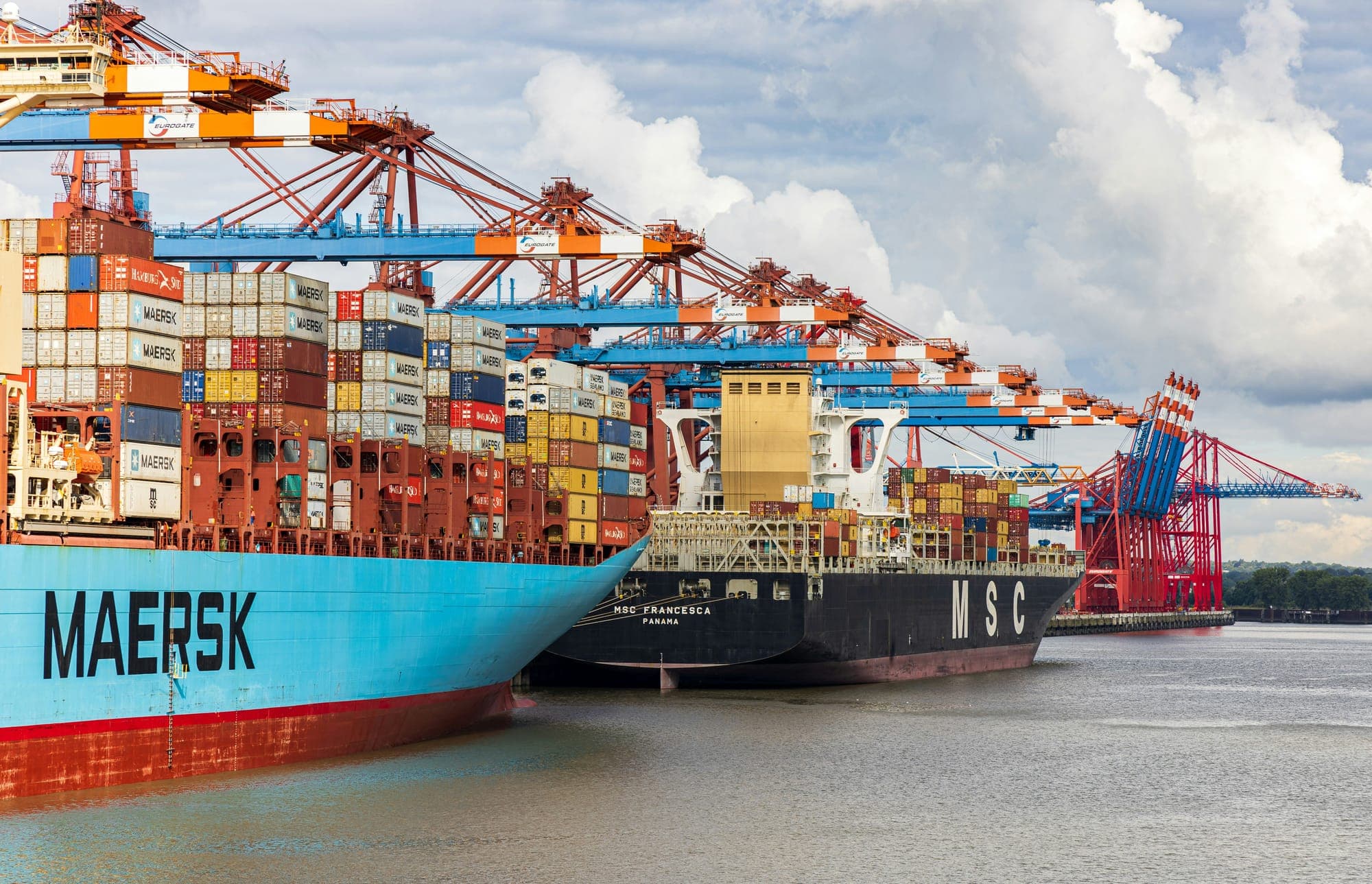
The four fastest-growing container trade lanes in the world are now all connected with Africa. Sub-Sahara Africa is posting the strongest regional import growth globally at 17.1% year-to-date. That matters because shipping lines do not add capacity at this pace for a temporary spike.
They do it when they believe trade patterns are shifting structurally.The clearest signal is on the Asia-Africa trade itself. Alphaliner data show fleet capacity on Asia-Africa services rose to nearly 2.2 million twenty-foot equivalent units (TEUs) in late 2025, up 54.3% year on year from 1.4 million. To meet this demand, Mediterranean Shipping Company (MSC), a Swiss-based global leader in container shipping and logistics, began using massive 24,000-TEU ships on its Africa Express service, stopping at ports like Lomé, Tema, Abidjan, and Kribi.
This major investment proves that global shipping companies expect African import demand to stay strong for the long term.That demand surge is colliding with a stubborn scale gap. Only four African ports made Lloyd’s List’s 2025 global top 100 container ports: Tanger Med, Port Said, Alexandria and Lomé. Even Durban, which handled 4.5 million TEU, fell out of the ranking because congestion, vessel delays and weak rail connectivity dragged down performance.
For investors, the message is clear: Africa's trade is growing faster than its ability to move goods smoothly. The best opportunities are no longer just about handling more cargo. Instead, the real value is in ports and trade routes that can connect large ship capacity with fast, reliable transport to the interior of the continent.Mombasa vs.
Dar Es Salaam: Which Corridor Will Capture The Next Wave Of Investment? Mombasa enters this race from a position of measurable strength. Kenya Ports Authority says the port handled a record 45.45 million tonnes in 2025, with container traffic up to 2.11 million TEU and transit cargo up 19.5% to 15.88 million tonnes.
The rise in transit cargo is critical. It shows the Northern Corridor still attracts more goods for Uganda, Rwanda, and Burundi than its rivals. To keep this lead, Kenya is adding 1.4 million TEU of capacity by expanding berths 19B, 23, and 24.
Meanwhile, the Port of Lamu is emerging as a second major trade hub, handling 799,161 tonnes and 55,687 TEUs in 2025.Mombasa is upgrading its systems and automating gates to speed up operations. However, the real challenge is now time, not just berth capacity. Kenya is launching a digital Port Community System to link shipping lines, agents, transporters, and government agencies with the aim of cutting cargo clearance times by 30%.
This is vital since current delays average 13.5 days. For inland customers in Uganda, Rwanda, and Burundi, reducing these delays is as valuable as adding new equipment because it provides the end-to-end predictability they need. Dar es Salaam is quickly becoming more efficient.
The port handled 27.7 million tonnes in 2024/25, up from 23.69 million. Its regional reach is growing, serving the DRC (6 million tonnes), Zambia (3.5M), and Rwanda (1.7M). Through the Dar es Salaam Maritime Gateway Project, the port deepened its berths to 14.5 metres which cut average vessel stay times from ten days to three.
By adding the Kwala Inland Container Depot and a new rail link to boost capacity up to 480,000 TEUs from 300,000 TEUs, Tanzania is proving that success depends on matching port speed with fast inland transport.Mombasa holds the lead in East Africa's regional trade, proven by its transit growth and the rise of Lamu as a secondary hub. However, Dar es Salaam is quickly closing the gap by improving efficiency, specifically reducing vessel delays, improving berth predictability, and enhancing digital coordination. The competition is no longer about port quay length alone, but about whether the Northern Corridor road and rail reforms can preserve Mombasa’s incumbency faster than the Central Corridor converts Dar’s berth-side port-side gains into efficient inland transport.
The port that wins this race will capture the significant logistics, warehousing, and industrial investment decisions that follow.How Is Lekki Deep Sea Port Reshaping Competitive Shipping In West Africa?Lekki Deep Sea Port has changed the competitive baseline in Nigeria by offering the modern, automated, deepwater capacity that older ports like Lagos lacked.Lekki has already reached nearly 50% of its designed operational capacity, with volume growing every month. Phase 1 handles 2.5 million TEUs annually, with plans to expand to 6 million TEUs.That is significant for a port built as a fully automated deepwater terminal rather than an upgrade.
Lekki’s main bottleneck is no longer berth space. Its managing director says the constraints are customs integration, physical examinations, rail access and evacuation links. In other words, the port can receive cargo faster than the wider system can clear it. Even so, for operators, managing high volume is a better chall