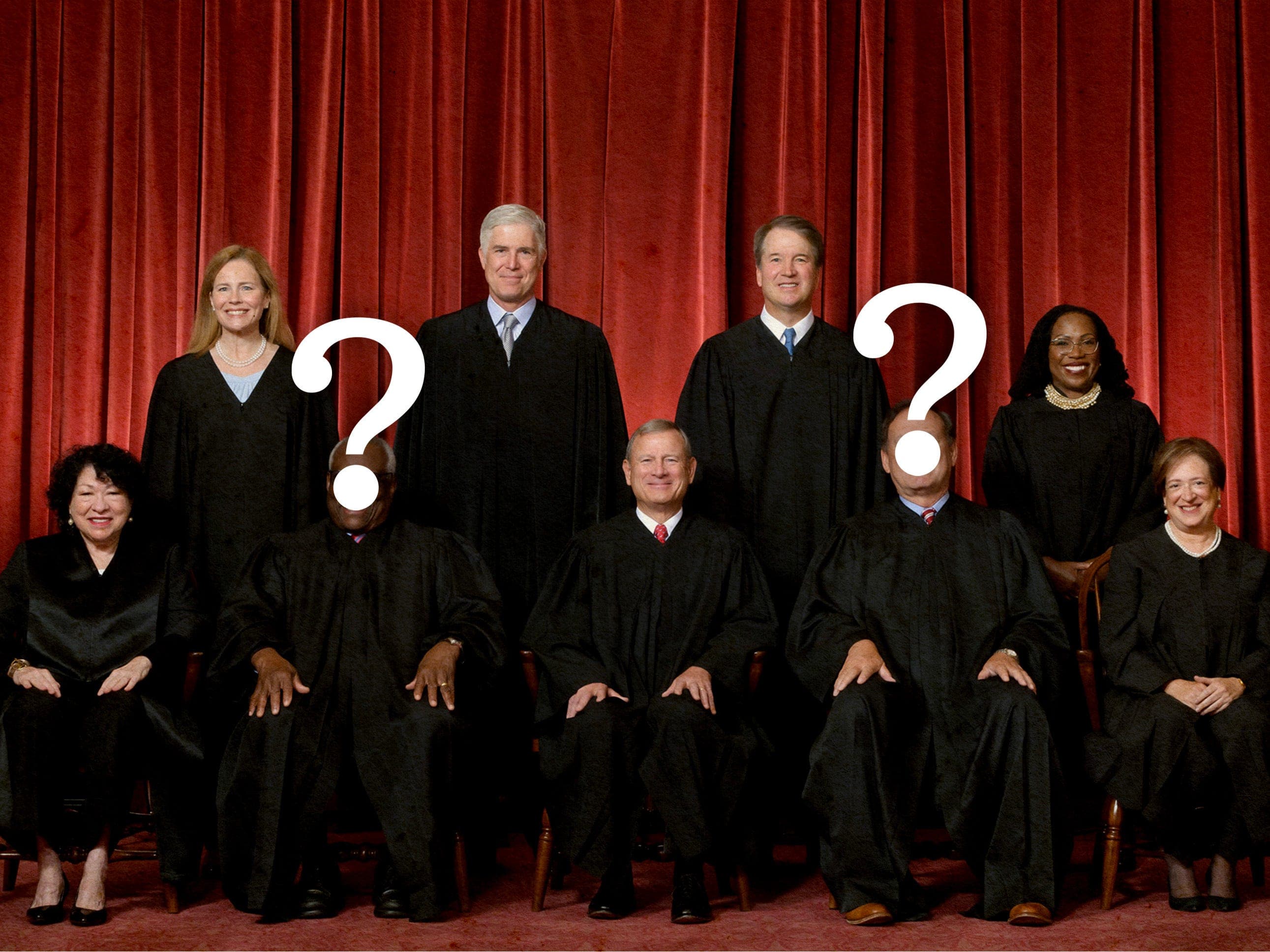
How the left is preparing for a midterm-year Trump SCOTUS vacancy—or even two.
(Photo Illustration by The Bulwark/Photo: Collection of the Supreme Court of the United States)ONE OF THE MAJOR OPEN QUESTIONS that could jolt this year’s midterms—a known unknown—is whether Donald Trump will get a chance to nominate another Supreme Court justice before Election Day. Will 76-year-old Justice Samuel Alito retire? What about 77-year-old Justice Clarence Thomas?
Or both?On Friday night, CBS News’s Jan Crawford, a journalist well connected in conservative legal circles, reported that neither of the Court’s two oldest members would step down “this year”—that timeframe being significant as it would extend to after the election and assuredly into the next Congress. Fox News followed up with a similar report. Yet both men are under pressure from Republicans to vacate their posts before the possibility arises that control of the Senate changes hands.
And Democrats, for their part, are treating the reports as smokescreens, choosing instead to plow forward with a major campaign for the likelihood that a vacancy (or two) will emerge before November.That campaign is being led by Demand Justice, a liberal judicial advocacy group. The group plans to spend an initial $3 million on framing a pending Supreme Court nomination battle in the public mind, and another $15 million if and when a justice retires. Its executive director, Josh Orton, told me the reporting of Alito and Thomas sticking around for another term was a case of the justices simply wanting “to look like they’re in control of their own destiny.
Ultimately, he said, “if Trump wants them off, they’re off.”1Even before this weekend’s reporting, the possibility of a Supreme Court confirmation fight has been the subject of rampant chatter among the Washington political class. A retirement—whether truly voluntary or forced by Trump—would not just reshape the contours of the midterm elections, it would give the president the chance to have the most enduring stamp on the judiciary of anyone to hold the office in nearly a century.“This could be unlike any other Supreme Court nomination fight in modern times, in that the first question will be: Is this person loyal to the truth or loyal to Donald Trump?,” said Orton.
“In the coming months, we have this opportunity to call the question on whether or not we will continue to allow Trump to attack and undermine our democratic institutions.”ShareOrton said Demand Justice plans to run TV and digital ads, although the timing and content are to be determined: The group will conduct polls and focus groups in battleground states in the coming weeks with the goal of finalizing messaging that resonates with not just their base voters, but independents and Republicans. Orton said he intentionally brought together a team of operatives across the left’s ideological spectrum out of a desire for the campaign to appeal to the broadest possible range of voters.
Demand Justice’s leaders have also been meeting with Democratic Senate candidates to work on consistency in messaging.“For all the reasons that you see Senate battleground candidates talk about needing to rein in [Trump’s] authoritarian excesses, how he’s much more willing to serve the billionaire and the corporate class than average working people—the reason that him appointing a crony creates this opportunity is because, almost by definition, that person will not be a reliable vote on the Court for everyday people,” said Orton.DEMOCRATS HAVE HISTORICALLY been outmatched by Republicans when it comes to waging federal judicial fights. That’s in part because the right has unified around originalism, while the left lacks a similar intellectual framework to rally its donors, advocacy groups, and think tanks.
Well-funded conservative groups like the Judicial Crisis Network and the Federalist Society have spent decades working to tilt the courts to the right, while liberals have struggled to come up with a long-term game plan, both for confirmation fights and around landmark decisions, including the overturning of Roe v. Wade.Demand Justice was founded in 2018 for this precise purpose. Its success has been mixed.
In the aftermath of the group’s founding, Trump got two nominees—Brett Kavanaugh and Amy Coney Barrett—confirmed to the high court. But each of those fights was bruising and it’s fair to say that Democrats have a heightened appreciation for the stakes in confirmation battles and the resources needed to fight them in Washington and the states.A battle this year over a fourth Trump-nominated Supreme Court justice (Neil Gorsuch was confirmed in 2017) would likely be another intense political clash. But the outcome would likely prove the same as the first three: with success for the president.That’s because without control of the Senate, Democrats have limited tools to stop a Trump nominee from getting confirmed. Party leaders whom I spoke with were clear-eyed about the fact that it’s unlikely that four Senate Republicans would break with Trump—although some said n