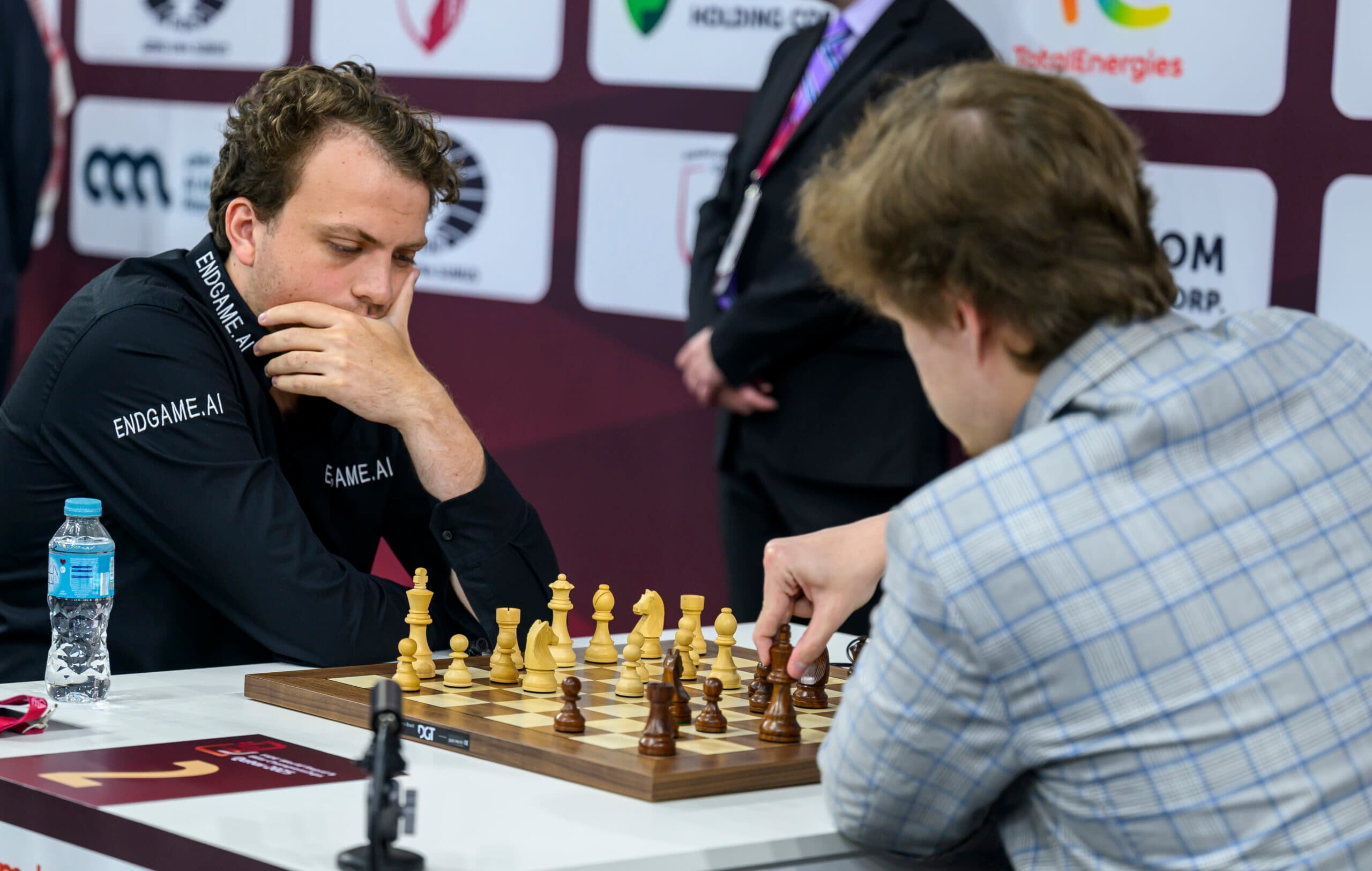
A new Netflix documentary investigates the rise of America’s next chess star. The post Genius and Controversy: The Story of Hans Niemann appeared first on The American Conservative.
Culture Genius and Controversy: The Story of Hans Niemann A new Netflix documentary investigates the rise of America’s next chess star. (Photo by Noushad Thekkayil/NurPhoto via Getty Images) It’s been more than 50 years since an American was crowned the world champion of chess. The Chicago-born Bobby Fischer held the distinction between 1972 and 1975 after he defeated the Russian Boris Spassky in what is still called the “Match of the Century.” The championship, played in Reykjavík, Iceland, occurred at the height of the Cold War and served as a de facto intellectual battlefield between the two great powers.
But the ’72 title fight isn’t only remembered for the games themselves. The matchup is also remembered for the way Fischer acted in the lead up and during the tournament itself. First, the enigmatic American discussed bypassing the championship altogether.
Fischer wanted more money and improved playing conditions such as better lighting and decreased camera noise. At one point, it looked like the match might never happen. In the end, Fischer did show.
But after losing the first match to Spassky, Fischer refused to appear for Game 2 which was ruled as a forfeit victory for Spassky. Fischer lobbied to have the remaining matches moved to a private room without an audience and only minimal cameras present. Surprisingly, Spassky agreed.
Over the course of the next 19 games, Fischer turned the tables on Spassky and won the championship by a convincing overall score of 12½–8½. Fischer never again competed in the official world championship cycle. He clashed over rules with officials of FIDE (International Chess Federation) and demanded a new format for the 1975 world chess championship where he was set to defend his title against the Russian Anatoly Karpov.
When FIDE refused to budge, Fischer withdrew from competitive chess, abandoning the game at the professional level for the next 20 years. What does any of this have to do with American chess player Hans Moke Niemann? A lot.
Fischer was brilliant, combative, and unyielding in his approach to the gentleman’s game. Niemann has cultivated a similar presence. Since the Covid-19 boom in online chess, Niemann has bowled his way into the upper ranks of the game, bringing with him not just victories, but controversy, suspicion, and a style that seems to dare the chess world to challenge him.
The Norwegian grandmaster Magnus Carlsen has defined the world of chess for nearly two decades now. He became the world’s Number 1 player at 19, and in the 16 years since, Carlsen has not only won but dominated with a style that has come to define what modern chess excellence looks like. Cold, calculated, and devastating—that’s Magnus.
In interviews, he’s warm enough, especially for a chess genius. But what he makes up for with grace, he definitively lacks in punch. That’s where Niemann comes in.
A savant of the internet age, Niemann’s rise through the chess rankings was spurred on by a surge of interest in the game that coincided with the Covid lockdowns. As people were forced to stay inside, the internet became the one-stop-shop for most social interactions, and chess found new legs. Chess.com became the central hub of the internet-era chess boom, and the main platform where Niemann gained visibility during his rise.
Though he was already a strong junior player who had already attained the rank of grandmaster in 2021, Niemann was star-ready for a platform that allowed visibility for his theatrics and access to challenge some of the premier players in the world. Niemann leveraged his ability to perform in front of the camera, gaining attention along with his rise up the world chess ranking. Some were put off by his antics.
Others could see clearly how Niemann’s trash-talking demeanor was entertaining a new generation of amateur players and watchers. As his star rose, so too did the inevitability of a matchup against Carlsen and other top chess players. That’s where the new Netflix documentary Untold: Chess Mates picks up, right at the apex of Niemann’s new stardom and with a match against Carlsen at the 2022 Sinquefield Cup in St.
Louis. That match appeared ordinary enough in the lead up. But then, the game was played. Niemann, who at the time was viewed as a rising grandmaster but not necessarily on the level of Carlsen, defeated the Norwegian master in a hard-fought match where Niemann leveraged his opening preparation to gain an advantage over Carlsen from the onset of the match.
In the documentary, Niemann admits he had prepared deeply for the opening that arose in the game, a decision that Erik Allebest and Danny Rensch, the founder and “chief chess officer” of Chess.com, argued is like “finding a needle in a haystack.” After the game, Carlsen, who had battled Niemann before the Sinquefield Cup, felt cheated. He considered confronting Niemann at his hotel room but Carlsen’s father convinced him to steer clear of such theatrics. Instead, Carlsen withdrew from the tourn