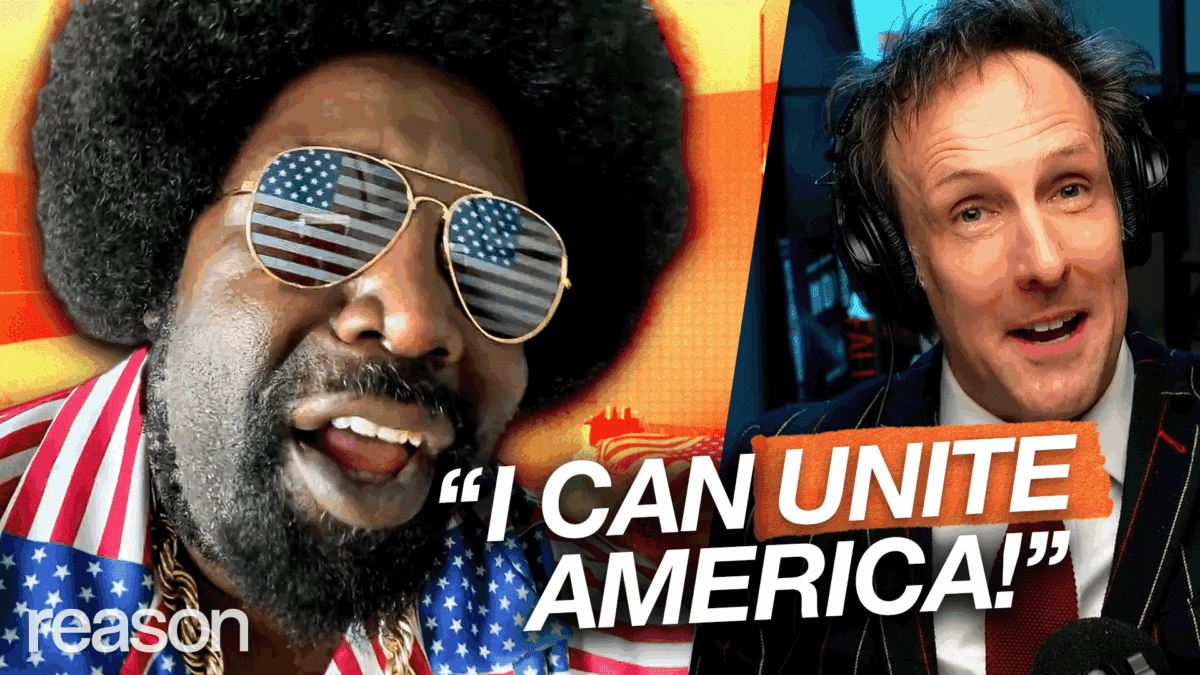
Afroman discusses his free speech court victory, why he thinks he could unite America, and whether he feels pressure to always be high.
This week, Andrew Heaton is joined by Grammy-nominated rapper Afroman, who recently turned a police raid on his home and the lawsuit that followed into an unlikely free speech victory and a new chapter in his career. Afroman explains how officers raided his house, damaged his property, seized cash, and then sued him after he used the security footage in his music videos to mock them. He argues that the real issue was not just the raid itself, but the lack of accountability that followed, and says the verdict was a win for ordinary Americans who want the right to criticize public officials without getting dragged into court.
Heaton and Afroman also discuss a possible presidential run, smaller government, patriotism, and why his unifying message could break through in a divided country. Along the way, they talk about Flavor Flav as a possible running mate, Lemon Pound Cake, and how this viral comeback can become something even bigger than his music. Plus, Heaton asks what fans have wondered for years: Does Afroman feel pressure to always be high? 0:00—Teaser 0:39—Introduction 1:42—What should the police have done following the raid? 3:20—The inspiration for Lemon Pound Cake 5:20—The defamation suit against Afroman 11:15—Afroman's stolen money and "crooked cops" 14:46—Afroman's court win as a victory for free speech 17:15—Presidential aspirations 21:37—Patriotism and the American identity 24:23—Does Afroman feel pressured to be high? 25:02—Who would be Afroman's running mate? 27:11—The effects of the trial on Afroman's music career Transcript This is an AI-generated, AI-edited transcript.
Check all quotes against the audio for accuracy. Andrew Heaton: Hey, Afroman, good to have you on. Afroman: Yes, sir. Good to be on, good to be on.
Ok, so I've been watching bits of the trial. Congratulations, by the way. Thank you. I've been watching bits of the trial, and it seems like the whole thing got out of hand multiple times.
So I'm curious: If I think you've kidnapped somebody and I break into your house, but I apologize and I fix the door, would we be ok? Where is the bright line with the cop? What could they have done to make the situation ok?
Treated me like an American citizen. I'm a black man in America, and a lot of times another black man is doing something wrong, possibly, and a cop may get me and him confused. So he may put me through some unfair treatment, let's say.
But once they find the other guy or realize I'm not that guy, an apology is the first humane step. It's ok to make mistakes in this lifetime. It's not ok to not apologize for making those mistakes.
They put erasers on the end of pencils because they expect you to make mistakes. I expect a human being to make a mistake, but when a human being knows they made a mistake and they're unapologetic and they're arrogant about it, then that takes you down a whole nother road. It's a whole different feeling toward a person that's not apologetic about the wrong they have done.
So how much of the album that you made was to try to recoup monetary damages for the gate and for having cash seized versus just being angry at how you were treated and the attitude they had when they did it? Well, it was all for the same purpose, you know. It was all, for one.
I got freedom of speech, so I had to say whatever I wanted to say about the cop and make it funny and entertaining. At the same time, I was selling this, and it was about them. It was inspired by them, and it was a way that I could monitor the financial progress I was making off of their inspiration.
So they break down your door, they seize some of your assets, it causes like $20,000 worth of damages, that's what I've heard. You do your album, but they end up suing you. What were they suing for?
What was their claim? Several things I may or may not remember. I'll name as many as I can: humiliation, emotional distress, loss of reputation.
And there were like, like seven or eight more titles like that. Like, because I'm not an attorney, even though I sometimes dress like one. So it wasn't just straight-up defamation and libel?
It was like emotional damages and, "I feel bad, I'm embarrassed," like that was the bulk of it? Yeah, they had all kinds of stuff. They had emotional distress.
They had humiliation, loss of reputation, defamation of character. And yeah, it was a few more that I can't quite remember. So with those, like most of them seem like they'd be very easily dismissed.
We can go into some of the other specifics, like one or two of them. I'm like, "that's a serious accusation." But like calling somebody Beatle Bailey or Gomer Pyle or whatever, like that's obviously nonfactual opinion.
Like, why do you think that they thought this would work? I would assume the threshold for this is so high that it was very unlikely they'd pull it off. Yes, I believe they live in a small world.
Being government officials, they control that small world. The police department is inside of the courthouse. They all meet