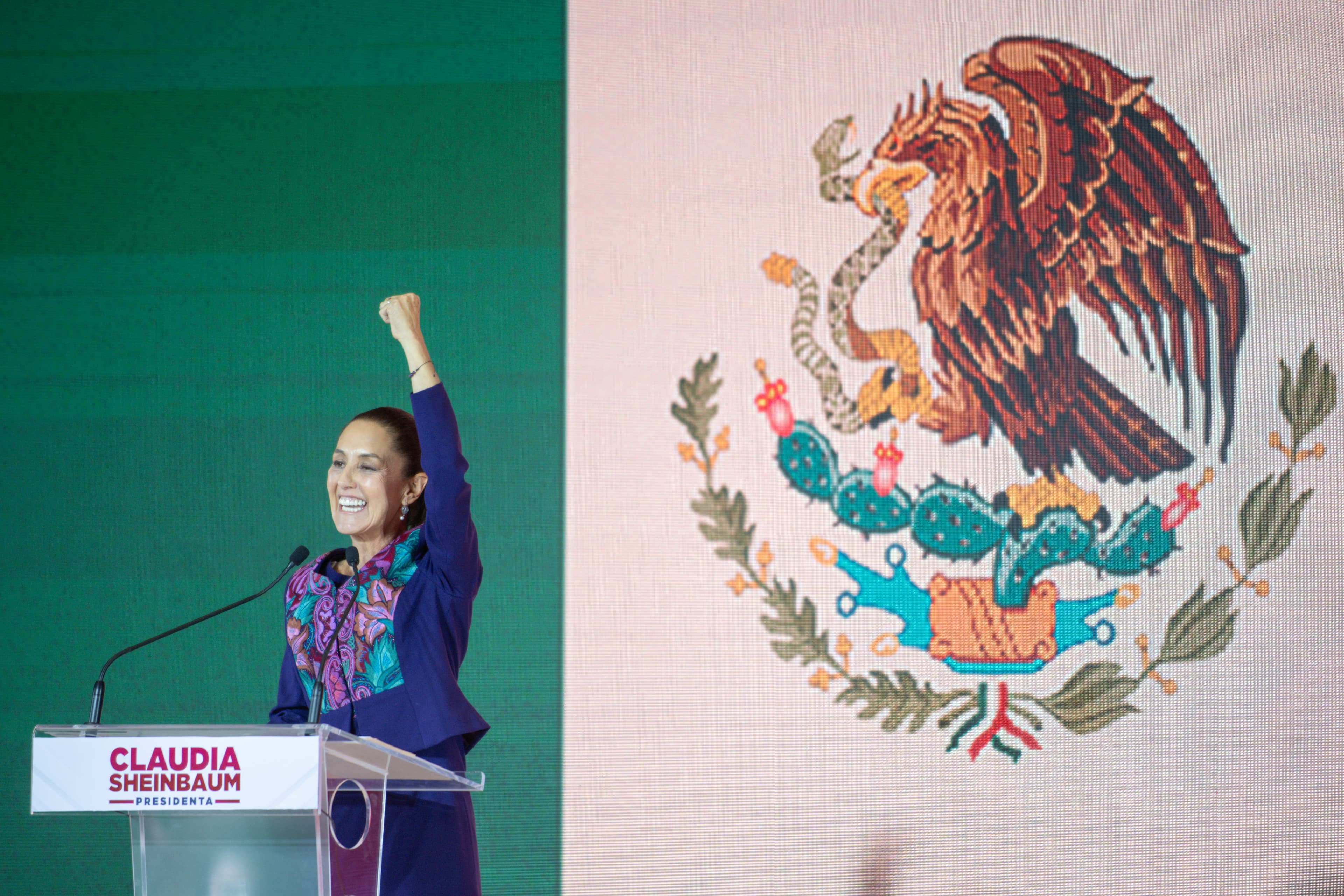
Image of Claudia Sheinbaum, President of Mexico. Retrieved from Wikimedia Commons. By Gerardo Otero Professor Emeritus of International Studies Simon Fraser University Since its electoral victory in 2018, MORENA (Movement for National Regeneration) has reduced poverty and inequality in Mexico despite considerable international and domestic constraints (World Bank 2024).
This triumph, after its presidential candidate Andrés Manuel López Obrador (AMLO) took power, fulfilled at least in part the huge expectations created by his promised Fourth Transformation (4T) of Mexico’s public life. AMLO compares such a transformation with the three prior great historical transformations in Mexico, each of which necessitated violent means for power ascension: the 1821 revolution of independence from Spain, the liberal reform codified in the 1857 Constitution, which separated Church and state, and, finally, the Mexican Revolution that yielded the 1917 Constitution. The latter contained Article 123, the most comprehensive labor reforms in the world to that date, and Article 27, the basis for the agrarian reform.
Unlike all previous transformations in Mexico, the 4T was achieved through democratic elections. This is a considerable achievement. The most important driver in reducing poverty and inequality has been MORENA’s labor policy.
Specifically, it has sustained increases in the minimum wage, complemented by expanded social programs such as universal pensions for adults over 65 (and, as of 2024, for women over 60), youth training fellowships, and disability grants. Together, these policies reflect Morena’s guiding principle and main campaign slogan: por el bien de todos, primero los pobres (“for everyone’s good, the poor come first”). MORENA’s redistributive efforts took place in a difficult structural context.
Rather than converging upward toward U.S. income levels after NAFTA, Mexico’s per capita income stagnated and, by 2014, fell below the world average, as shown in Figure 1. By contrast, China’s per capita income and labor share of GDP have moved closer to North American levels than Mexico’s. Mexico’s workers thus remain structurally disadvantaged within the global economy.
Source: https://www.fao.org/faostat/en/#data/MK (28 January 2026). Figure 2 summarizes Mexico’s constraints by comparing labor’s share of GDP across countries. Between 1994 and 2023, labor captured roughly 65-72 percent of GDP in Canada and 56-63 percent in the United States.
China followed closely with 55-60 percent. Mexico’s labor share, in contrast, remained dramatically lower at about 35-40 percent, underscoring the limited structural leverage available to its working classes. Source: Federal Reserve Economic Database (FRED): https://fred.stlouisfed.org, LABSHPCAA156NRUG (Canada), LABSHPUSA156NRUG (USA), LABSHPMXA156NRUG (China), LABSHPCNA156NRUG (Mexico).
Given these constraints, the key question is whether MORENA’s domestic policies have nevertheless reduced inequality within Mexico. Evidence from household income surveys suggests that they have. One widely used measure of inequality is the Gini coefficient.
Using Mexico’s national household survey (ENIGH), adjusted for household size and economies of scale, Figure 3 shows that the Gini coefficient declined steadily after 2018, falling from approximately 0.42 to 0.38 by 2024. This represents one of the most sustained reductions in inequality observed in recent decades. Source: Constructed with data from INEGI.
Encuesta Nacional de Ingresos y Gastos de los Hogares 2024. SNIEG. Información de Interés Nacional. While useful, the Gini coefficient does not directly capture the distance between economic elites and the broader population.
A widely used alternative to the Gini coefficient is the Palma Index, which measures inequality as the ratio between the income share of the richest 10 percent and that of the poorest 40 percent. Its premise is that the middle sectors (roughly deciles V to IX) tend to capture about half of national income and therefore remain relatively stable across countries (Palma 2013). In Mexico, however, households in the first seven deciles do not even reach the national average income.
This suggests that the country’s middle sector is considerably smaller than the Palma Index assumes and that inequality is better understood as a widening gap between economic elites and the social majority. To address this limitation, I propose the Otero Index, which measures inequality as the ratio between the income of the richest 10 percent and that of the bottom 70 percent of households. This approach reflects the empirical reality that households in the first seven deciles do not reach the national average income and therefore cannot reasonably be described as part of a broad middle class.
Figure 4 presents the evolution of the Otero Index since 1984. Inequality increased sharply during the early decades of neoliberal restructuring, peaked in the 1990s, and remained persistently high a