Since 2012, the title of Pakistan’s biggest bank seemed set in stone—until a record-breaking 15 months finally changed the leaderboard. The post UBL officially becomes Pakistan’s largest bank by deposits appeared first on Profit by Pakistan Today.
The long-standing hierarchy of Pakistan’s banking sector has been upended. Following Habib Bank Limited’s (HBL) release of its first-quarter results today (Friday), and coming just 48 hours after United Bank Limited (UBL) posted a historic performance for the first quarter of this financial year, the data confirms a significant shift: UBL is now officially Pakistan’s largest bank by deposits, the industry’s primary benchmark for size. A tale of two quarters The two giants showed quite a variance in their first-quarter results.
HBL’s consolidated pre-tax profit for Q1 2026 stood at an impressive Rs 33.7 billion, but it paled in comparison to UBL’s performance, which set a new industry record by posting a standalone pre-tax profit of Rs 102 billion for the same period—a first for any bank in Pakistan. The shift in the “largest bank” title, however, was settled in the deposit column. HBL’s unconsolidated deposits declined during the quarter, falling to Rs 5.07 trillion.
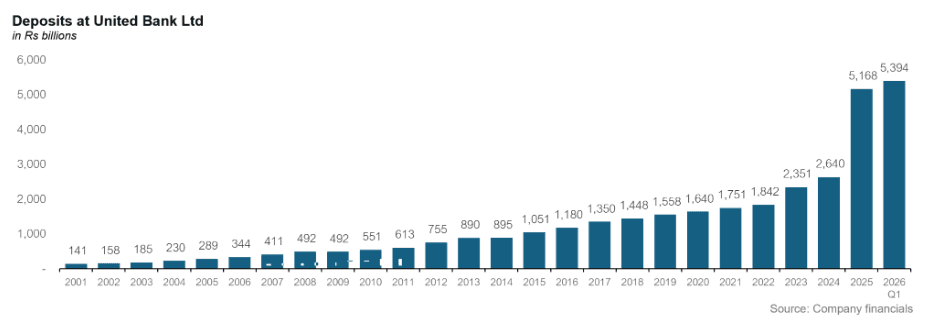
Meanwhile, UBL’s deposit base continued its aggressive climb, reaching Rs 5.39 trillion and officially overtaking its rival. For context UBL had started the year 2025 as the third largest bank in Pakistan and in just fifteen months it has now become the largest after having more than doubled its deposits during this short period of time. The last time a bank achieved a similar growth spurt was way back in 2012 when HBL overtook the National Bank of Pakistan to become the largest bank in Pakistan by deposits.
Ranking by asset size and equity Notwithstanding the latest deposit lead, UBL had taken over the title of Pakistan’s largest bank measured by total asset size some time ago. But despite UBL’s larger asset book, the title of the largest bank remained with HBL, as UBL’s massive assets of Rs 12.7 trillion compared to HBL’s 7.7 trillion is a somewhat deceptive measure to size up a bank. This is because a significant portion of UBL’s assets are driven by massive Open Market Operation (OMO) borrowings, which currently stand at Rs 6.6 trillion.
Essentially, the bank is borrowing trillions from the SBP to finance heavy investments in government T-bills. While HBL still holds the lead in terms of shareholders’ equity (book value) at Rs 454.3 billion compared to UBL’s Rs 416.2 billion, investors have signaled a clear preference for UBL’s growth trajectory. With a market valuation exceeding Rs 1 trillion, UBL is now the largest bank in Pakistan by market cap and the second-largest listed entity on the entire Pakistan Stock Exchange (PSX), trailing only OGDC.
Top 5 Pakistani banks by market capitalisation Bank Market Cap Status UBL Rs 1.0T #1 Bank / #2 PSX Overall Meezan Bank Rs 891B Strong #2 MCB Rs 493B #3 HBL Rs 458B #4 NBP Rs 449B #5 (Ex-Dividend) How did UBL do it? The accounts for the latest quarter are not detailed and only give the broad numbers. A look at UBL’s annual accounts ending December 2025 can give us an idea of how the bank managed this surge over the past year and a half.
The bank saw its deposits from individuals increase by 42%, while deposits from corporate clients increased by 127% compared to the previous year. Taken together, these two categories of depositors—the most diversified kind a bank can have—account for over 58% of the increase in deposits that took place at UBL. Yes, the bank’s deposits from government entities and non-banking financial institutions (NBFIs) rose by abnormally large amounts—344% and 403% respectively—but those two categories account for less than 35% of the increase in deposits.
This is substantial, to be sure, but it does not appear to be a case of winning only a handful of relationships to pump up the numbers, at least from the data available. Neither does this appear to be a case of attracting deposits by offering abnormally high interest rates, at least not in quantities that would become a meaningful problem for the bank. The Current Account to Savings Account ratio (CASA) fell from about 91.5% of total deposits to 84.3%, a noticeable drop, but hardly a catastrophic one.
They grew relationships with individuals and businesses, with the government, and with financial institutions. To put it simply there was no single path to getting here for UBL. The ambition to grow fast was complimented by an aggressive management strategy that prioritised gaining new business.
The story is more about a diversified approach with the ambition to grow as fast as possible despite already being a large bank with a comfortably steady stream of profits from its existing business lines. But that does raise the question: if a bank isn’t competing on better rates, then what exactly is it doing to grow its share of current accounts, which pay zero interest? A big part of the growth story is how the bank is being run.
Senior-level staff at UBL confirmed to Profit that, unlike other banks where each department works in silos and has its own targets to achieve, UBL runs like a one-man show. The bank’s President, Jawaid I