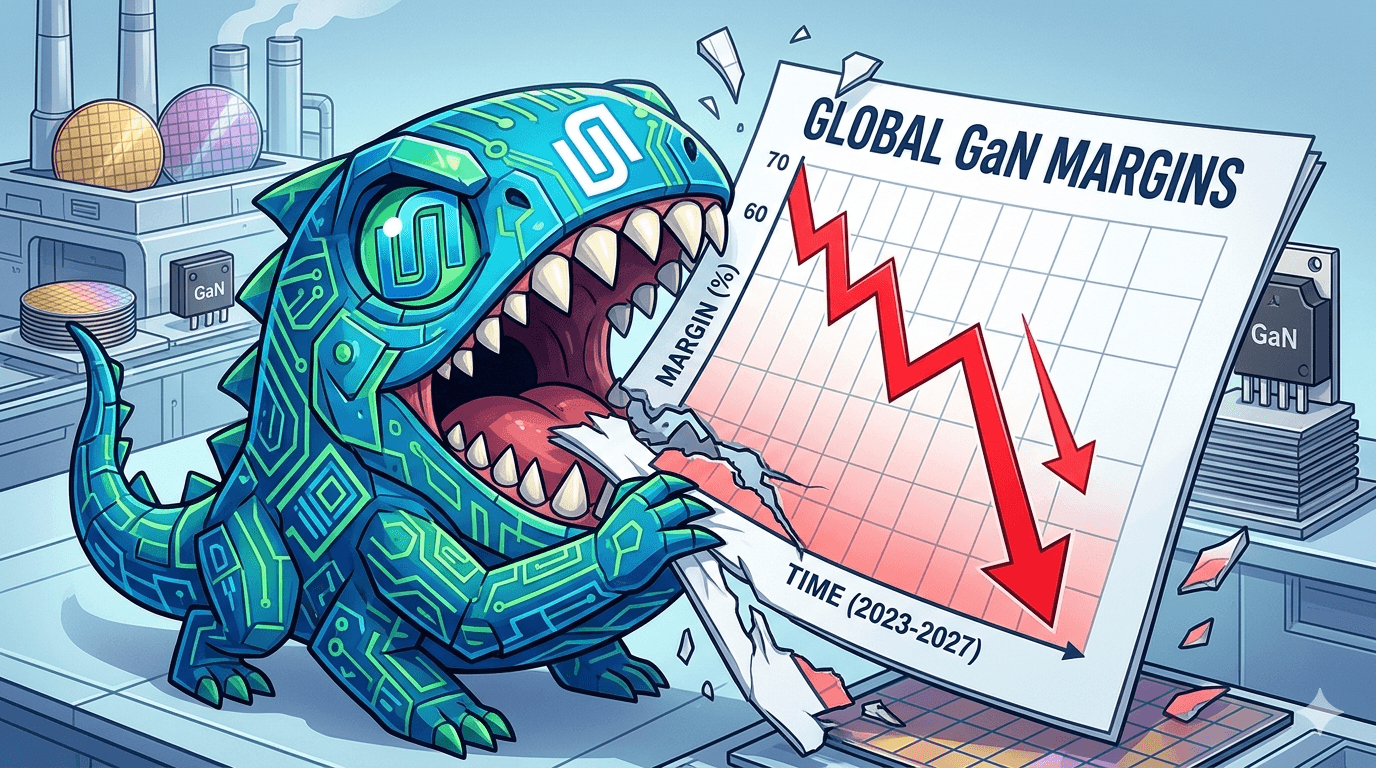
Before Another Supply Chain Emergency
In the semiconductor industry, the Trump administration is striving to bring back critical technologies that slipped out of our hands decades ago. The U.S. has attracted billions of dollars in investment to stimulate cutting-edge logic manufacturing, the development of EUV lithography, and HBM production. However, the semiconductor ecosystem is a lot more than just AI chips.
And if the administration wants secure supply chains, it should focus on another rising material: gallium.Just as Pluto is technically not a planet, gallium is technically not a rare-earth element despite often being discussed in the same context. Like many rare earths, gallium is not directly mined from the Earth’s crust but rather a byproduct of aluminum extraction. Although not classified as a rare earth, the mineral plays a major role in compound semiconductors and has critical importance for the future of AI, defense, robotics, and more.China has realized the element’s importance and has quietly shored up its supply chain while the U.S. has been asleep at the wheel.
Now, the U.S. must secure this critical mineral and its downstream technologies before another lead slips from our hands.The ProblemChina’s recognition of gallium as a priority — both for domestic development and weaponization against adversaries — is unmistakable. As a result of their efforts, China is responsible for 99% of raw gallium production today.Created with Claude Code.Since the early 2000s, China has required domestic aluminum producers to also extract gallium, which has enabled the country to not just become self-sufficient but dominate the global market for gallium extraction. In the meantime, the U.S. has not shored up its supply chain insecurities, particularly in upstream extraction, leaving America vulnerable to weaponization of the mineral.Such vulnerability is not just hypothetical.
China noticed its leverage and imposed export restrictions on gallium (and the tools to extract it) since 2023. These export controls wreaked havoc on gallium prices in the global market, and firms have reported trouble in securing licenses for required gallium. As China builds up dominance over the products downstream from gallium, the United States should be worried about a future where industries are cut off from critical semiconductors and begin working now to ensure that such a threat is neutralized.This is the current story for upstream gallium — the mineral itself.
America’s dependence on China for upstream gallium has been covered excellently by other institutions like CSIS and the Atlantic Council. To address this dependence, the U.S. must actually follow up on its many ongoing projects to produce gallium domestically.However, a less-discussed security issue is looming: the dangers facing downstream gallium — that is, the products made from gallium. China’s downstream gallium semiconductor industry has begun to encroach on the viability of American and allied companies.
Instead of panicking when it’s too late, the U.S. must address its impending downstream gallium crisis in tandem with its already-existing upstream gallium problem.The Downstream CompetitionGallium in Power SemiconductorsWhat is gallium used for, and why has China emphasized it so much? The mineral forms the backbone of semiconductors like gallium nitride (GaN) and gallium arsenide (GaAs) chips, which are irreplaceable for certain defense, power, and optoelectronics applications.Gallium, from AsianScientistOne of the most critical of these uses — and the one most under threat — is in power semiconductors, typically using gallium nitride (GaN).
GaN chips used for power functions are often referred to as GaN high electron mobility transistors (HEMTs). GaN HEMTs, though currently a limited market, are increasing in popularity due to their use in EVs, motor control for robotics, and power solutions for data centers. Currently, their biggest market is the consumer end-market, focused on products like fast chargers for your laptop and phone.
While consumer end-markets will likely remain GaN’s biggest cash cow, it punches above its weight in terms of irreplaceability for humanoid robotics, data centers, and EVs.From Yole GroupGaN, alongside silicon carbide (SiC), is considered a wide bandgap semiconductor, which endows it with properties better for power electronics compared to standard silicon. These properties include faster switching and better power efficiency. Although SiC chips are able to stand in for GaN in some contexts, GaN for power is largely irreplaceable due to its faster switching and better performance at lower voltages. Generally, SiC is used in heavy-duty applications like large industrial robotics, whereas GaN is used for lower-voltage applications like smaller humanoid robots.BLDC motor drive inverter used in humanoid robots, which requires GaN power chips, from EPCInnoscience’s RiseWith respect to GaN power semiconductors, the U.S. has already lost its lead and is at risk of being pus