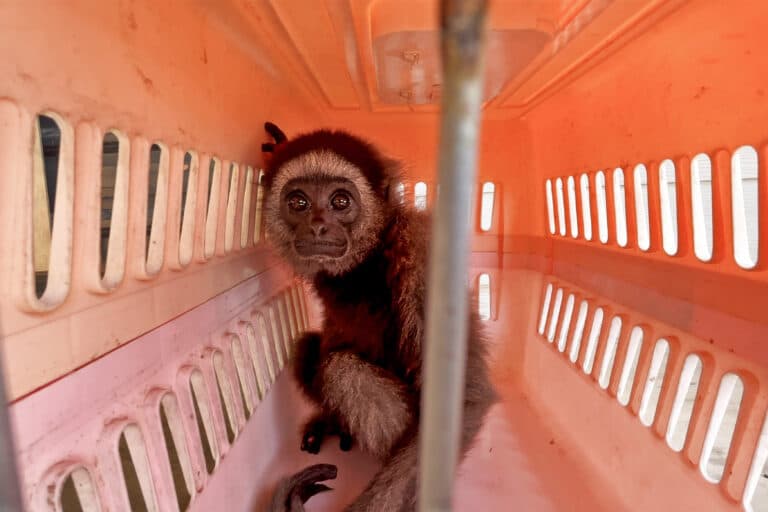
“When we first got Joy, we thought he was a monkey,” says Esther. A hunter had come to her village in the Malaysian state of Sabah, on the island of Borneo, to sell wild meat. He showed Esther (not her real name) and her husband a weeks-old primate with long arms, dark skin and large, […]
“When we first got Joy, we thought he was a monkey,” says Esther. A hunter had come to her village in the Malaysian state of Sabah, on the island of Borneo, to sell wild meat. He showed Esther (not her real name) and her husband a weeks-old primate with long arms, dark skin and large, round eyes.
Worried the animal might otherwise be killed for food, she decided to take him home. It was only later that she realized Joy was not a monkey, but a gibbon. Gibbons are small apes, more closely related to chimpanzees and humans than to monkeys.
Across their range in South and Southeast Asia, they are increasingly threatened by the exotic pet trade. Despite laws that prohibit their capture, sale and ownership, demand for pet gibbons continues to drive illegal trade in wild-caught animals, much of which now plays out online. In 2025, gibbon trafficking seizures reached an all-time high, with confiscations of 336 individual gibbons recorded between January and August alone, accounting for around 20% of all records since 2016, according to an analysis by wildlife trade monitoring network TRAFFIC.
Because gibbons are highly social animals and will defend their young to the death, the capture of an infant gibbon often represents the annihilation of an entire family group. Between 2016 and August 2025, more than 200 seizures were recorded, but “in reality, the trade is likely much bigger,” says Elizabeth John of TRAFFIC. While Indonesia and Vietnam have historically dominated the trade, India…This article was originally published on Mongabay