A Gaming Executive Said “Build Me a Crystal House.” This Is What 7,300 sq. ft. of Pure Glass Looks LikeGlass is the most psychologically loaded material in architecture. It promises transparency and delivers ambiguity, reads as weightless while demanding extraordinary structural engineering, and has...
Glass is the most psychologically loaded material in architecture. It promises transparency and delivers ambiguity, reads as weightless while demanding extraordinary structural engineering, and has the strange property of making a building simultaneously present and absent depending on where you stand and what the light is doing. Architects have been exploiting these contradictions since Joseph Paxton’s Crystal Palace in 1851, and the conversation has never really stopped.
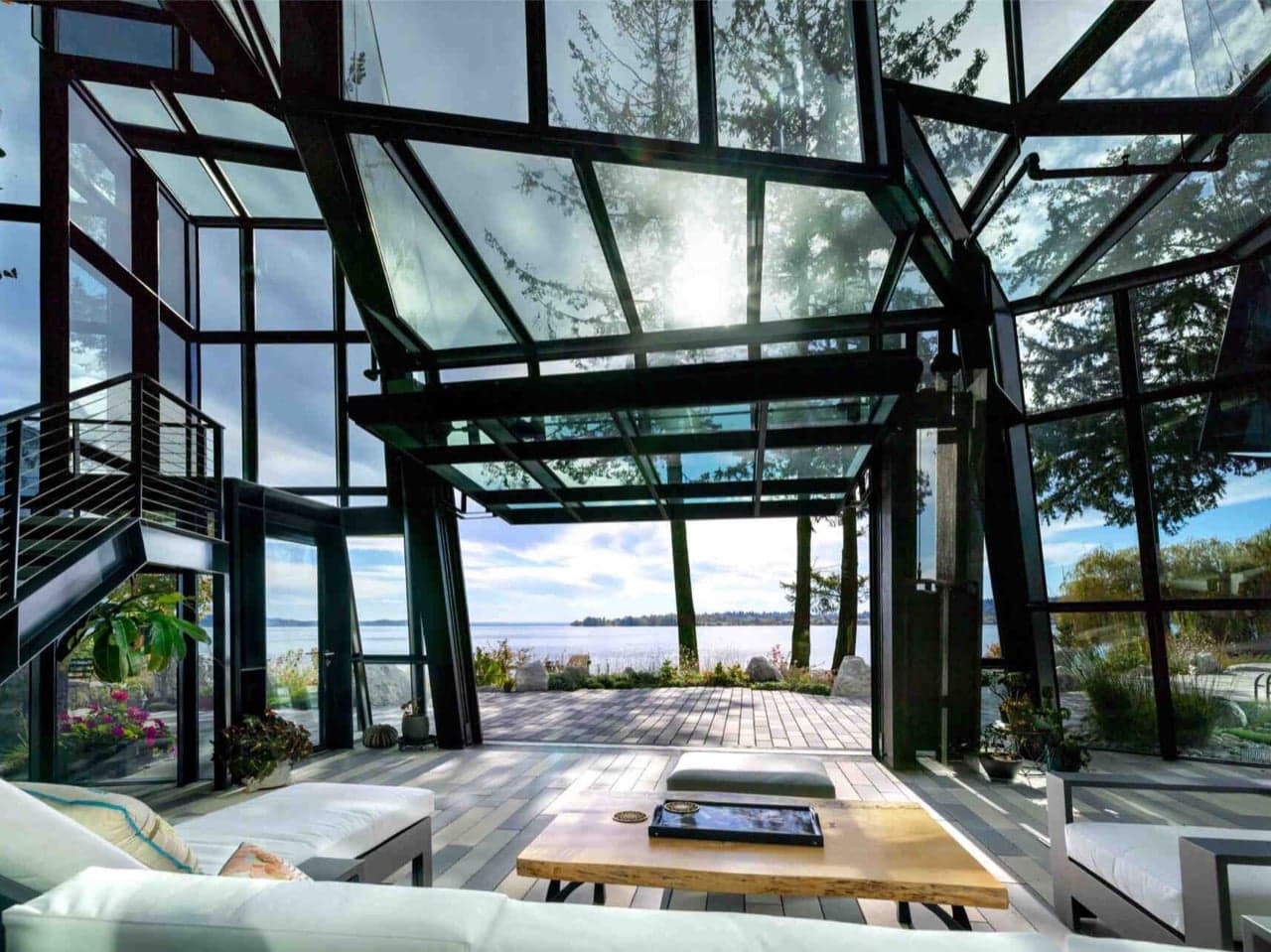
F-House, a private residence on Lake Washington in Kirkland, Washington, designed by Goble Berriman Design with facade specialist Pulp Studio, pushes that conversation to a place most residential architects would consider genuinely unreasonable. The brief, issued by a client working in the computer gaming industry, was a single directive: build a crystal house. What followed was years of design development, engineering collaboration, and custom fabrication to produce a home with zero conventional exterior cladding.
Every surface is glass, cut into angular, irregular panels that assemble into a faceted form inspired by shattered ice erupting through terrain. The steel structure supporting all of it is hidden. The fixings are concealed.
Even drainage details disappear behind custom direct-to-glass printed borders, because Goble Berriman understood that one visible downspout would break the entire illusion. Designer: Goble Berriman Design & Pulp Studio The pedigree behind this project deserves context. Stuart Berriman spent years at The Jerde Partnership working on large-scale mixed-use developments across Asia before co-founding Goble Berriman.
Partner Angus Goble was a founding member of Front Inc., a leading facade consultancy whose client list included Frank Gehry, OMA, Herzog and de Meuron, and SANAA. That lineage matters here, because F-House reads less like an ambitious residential project and more like a commercial-grade facade engineering exercise that happens to contain bedrooms. The crystalline exterior geometry, which shifts from mirror-flat reflectivity to deep angular shadow depending on the hour, is the kind of work you expect from firms operating at institutional scale, not on a private lakeside lot in Kirkland.
The home spans 7,300 square feet and sits surrounded by natural rock formations and dense Pacific Northwest greenery, with Mount Rainier visible across the water. That landscape pairing is doing real compositional work. The hard, faceted glass skin reads against the softness of the firs and boulders as a deliberate counterpoint, the same logic that makes mineral specimens so visually arresting when you set them against organic matter.
The building doesn’t try to blend into its site. It announces itself as something foreign to the natural order, which, given the crystal brief, is precisely correct. The thermal and privacy engineering required to make a fully glazed house actually livable is where the project earns its most serious design credibility.
Double silver-coated glass handles the main residence, while solar-protected glass was selected for the winter garden. Low-emissivity coatings regulate temperature across the envelope, and custom dot-pattern shading improves energy performance without introducing visible blinds or screens that would compromise the exterior reading. Each glass unit is a layered assembly with an air gap and Saflex interlayers that can shift from clear to opaque, giving occupants control over privacy without resorting to curtains.
Insulated spandrel panels handle transitions where solid construction was unavoidable. The result is a house that performs like a thermally responsible building while looking like it was assembled from a single continuous material. The interior layout is organized around a winter garden that acts as a central divider, separating the main residence from the studio and garage, the latter featuring a glazed hangar door.
A continuous skylight stretches from the entry through to the dining area and garden terraces, and a glass bridge connects to the master bedroom, turning what would ordinarily be a corridor into a suspended, luminous passage. Goble Berriman ran the entire project through a shared 3D model across every consultant and contractor, and the homeowner navigated the design in VR goggles long before construction began. By the time the building was finished, it felt entirely familiar to the client, confirmation that years of immersive pre-visualization had done their job in a way that no flat drawing ever could.
F-House sits in a tradition of glass architecture that runs from Mies van der Rohe’s Farnsworth House through Philip Johnson’s New Canaan Glass House and into the parametric facade work of the last two decades. What separates it from most of that lineage is the refusal of orthogonal geometry. There are no flat planes meeting at right angles here, no clean curtain wall logic. Every panel is its own negotiated shape, and the whole facade behaves more like