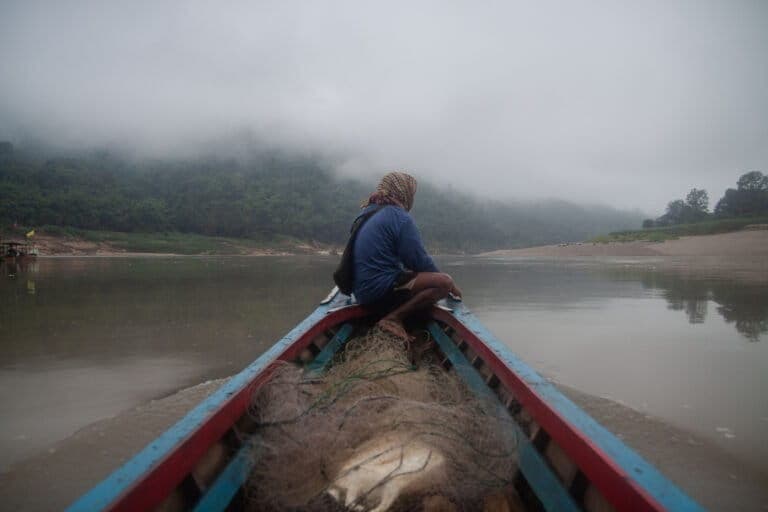
MAE HONG SON, Thailand — Saw Si Paw Rak Salween guns the wooden fishing boat’s engine and steers along the river that inspired his family name. He is ethnic Karen — his parents migrated from Myanmar’s side of the Salween River to the Thai side. When he acquired Thai citizenship, Saw Si Paw had to […]
MAE HONG SON, Thailand — Saw Si Paw Rak Salween guns the wooden fishing boat’s engine and steers along the river that inspired his family name. He is ethnic Karen — his parents migrated from Myanmar’s side of the Salween River to the Thai side. When he acquired Thai citizenship, Saw Si Paw had to select his own family name, a convention not followed in much of Myanmar.
He settled on Rak Salween, which translates to “Love the Salween River.” Saw Si Paw’s love for the wild, free-flowing waterway extends beyond his chosen name. Together with his father, he guides the boat to his family’s 8-meter (26-foot) fishing nets left overnight on the Myanmar side of the river. Fishing is all he’s ever known, having learned the trade from his father and plied it on the Salween his entire life.
So, it was especially jarring for him to hear about toxic chemicals recently found in the Salween. Independent testing of the Salween River began in September 2025, when researchers from Thailand’s Institute of Health Sciences Research at Chiang Mai University found alarming levels of contamination detected in the nearby Kok, Sai and Ruak rivers in Chiang Mai and Chiang Rai in Thailand, much of which has been linked to unregulated mining in Myanmar. In particular, rare earth mines exporting crucial minerals — needed for artificial intelligence, mobile phones, laptops, electric vehicles and renewable energy technologies, among other things — have been blamed. But the mining of gold and various critical…This article was originally published on Mongabay