APRIL 22 — The extension of the fragile ceasefire between the United States and Iran is less a sign of peace than it is a strategic pause — one engineered episodically by President Donald Trump to recalibrate leverage rather than relinquish it. While the rhetoric from Washington continues to oscillate between coercion and conciliation, the underlying logic remains unmistakably realist: compel Tehran into submission without conceding strategic advantage.Trump’s declaration that the blockade of Iranian ports will persist until Tehran produces a “unified proposal” is revealing. It underscores a negotiation style that thrives on threats and fluid time lines.By maintaining economic strangulation while dangling the prospect of talks, the United States is attempting to dictate not only the terms of negotiation, but also the internal coherence of Iran’s political position.
In effect, Washington is asking Tehran to resolve its factional divisions before even approaching the table.This is no small demand. Iran’s political system is not monolithic. It is a complex interplay between elected officials, clerical authorities, and the Islamic Revolutionary Guard Corps (IRGC), each with its own strategic calculus.
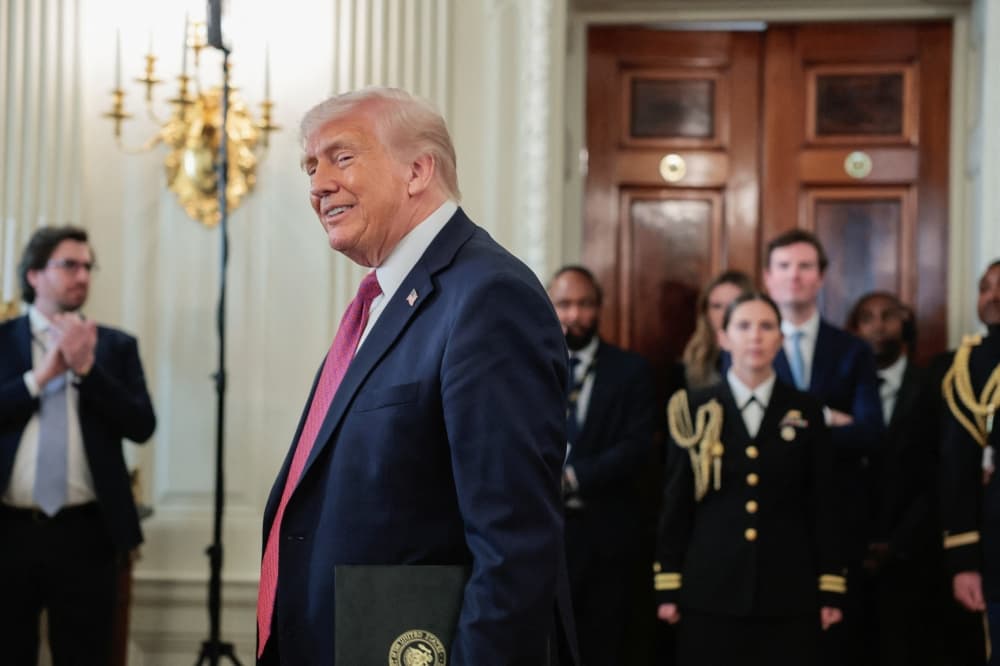
To insist on a “unified proposal” is to impose an external condition on an internal political process — one that may delay diplomacy rather than expedite it. According to the author, US President Donald Trump’s declaration that the blockade of Iranian ports will persist until Tehran produces a ‘unified proposal’ is revealing, and underscores a negotiation style that thrives on threats and fluid time lines. — Reuters pic Yet Trump appears willing to accept that delay. The extension of the ceasefire, even as it hangs precariously, provides him with a valuable commodity: time.
Time to assess Iran’s internal dynamics. Time to gauge the reactions of key stakeholders, including China and India, both of whom remain heavily dependent on Iranian crude. And perhaps most importantly, time to manage domestic political optics in the United States.The uncertainty surrounding the US-Iran talks — initially expected to take place in Islamabad — further illustrates this strategic ambiguity.
Vice President JD Vance’s decision not to travel to Pakistan, despite earlier expectations, is particularly telling. It signals that Washington is not yet ready to fully commit to a diplomatic track. High-level engagement would imply a degree of seriousness and urgency that the current administration may not wish to project prematurely.Instead, the absence of JD Vance in Islamabad suggests a deliberate downgrading of expectations.By keeping negotiations at arm’s length, the United States retains flexibility.
It can escalate pressure if needed, or pivot toward diplomacy when conditions become more favorable. Trump’s diplomacy is marked by unilateral announcements—a tactic that allows Washington to remain in control of the tempo.Iran, for its part, is mirroring this ambiguity. The fact that Tehran has yet to decide whether to send a delegation to Pakistan indicates its own internal deliberations are far from settled.
Iranian officials are acutely aware that entering negotiations under conditions of economic blockade risks being perceived domestically as capitulation. At the same time, the prolonged strain on its economy — exacerbated by war damage and sanctions — creates pressure to engage.This mutual hesitation produces a peculiar equilibrium. Neither side is willing to fully commit to diplomacy, yet neither is prepared to abandon it altogether.
The result is a prolonged stalemate between Trump and Teheran period; marked by partial ceasefire, indirect signaling, and strategic posturing.From a broader geopolitical perspective, this episode reinforces a critical insight: conflicts at sea often originate from unresolved tensions on land. The focus on maritime choke points such as the Strait of Hormuz, while important, can obscure the deeper ideological and security dilemmas that drive state behaviour. Iran’s assertiveness in the Gulf is not merely about controlling shipping lanes; it is rooted in a security doctrine shaped by decades of conflict, most notably the Iran-Iraq War.For the United States, the challenge lies in reconciling its desire for unipolar dominance with the realities of a multipolar energy market.
The blockade of Iranian ports may constrain Tehran’s revenue streams, but it also risks entangling Washington in a broader confrontation involving other major powers. China’s continued reliance on Iranian oil, for instance, introduces a layer of complexity that cannot be easily managed through unilateral measures. Beijing may not have said much to date. But China remains capable of weathering the crisis to be seen as a nominal responsible power.Thus, Trump’s current approach — to extend the ceasefire beyond April 22, indeed, to maintain the blockade — reflects an attempt to navigate these complexities with Iran and China in the main witho