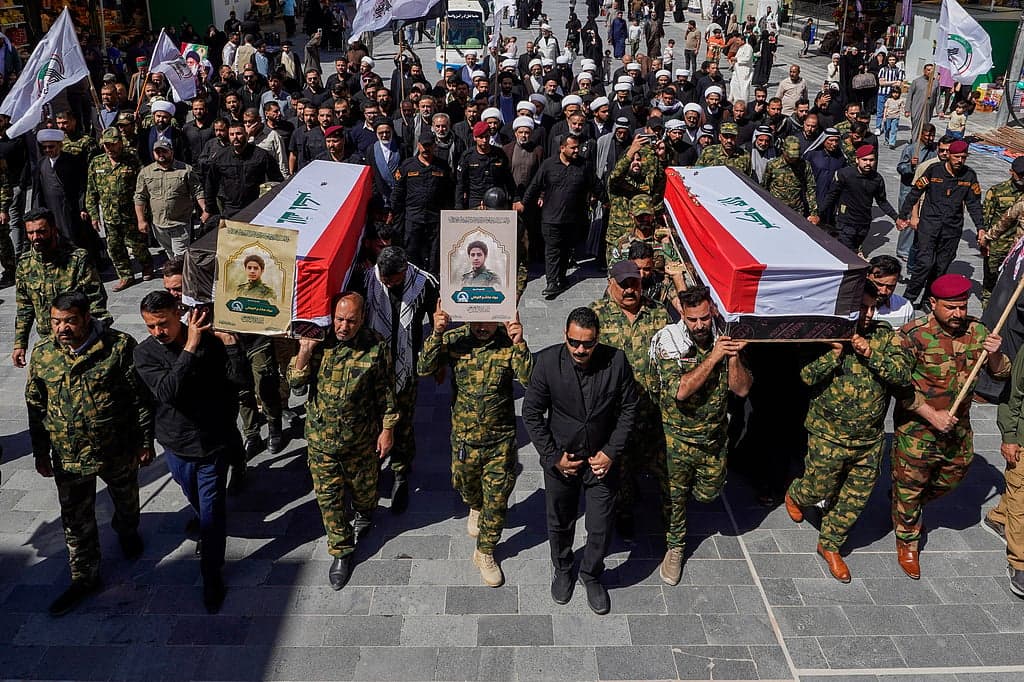
BAGHDAD: Iran has granted its commanders greater autonomy over militias in Iraq, allowing some groups to carry out operations without Tehran’s approval, a shift driven by the pressures of the war, three militia members and two other officials told The Associated Press.Many Iran-backed militias are funded through the Iraqi state budget and embedded within the security apparatus, drawing criticism from the United States and other countries that have borne the brunt of their attacks and say Baghdad has failed to take a tougher stance.Despite mounting pressure from the US, Baghdad has struggled to contain or deter the groups.Iraq says some US military advisers will stay due to Daesh threat in SyriaIraq toughens stance against pro-Iran faction after Baghdad clashIranian Kurdish dissidents abroad watch for signs of Tehran vulnerability after war with IsraelUS strike kills pro-Iran commander in IraqThe most hard-line factions now operate under Iranian advisers using a decentralised command structure, the five officials told AP, each on condition of anonymity to speak freely about sensitive matters. “The various forces have been granted the authority to operate according to their own field assessments without referring back to a central command,” said one militia official, who didn't have permission to speak publicly.
The war in the Middle East has exposed the fragility of Iraq’s state institutions and their limited ability to restrain these groups. Parallel confrontationA parallel confrontation between Washington and the militias has deepened the crisis, with factions acting as an extension of Iran’s regional campaign and escalating attacks on U.S. assets in Iraq before a tenuous ceasefire deal was reached in April.Even if the ceasefire agreement holds, Washington is expected to intensify efforts against the groups militarily and politically, particularly as they gain latitude to operate more independently, officials and experts said.
On Friday, the US imposed sanctions on seven commanders and senior members of four hard-line Iran-backed Iraqi militia groups. “The US is still going to feel it has the freedom of action to hit Iraqi militias,” said Michael Knights, head of research for Horizon Engage, a geopolitical risk consulting firm, and an adjunct fellow at the Washington Institute for Near East Policy. “That may well play out into an effort to try and guide a less militia-dominated government formation.” For Iran-backed militias in Iraq, a move to decentralised controlDays into the war sparked by U.S. and Israeli strikes on Iran on Feb. 28, an Iranian delegation arrived in Iraq’s Kurdish region and delivered a blunt message: If militia attacks escalated near U.S. military bases, commercial interests and diplomatic missions, Iraqi Kurdish authorities should not come to Tehran with complaints, as there was little they could do about it.“They said they’ve devolved authority to regional Iranian commanders,” a senior Iraqi Kurdish government official said on condition of anonymity, citing the subject's sensitivity.
In the past, Kurdish leaders in Iraq would call Iranian officials after attacks to ask why they had been targeted. “This time, they wanted to preempt that by saying, ‘We can’t help you with the groups in the south right now,’” the official said.This shift reflects lessons drawn from the 12-day war in June, the official said. Militia officials corroborated the claim.
During that war, operations were tightly centralised. In its aftermath, greater autonomy was granted in the field.'Coordination with brothers'A spokesperson for Harakat Hezbollah al-Nujaba, among the Iran-backed militia groups that have attacked the US in Iraq, said there was “coordination” with Iran in launching attacks but didn't give details. "Since we are allies of the Islamic Republic, we have coordination with our brothers in the Islamic Republic,” Mahdi al-Kaabi said.
In the recent war, key Iraqi militia leaders appeared to step back from the latest phase and didn't appear to be directly involved in operations, Knights said. U.S. strikes largely killed mid-level commanders, according to militia officials. “None of the first-line leaders have been killed,” said a second militia official, who wasn't authorized to brief reporters.
Rather than targeting top figures, the U.S. also focused on Iranian Revolutionary Guard advisory cells, said Knights, who tracked the attacks. In one strike in Baghdad’s upscale Jadriya neighborhood, three Guard advisers were killed at a house used as their headquarters during a meeting, according to the second militia official.Pressure on Iraq intensifying At the heart of government efforts to rein in militia groups lies a paradox: The factions the government says it cannot control are tied to political parties that brought it to power.The Coordination Framework, an alliance of influential pro-Iran Shiite factions, helped install Mohammed Shia al-Sudani as prime minister in 2022. He now serves as caretaker prem