Médecins Sans Frontières’ (MSF) hospital in Lankien, a town in South Sudan’s Jonglei state, was hit by an airstrike in February, although the medical charity’s bright red logo was painted on the building’s roof. Lucy Lau, an MSF project coordinator deployed to the eastern African nation, said she believed the airstrike on February 3 was […]
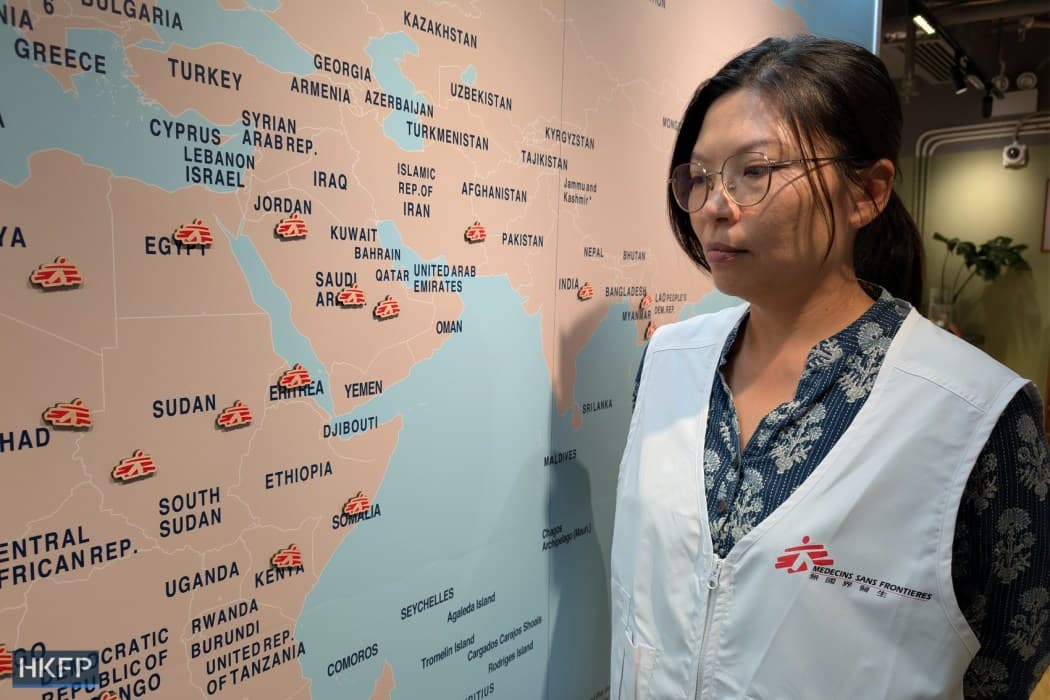
Médecins Sans Frontières’ (MSF) hospital in Lankien, a town in South Sudan’s Jonglei state, was hit by an airstrike in February, although the medical charity’s bright red logo was painted on the building’s roof. Lucy Lau, an MSF project coordinator deployed to the eastern African nation, said she believed the airstrike on February 3 was not a coincidence. MSF project coordinator Lucy Lau on April 1, 2026.
Photo: James Lee/HKFP. It was a tactical attack targeting the hospital’s main warehouse, destroying not only the building but also most of the critical supplies stored inside, she said in early April. Before the airstrike, MSF received information about a possible attack on Lankien and decided to evacuate the hospital.
Lau and other staff members were able to escape unscathed, but one worker was injured in the strike, which MSF blamed on the South Sudanese military. She and her team were forced to cut their six-month mission short and leave the country the same evening. Lankien is an opposition stronghold in South Sudan, a country that has been wracked by political instability since a civil war erupted in 2013.
Despite a 2018 peace deal, armed conflict has continued between President Salva Kiir’s government troops and rebel forces loyal to former vice president Riek Machar. Citing the UN, MSF said the renewed conflict killed 2,000 people and displaced 320,000 in 2025. MSF’s hospital in Lankien, Jonglei state, South Sudan, was hit in an airstrike by the government of South Sudan forces on February 3, 2026.
Photo: MSF. The humanitarian aid NGO also said that its health facility in Pieri, another town in Jonglei, was looted by unknown assailants on February 3, hours before the airstrike in Lankien. In a statement issued the day after, MSF lambasted the attacks. ”While we are aware of the enormous needs in the country, we find it unacceptable to be a target for attacks,” said MSF operations manager Gul Badshah.
MSF suffered eight targeted attacks in 2025, forcing the charity to close two hospitals and suspend medical activities in Upper Nile, Jonglei and Central Equatoria states. The UN said an aerial bombing of an MSF hospital in Old Fangak, also located in Jonglei, in May last year “could amount to a war crime.” Lau said the attacks were meant to cripple healthcare systems in an area controlled by political opponents, disregarding the effect on civilians. Lau, an engineer by training, joined MSF’s logistics team in 2011.
She said she had noticed an increased willingness in recent years to target civilian infrastructure and aid organisations in armed conflicts, resulting in greater difficulty in delivering humanitarian aid. It “feels like a growing trend worldwide,” the 46-year-old said. Underfunded Lau was deployed to Jonglei state in October, four months before the airstrike, to work as a project coordinator.
She was responsible for managing MSF’s emergency medical projects, coordinating operations between different departments: medical, human resources, finance, and logistics. MSF’s Lucy Lau with local staff in South Sudan. Photo: MSF.
The MSF hospital in Lankien treated paediatric malnutrition and maternity cases and provided treatment for infectious diseases, including cholera, tuberculosis, and HIV. Disease outbreaks “are indirect impacts of the civil war,” especially in a country whose budget has gone mostly to the military, while healthcare is chronically underfunded, Lau said. “I was told by officials that only 1 per cent of the 2026 national budget was allocated to the health ministry.” Those seeking treatment included civilians hit by explosives and gunshot wounds.
The hospital also ran programmes for survivors of intimate partner violence. The Hongkonger, who arrived in South Sudan with a small MSF team, worked mostly with local healthcare workers and engineers. “These people spend most of their lives around this civil war.
They’re tired,” she said. ‘Classic dilemma’ Despite the threat to their safety, healthcare workers still feel responsible for their patients. Lau recalled how a team member, who took shelter in a nearby safe house after the bombardment, asked if they could head back to the hospital to treat wounded patients who had just arrived.
Displaced families live in the open without adequate shelter, food, or access to basic healthcare in Nyatim, Jonglei State, South Sudan, where displaced after fleeing violence in Lankien and surrounding areas. Photo: MSF. “Our duty is to help [patients], but we also have to consider our own well-being… they were worried about their own safety, then they turned their attention to how they could help the wounded,” Lau said.
“It’s a classic dilemma.” Because of the airstrike, tens of thousands of South Sudanese were displaced. Some fled into the bush and eventually to nearby villages, such as Chuil and Minkaman in Lakes state. Some with more means fled to neighbouring countries like Ethiopia or Uganda, Lau said. The escalating violence means that local com