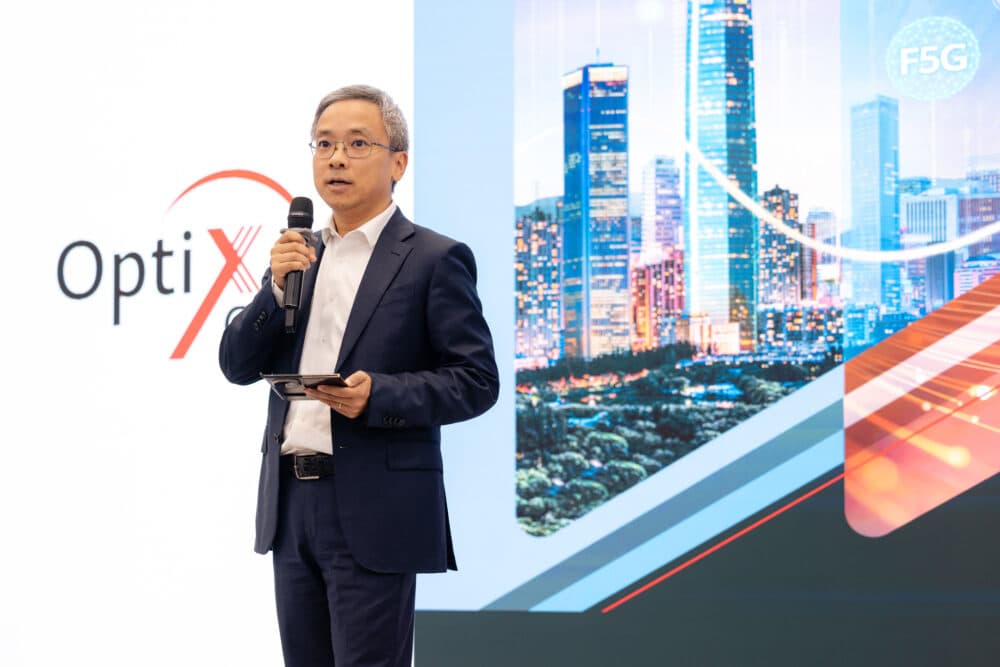
As AI adoption accelerates, organisations are rethinking the network infrastructure required to support data-intensive workload. Against this backdrop, Huawei’s OptiX Club 2026, hosted in Johannesburg focused on the role of optical networks in enabling faster, smarter digital environments. The event brought together more than 120 customers, partners and industry stakeholders to explore how AI is changing the demands placed on enterprise networks.
Opening the event, York Ning, Director of Huawei South Africa ICT Marketing & Solution Sales Department noted that intelligent upgrades still depend on a stable network foundation. “Frankly speaking, in the AI era, networks are the foundation. Networks must be fast and reliable, and optical communication is the key.
Without a high-quality optical network, even the most powerful AI cannot perform effectively,” he said. York Ning, Director of Huawei South Africa ICT Marketing & Solution Sales Department He outlined four priority areas shaping Huawei’s approach in South Africa: faster backbone networks, more stable industry networks, more seamless campus connectivity, and safer optical technologies. That strategy is already taking shape in local deployments, including South Africa’s first 800G backbone network with Broadband Infraco (BBI) and the first 100G private power network with Eskom.
Ning said Huawei is “willing to work together with all partners to seize the new opportunities of the AI era, and achieve new breakthroughs in business development.” The broader technology direction was unpacked by Dr. Bello Moussa, CTO of Huawei Southern Africa Enterprise Government & Public Utility Account Department, who described F5G Advanced as the next stage of fixed-network development. “As AI and enterprise digitisation, and immersive applications continue to expand, fibre is becoming a core layer of digital infrastructure across homes, campuses, industries and critical services,” he said.
Dr. Bello Moussa, CTO of Huawei Southern Africa Enterprise Government & Public Utility Account Department Rather than serving only as a connectivity pipe, fibre is increasingly being shaped into a platform for lower latency, stronger reliability and wider application. In this context, Huawei presented F5G as the next frontier of fibre.
“The future of AI will be in the combination of different servers. The more you can combine, the more powerful you will be,” said Dr. Moussa.
To further elaborate on that, Skyler Wang, Solution Architect at Huawei South Africa’s Enterprise Network Solution Sales Department, said: “AI is also changing how networks are built and monetised. The first wave of ISP growth was about covering more homes and selling faster packages, the next wave will deliver a more intelligent and consistent user experience. AI is not just changing the services, it’s redefining our network and redefining how we should build our network.
AI is a business transformation.” Skyler Wang, Solution Architect at Huawei South Africa’s Enterprise Network Solution Sales Department Huawei’s answer is the “one fibre, one network, one smart home” approach, a full-chain model that ties the network itself to the experience people get from it, and to the services that operators can build on top of it. The same logic was applied to campus environments. Justin Liu, Director of Huawei’s Intelligent Campus Marketing and Solution Sales Department, focused on how AI and all-optical networking can benefit campus environments.
“As the physical environment where people work, live and learn, and said AI is now moving from the digital world into the physical world,” he said. Justin Liu, Director of Huawei’s Intelligent Campus Marketing and Solution Sales Department In practice, Huawei’s FTTO and IFTTO approach simplifies campus networks while enabling new services across education, healthcare and hospitality sectors. Liu said this model combines fibre, Wi-Fi 7, sensing and unified digital platforms to improve both user experience and operations.
Beyond campuses and home connectivity, the transport layer remains central. Alwin Yin, Solution Architect at Huawei’s Optical Product Line, focused on the transport layer behind AI-era networks. “Industries such as power, rail and government need optical backbone infrastructure with more bandwidth,” Yin said.
Alwin Yin, Solution Architect at Huawei’s Optical Product Line “The multiple-service OTN approach, including fgOTN, is a way to balance bigger bandwidth demands with the reliability needs of industrial networks,” he said. Huawei also demonstrated how optical infrastructure can do more than move data. Botshelo Bianca Matome, Solutions Architect at Huawei South Africa Enterprise Network Solutions Sales Department, explained how fibre sensing can be used to detect faults and unusual activity faster.
Optical fibre can act as connectivity infrastructure and be used to detect changes in temperature, vibration and strain, she explained. Botshelo Bianca Matome, Solutio