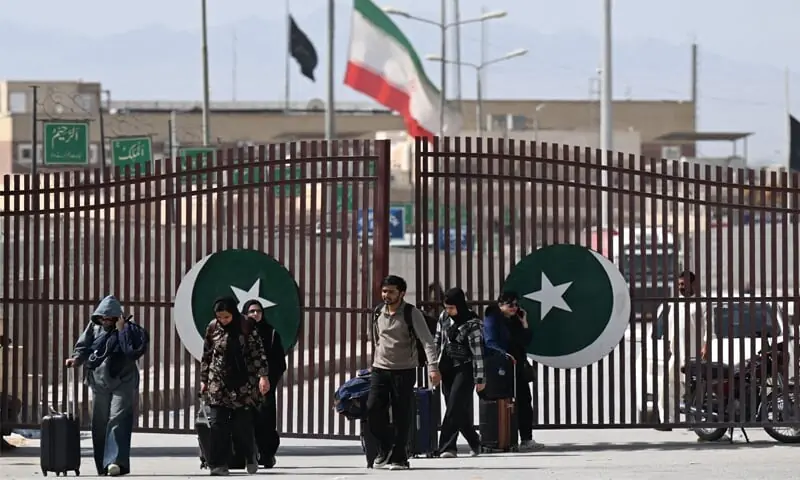
• Taftan-Mirjaveh and Gabd-Kumb-Rimdan border crossings see a daily average of 296 people• 170,153 individuals enter Afghanistan from Iran during the same period• People’s return to Iran increases after ceasefire announcement ISLAMABAD: The United Nations migration agency says over 13,000 people have crossed into Pakistan from Iran over the past six weeks due to war jointly launched by the US and
Israel against Iran, representing a daily average of 296 people. According to the International Organisation for Migration (IOM), the migration of 13,044 people occurred primarily through the Taftan-Mirjaveh crossing (10,372 individuals), and the Gabd-Kumb-Rimdan crossing (2672 individuals). During the first two weeks of March, inflows from Iran into Pakistan were relatively high, with the majority of them being Pakistani returnees, among them mostly students and tourists who returned to Pakistan after the US and Israeli jointly launched war against Iran.
During the third week of March, inflows declined drastically, both for Pakistani and Iranian nationals, due to the Ramazan and Eid holidays. After these holidays, the migration of people increased again, but not to the level reported before the period. Compared to the period before the Eid holidays, the share of Pakistani returnees remained low, most likely because most Pakistani nationals, including students and tourists, returned during the first two weeks of March.
On the other hand, inflows of Iranian nationals increased again to the level reported before Eid holidays, however, the reasons for this remain unclear. Furthermore, Pakistani authorities report that all Iranian entrants hold valid documents, such as visas, passports, or local movement passes. Apart from valid documents, these movements may reflect routine activities, such as tourism, transit, family visits, or represent precautionary and temporary travel as individuals assess the ongoing situation in Iran.
As of April 13, a total of 52 Third Country Nationals (TCNs) were recorded in Pakistan. According to authorities, people from third countries entering through the Taftan and Gabd-Rimdan borders were mostly tourists or businessmen. Many had been stranded in Iran and, due to the unavailability of flights, transited through Pakistan before returning to their countries of origin.
The report says 170,153 individuals entered Afghanistan from Iran, representing a daily average of 3,867 flows, while 73,246 left Afghanistan for Iran (1,665 daily average). Movements across the border remained stable and largely uninterrupted throughout the reporting period. A temporary drop in movements was observed during Nowruz and Eid holidays, followed by a steady increase over the past four weeks.
The resumption of taxi transit services after a prolonged suspension contributed to improved movement fluidity. Ceasefire triggers increase in people’s return to Iran A slight increase in movements towards Iran followed the announcement of a ceasefire between the United States and Iran, while travellers consistently reported a stable security environment with no widespread incidents affecting mobility. Between April 7 and 13, displacement tracking matrix (DTM) Afghanistan recorded 1,144 movements of Iranian nationals from Afghanistan to Iran, compared to 37 movements from Iran to Afghanistan, reflecting a substantial outbound mobility pattern for this group.
Islam Qala accounted for the most observed flows (874 outflows and all recorded inflows), while Milak registered 270 outflows, and Abu Nasr Farahi reported no movement during the period. Movements of Iranian nationals transiting through Afghanistan appear to be structured, family-related, and well-documented. Most surveyed individuals were traveling as part of households (75 per cent), while 25pc travelled alone.
All respondents reported holding valid passports, visas, and national identity documents. The majority had been residing in the United Arab Emirates and were transiting by land through Afghanistan (87 per cent) primarily due to flight disruptions and a lack of direct international flights (75pc), with Seestan-Baluchistan province of Iran identified as the main destination (100 per cent). Mobility patterns among Afghan nationals reveal a clear contrast between inflows from Iran and outflows to Iran.
Returns from Iran to Afghanistan were primarily driven by protection concerns (46pc), forced returns (34pc), and economic pressures such as loss of employment or livelihoods (15pc). Many individuals reported long-term residence in Iran prior to returning to Afghanistan (52pc). Published in Dawn, April 18th, 2026