I have been cycling for years, be it going to schools or entire cyclo-thons. I have also navigated a considerable amount of my adult life on a scooter so when I got my hands on the EMotorad Ranger, I had a decent sense of what to expect from both sides of the coin. I have […]
I have been cycling for years, be it going to schools or entire cyclo-thons. I have also navigated a considerable amount of my adult life on a scooter so when I got my hands on the EMotorad Ranger, I had a decent sense of what to expect from both sides of the coin. I have been driving around Mumbai on the Ranger for a month now and I think I have a clear picture now of what this thing actually is.
Survey Thank you for completing the survey! Mumbai is a city that will test anything, especially on the roads. Potholes that appear mid-corner, stretches under construction that are more rubble than road, uphill patches, bumper-to-bumper traffic, and the occasional clear stretch where you can breathe.
The Ranger handled all of it without a hiccup. Also read: EMotorad’s Kapil Mandlik on AI, IoT and why your e-bike is smarter than you think The design is polarising The Ranger turns heads. I know this because people have stopped me to ask about it multiple times over the month.
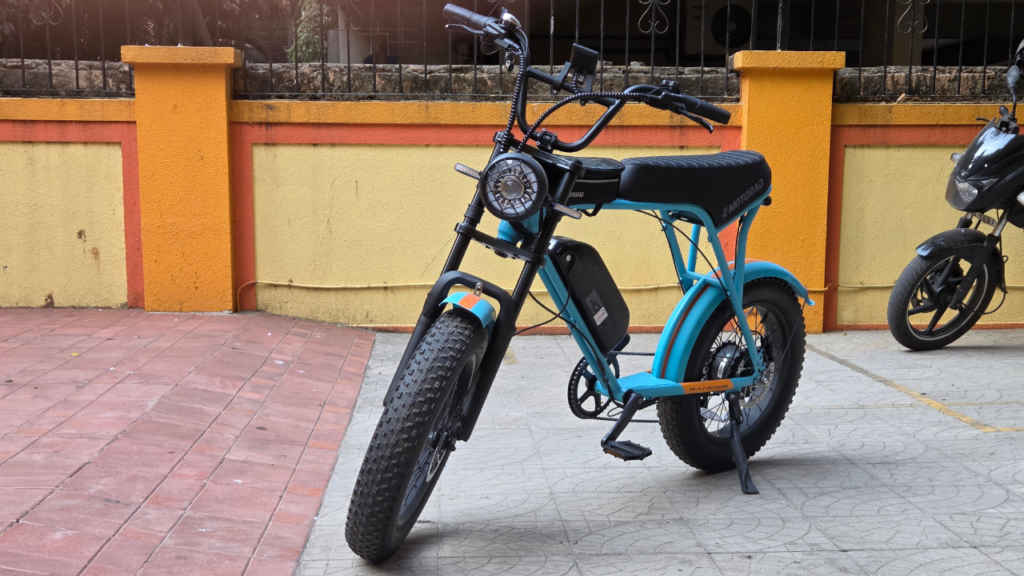
The wide 4.0-inch fat tyres, the long stretched-out seat, the headlamp grille, the integrated indicators, it has a rugged almost moto-inspired look and the ambition is evident. Whether it works depends entirely on your taste. Personally, I don’t think it is quite my style.
It can read as a little tacky depending on the colourway and the angle. But there were people I met who really liked the bike-like design of the Ranger so it can clearly work. The tech behind the bike The Ranger runs a 250W rear hub motor paired with a 48V, 12.75Ah removable lithium-ion battery.
The pedal assist is where this cycle earns its money. There are five levels, and the difference between them is very noticeable. Lower levels give you a gentle nudge, higher levels practically push the cycle for you.
On construction-riddled stretches and uphill sections, I kept it at mid-to-high assist and the motor pulled without an issue. It does not lunge, it just keeps going, which is exactly what you want when the road beneath you is unpredictable. Also read: EMotorad Doodle Pro Review: A foldable fat-tyre E-bike that’s fun, flawed but hard to ignore The throttle is a different story.
The free play on it is noticeable. You twist it a little, nothing happens, you twist more, and then the power hits you hard. It is not the gradual delivery you get from a traditional scooter where acceleration maps to how far you roll the grip.
It is more binary, and early on it catches you off guard at junctions with traffic nearby. You can easily adapt, but it isn’t as easy to control initially as a regular scooter or bike. I found myself using the throttle mainly while already in motion and merging with moving traffic and I rely entirely on pedal assist for pick-ups from signals and most other situations.
That split might come from me having an inclination towards cycling, but it felt like the more natural way to ride this thing. The Cycle also comes with two keys, one for the battery and another for your throttle. The battery needs to be locked into place once you attach it to the cycle for it to actually start giving power to the cycle.
And the second key works similar to your bike or car key where you need it to be able to start the cycle. If you are just out for leisure you can go without the battery or the keys to have a lighter cycle that you can use like a normal cycle. The claimed maximum range is 75 km which you could probably get on an ideal road.
Real-world range, however, sat around 55 to 65 km in mixed usage. The battery is removable and weighs just under 3 kg so it is easy to carry indoors without it being a hassle, though a handle or strap integrated into it would make it less awkward to carry. The seat height I am 5’11 and rode the large variant, so this was a non-issue for me.
But if you are under 5’9, go for the medium regardless of what the website says. The seat is not height-adjustable, and getting both feet flat on the ground will be a major struggle. On an e-cycle where you might use it for daily commute, it will become an issue for stopping and starting constantly in city traffic.
So, is it worth it? The Ranger is for someone who wants to get around the city without getting exhausted, wants a ride that handles rough roads without falling apart, and wants something that does not look like every other cycle on the road. At 58,999 INR, it is not an impulse buy, but the e-cycle segment in India has real room to grow, and products that actually think about the riding experience rather than just the spec sheet are what will bring more people into it.
The Ranger, to me, is one of those products. Also read: Uber Rs 25 bike taxis for busy Indian cities sound useful, but questions remain