This article is part of a series of pieces celebrating Glasstire’s 25th anniversary. To see other stories from this series, go here. To see pieces from the month of April, around the theme The Circuit: Art Fairs, Festivals & Beyond, go here. How does a once-brilliant, popular, expansive, and provocative contemporary arts festival wither away? […] The post Luminaria: Into the Darkness? appeared fir
This article is part of a series of pieces celebrating Glasstire’s 25th anniversary. To see other stories from this series, go here. To see pieces from the month of April, around the theme The Circuit: Art Fairs, Festivals & Beyond, go here.
How does a once-brilliant, popular, expansive, and provocative contemporary arts festival wither away? It all comes down to money, if we’re to listen to Phil Hardberger. As second-term Mayor of San Antonio in 2008, Hardberger essentially invented the Luminaria Contemporary Arts Festival, San Antonio’s annual nighttime one-day multidisciplinary arts event.
Aiming toward Nuit Blanche nighttime art festivals he’d experienced in Toronto and Paris, the mayor was able to convince his peers and colleagues of the felicity of a festival focused on contemporary arts, to the tune of a $1 million budget. He enrolled a couple of heavy-hitters to plan and run the show — Marise McDermott, then Executive Director the Witte Museum, and Janet Holliday, an event logistics expert. It was a winning combination.
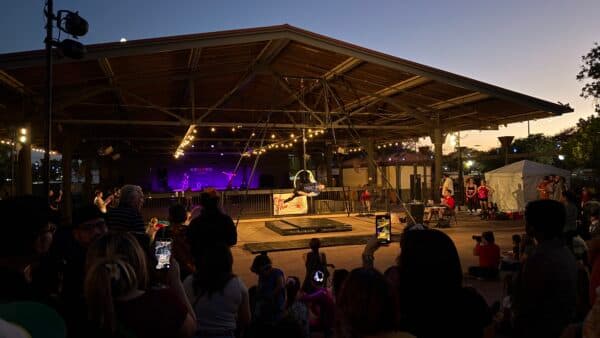
Hardberger says 100,000 people attended the first festival, and the attendance figure doubled in the event’s second year. Unfortunately, as Hardberger told me, “That was, I’m sorry to say, the high point, though.” Attendees watch the Cirque Aria acrobatics troupe perform while House of Shyne poetry duo reads onstage in the background, at the Luminaria Contemporary Arts Festival in 2025 If you happened to attend the 2025 version of Luminaria, you’d have hardly recognized it as a direct descendent of past versions, a far cry from its former glory. I only arrived in San Antonio in 2017, so I missed those heady early days.
But even then and for a couple years after, Luminaria possessed obvious ambition, with a large footprint surrounding the Henry B. Gonzales Convention Center in the heart of the city’s downtown. My mind’s eye can still easily conjure a towering metal sculpture breathing big bursts of literal fire — Actual fire in a city-run event?
Yes! — and, for just a couple examples, a strange conglomeration of glowing neon glass sculptures congregated on a tiny isle in the San Antonio River, and the sight of people mesmerized by a live, onsite opera performance being streamed through their headphones, attention diverted from the ubiquitous festival din surrounding them. It’s not just that these commissioned artworks, by Women Who Weld from Houston, the San Antonio collaborative duo of Justin Parr and Adam Smolensky, and composer Nathan Felix, respectively, are missing from recent Luminarias, it’s that the ambition and grandiosity of projects like these seems to have gone missing.
Hardberger issued a corrective when we spoke on the topic: he approves of the work that current Luminaria Director, Yadhira Lozano, has been doing, saying knowingly as an advisory board member that she does the best she can with what she’s got. He identified practical issues affecting the festival’s scope and reach: it has no permanent home, instead ranging from its first iteration around the Alamo, to Dignowity Hill east of downtown, to the convention center grounds, and recently at the Espee, a renovation of the old Sunset Station Amtrak stop, with soaring halls and an outdoor concert venue.
But the primary issue, he repeated, is a diminishing line in the City’s annual budget for arts and culture, with Luminaria’s funding now down to nearly a tenth of what it once was. Overall, the City’s arts funding has held steady or grown over the past decade and a half, but priorities have shifted toward equity, so that the amount granted to older legacy institutions is being wound down to benefit smaller, historically neglected groups, including culturally-specific institutions such as the Esperanza Center for Peace and Justice, the Guadalupe Cultural Arts Center, San Anto Cultural Arts, and others.
Individual artists have also benefited from a generous project-based program instituted in recent years. The initial directorial staff for the Luminaria served in a volunteer capacity, despite the massive amount of work necessary for pulling off a big downtown festival. Hardberger said the ethic of paying artists was present from the beginning, but as funds have dwindled, there’s simply less to put toward more ambitious projects like those cited above.
To be fair, though, I’m biased toward visual art, those giant, fire-breathing sculptures, building-sized video projections, illuminated interior installations, hauntingly inexplicable glass sculptures; and even experimental projects like the headphone opera that cross over into conceptual art realms. But there can be no faulting the ambition of other aspects of the current version of the festival. Last year, attendees were greeted by a massive concert stage with full-on lighting trusses and speaker towers, blasting the music of Moniq, Jesse Borrego, and others, even if the crowd seemed awkwardly clumped in the Espee’s asphalt parking lot. At the festival entrance proper,