Lumio has launched the 2026 Vision 9 and Vision 7 TVs in India. While the TVs bring a lot of tempting hardware as part of this refresh, the brand’s work on the software side of things is also quite impressive. One initiative, currently in the works, is Project Neo. Select media folks were given a […]
Lumio has launched the 2026 Vision 9 and Vision 7 TVs in India. While the TVs bring a lot of tempting hardware as part of this refresh, the brand’s work on the software side of things is also quite impressive. One initiative, currently in the works, is Project Neo.
Select media folks were given a demo of this feature. The core problem Project Neo is trying to solve is the disconnect between discovery on smartphones and consumption on TVs. It aims to enhance TV interfaces by turning messaging apps like WhatsApp, Instagram and Telegram into a control layer for the television.
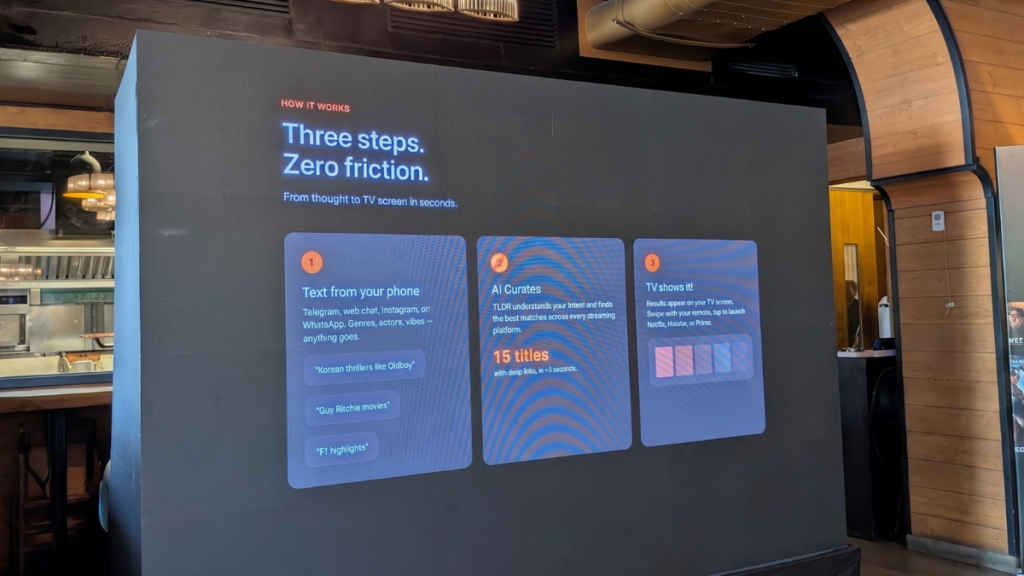
Survey Thank you for completing the survey! The concept of Project Neo is simple. Instead of searching on the TV, you send content from your phone through the TLDR bot in these messaging apps, the system understands it, transmits the request to the TV, and the TV responds.
In the closed room demo, all of these worked with minimal friction. Seamless cross-platform pairing Project Neo does not require a dedicated app or ecosystem lock-in. Instead, it uses the TLDR bot within messaging apps like WhatsApp, Instagram, and Telegram.
You have to pair the phone and the Lumio TV using a QR code. Once scanned, the phone stays connected to the TV, effectively becoming the main input device. This removes the need to switch between apps or rely on a physical remote.
Because the system works within existing apps, users can familiarly interact with the TV. Everyday actions like sending a message, forwarding a link, or sharing a reel can result in searching or selecting content on the TV. Also Read: BenQ TK705STi review: Best projector for Rs 2.25 lakh if it suits your needs Content discovery through social media interactions The key shift with Project Neo is how it treats content discovery.
It relies on what people already engage with: short videos, trailers, and creator-led recommendations. If a user comes across a film recommendation in an Instagram Reel or a YouTube video, they can send it to the TLDR bot. The system analyses the video, identifies the titles mentioned, and surfaces them on the TV interface.
You can also type in a natural query like ‘movies where the villain wins’, and the system shows you results tailored to that request. Lumio is also testing a swipe-based discovery feature inspired by Tinder design. You and your partner can access a ‘match’ mode, where both of you swipe through content cards.
The system then surfaces overlapping preferences on the TV. Over time, these interactions help build a shared taste profile without requiring separate user accounts. This also ties into a unified watchlist.
Anything shared with the bot is saved automatically, so users do not have to bookmark links across multiple apps. A recommendation discovered during the day can be accessed directly on the TV later. Once a title is identified, the system shows which streaming platforms host it and provides a direct deep link to open the content.
This reduces the friction of searching across multiple apps manually. While speaking at the launch event, Lumio co-founder and COO, Kailash Sankaranarayanan, said, ‘Your smartphone is your primary interface for the world. With Project Neo, we aren’t forcing users to download another proprietary remote app.
We are meeting them where they already spend hours a day, inside WhatsApp and Instagram. The AI sits in the background, translating messy human intent into TV actions so you don’t have to type movie names on a clunky on-screen keyboard. This is what we mean by ‘Tech that Sparks Joy’: killing the friction so you can get straight to the content.’ TLDR app on the TV gets more feature-rich While early demos focus on films and shows, Lumio is extending the system to handle sports and music queries with more precision.
For sports, the system can process requests like ‘F1 highlights from 2026’ or ‘IPL highlights yesterday.’ It can also narrow results further, for example, by surfacing specific commentary tracks or curated highlight content. The interface is designed to focus on understanding intent rather than requiring accurate spelling or structured commands. This makes the interaction closer to natural conversation than traditional search.
At this stage, Project Neo works as a text-based interface inside messaging apps. Lumio has indicated that voice integration is the next step, which would allow users to send voice notes or spoken queries through these platforms. What happens next and why this approach matters Project Neo intends to change how people discover content.
Today, we mostly find content we like to watch on our phones through social media creators and channels. We don’t necessarily find what we watch through search bars on OTT platforms or Google Search, for that matter. So, with this feature, Lumio aims to reposition the smartphone as the primary input device and help in faster content discovery, interaction and consumption on TV. And although we have seen app-based remote control for TVs before, this