For years, the way large language models handle inference has been stuck inside a box — literally. The high-bandwidth RDMA networks that make modern LLM serving work have confined both prefill and decode to the same datacenter, sometimes even the same rack. A team of researchers at Moonshot AI and Tsinghua University is making the […] The post Moonshot AI and Tsinghua Researchers Propose PrfaaS: A
For years, the way large language models handle inference has been stuck inside a box — literally. The high-bandwidth RDMA networks that make modern LLM serving work have confined both prefill and decode to the same datacenter, sometimes even the same rack. A team of researchers at Moonshot AI and Tsinghua University is making the case that this constraint is about to break down — and that the right architecture can already exploit that shift.
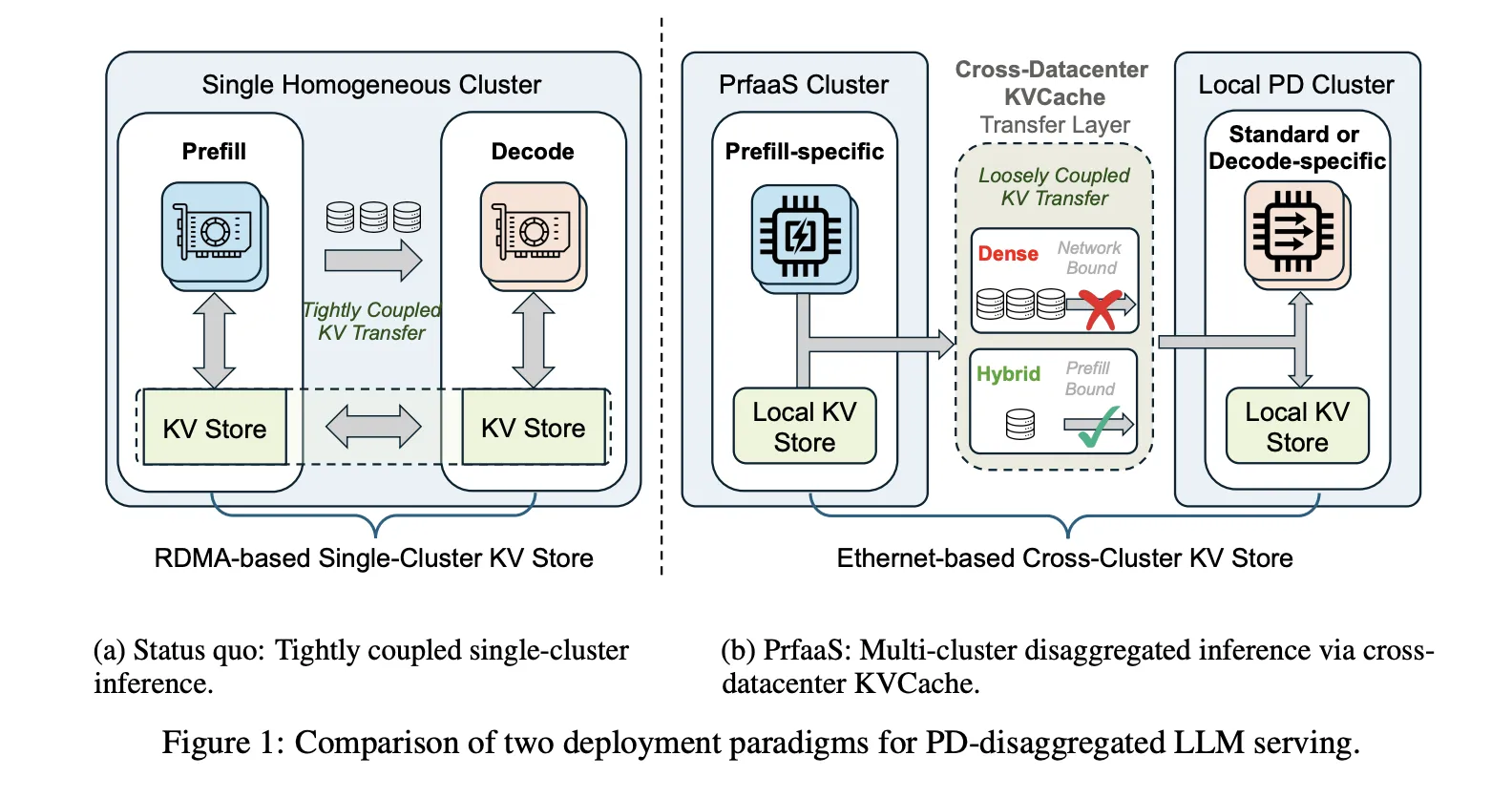
The research team introduces Prefill-as-a-Service (PrfaaS), a cross-datacenter serving architecture that selectively offloads long-context prefill to standalone, compute-dense prefill clusters and transfers the resulting KVCache over commodity Ethernet to local PD clusters for decode. The result, in a case study using an internal 1T-parameter hybrid model, is 54% higher serving throughput than a homogeneous PD baseline and 32% higher than a naive heterogeneous setup — while consuming only a fraction of available cross-datacenter bandwidth. The research team note that when compared at equal hardware cost, the throughput gain is approximately 15%, reflecting that the full 54% advantage comes partly from pairing higher-compute H200 GPUs for prefill with H20 GPUs for decode. https://arxiv.org/pdf/2604.15039v1 Why the Existing Architecture Has Hit a Wall To understand what PrfaaS solves, it helps to understand why LLM serving is split into two phases in the first place.
Prefill is the step where the model processes all of the input tokens and generates the KVCache — it is compute-intensive. Decode is where the model generates output tokens one at a time — it is memory-bandwidth-intensive. Prefill-decode (PD) disaggregation separates these two phases onto different hardware, which improves utilization and allows each phase to be independently optimized.
The problem is that separating prefill from decode creates a transport problem. Once prefill runs on one set of machines and decode runs on another, the KVCache produced by prefill must be transferred to the decode side before output generation can begin. In conventional dense-attention models — those using Grouped Query Attention (GQA) — this KVCache is enormous.
The research team benchmarks MiniMax-M2.5, a representative dense model with GQA, producing KVCache at roughly 60 Gbps for a 32K-token request on a single 8×H200 instance. That volume of data requires RDMA-class interconnects to transfer without stalling compute, which is why conventional PD disaggregation is tightly bound to a single datacenter-scale network fabric. Moving prefill and decode to separate clusters, let alone across datacenters, has simply not been feasible.
Hybrid Attention Changes the Math What makes PrfaaS timely is an architectural shift happening at the model level. A growing class of models — including Kimi Linear, MiMo-V2-Flash, Qwen3.5-397B, and Ring-2.5-1T — adopt hybrid attention stacks that interleave a small number of full-attention layers with a larger number of linear-complexity or bounded-state layers such as Kimi Delta Attention (KDA), Multi-head Latent Attention (MLA), and Sliding Window Attention (SWA). In these architectures, only the full-attention layers produce KVCache that scales with sequence length.
The linear-complexity layers maintain fixed-size recurrent states whose footprint is negligible at long context. The KV throughput numbers — defined as KVCache size divided by prefill latency — tell the story clearly. At 32K tokens, MiMo-V2-Flash produces KVCache at 4.66 Gbps versus 59.93 Gbps for MiniMax-M2.5, a 13× reduction.
Qwen3.5-397B reaches 8.25 Gbps versus 33.35 Gbps for Qwen3-235B, a 4× reduction. For Ring-2.5-1T specifically, the paper decomposes the savings: MLA contributes roughly a 4.5× compression over GQA, and the 7:1 hybrid ratio contributes another approximately 8× reduction, yielding an overall KV memory saving of roughly 36×. For the internal 1T model used in the case study, KV throughput at 32K tokens is just 3.19 Gbps — a level that modern inter-datacenter Ethernet links can actually sustain.
But the research team is careful to make a distinction that matters for AI devs building real systems: a smaller KVCache is necessary but not sufficient to make cross-datacenter PD disaggregation practical. Real workloads are bursty, request lengths are skewed, prefix caches are distributed unevenly across nodes, and inter-cluster bandwidth fluctuates. A naive design that routes every prefill to a remote cluster still runs into congestion and unstable queuing. https://arxiv.org/pdf/2604.15039v1 What PrfaaS Actually Does The PrfaaS-PD architecture sits on top of three subsystems: compute, network, and storage.
The compute subsystem separates clusters into two types — local PD clusters that handle end-to-end inference for short requests, and PrfaaS clusters with high-compute-throughput accelerators dedicated to long-context prefill. The network subsystem uses intra-cluster RDMA for fast local transfers and commodity Ethern