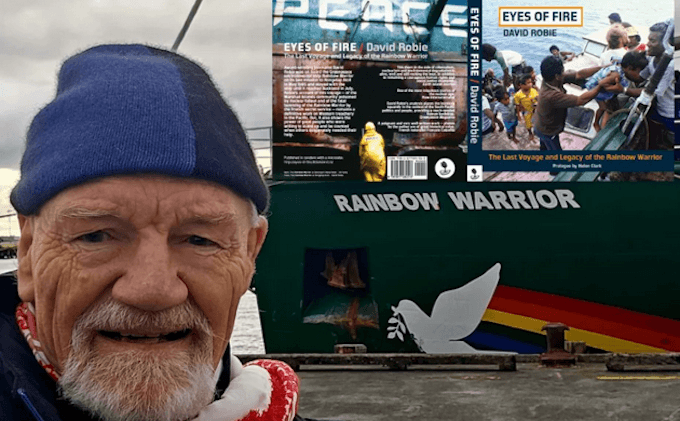
Updated research has shown up lingering headaches over the impacts of decades-long nuclear testing in the Pacific islands and interventions of outside powers, amid growing threats from climate change, writes Dr Lee Duffield. REVIEW: By Lee Duffield The journalist, professor and peace activist Dr David Robie, was one of a media party on the ill-fated voyage of the Greenpeace ship Rainbow Warrior in 1985, before its sinking by French security operatives in Auckland Harbour. He wrote a definitive book about the lead-up in the region to the fatal sinking of the ship with limpet mines; unmasking of the plot made in Paris; attempts to obtain justice and a long aftermath with demands for empowerment by former “colonial” people to prevent such outrages in their island homelands.
The book is Eyes of Fire, first published in 1986, then successively updated as the story unfolded, with new facts and consequences of the outrage coming to light. It ran to three revised editions, the latest out now to commemorate 40 years since the attack took place. It therefore marked 40 years since the death of the Greenpeace photographer Fernando Pereira, a Portuguese-born Dutch national, aged 35, father of two children, Marelle and Paul, drowned on board after the second of two blasts that hit the ship.
Eyes of Fire is a highly professional work of journalism, built out of investigation and documentation of facts, then fashioned into an accessible read; illustrated also with easy-to-comprehend maps and diagrams, showing where the ship travelled and where the bombs were planted against its hull, plus photographs from a copious accumulation built up as the Greenpeace movement generated publicity for its actions worldwide. New Zealand author David Robie . . . His book identifies same-old patterns of resistance in latter-day moves, successful, to get better recognition of the impacts of nuclear contamination and in moves through international forums.
Image: The Australia Today montage Voyage of the Rainbow Warrior One section describes the Rainbow Warrior, appreciatively and affectionately: a former fisheries research vessel, a trawler type, 50-metres in length, with some difficulty converted for sail as well as power, made into a “proud campaign ship”, painted a strong green with a long rainbow-emblem along the sides. ‘The wheelhouse was rather lumpy and unattractive but the rest of the ship was appealing. She had a high North Sea prow, graceful sheerline and round-the-corner stern.’ For the record… The Rainbow Warrior sailed from Hawai’i on the Pacific Voyage — taking on board seven journalists and some leading figures from the Pacific communities, to the Marshall Islands — where it evacuated the inhabitants of a nuclear afflicted island, Rongelap, to an uninhabited island Mejatto on Kwajalein Atoll.
Pacific distances are great. They transported 350 people — with house lumber and belongings — in four trips, 250 km there and back. Eyes of Fire: The Last Voyage and Legacy of the Rainbow Warrior.
Image: David Robie/Little Island Press The islanders were suffering from contamination by the infamous upwind explosion of the experimental thermonuclear weapon, Castle Bravo, in 1954 — causing thyroid disorders, cancers and constant miscarriages and birthing disorders. Dissatisfied that health officials sent by the United States administration were more interested in research than care, they decided to leave. The key instigator was the late Marshall Islands legislator Senator Jeton Anjain.
He was one of two Pacific Islands leaders with prominent roles in Robie’s narrative. The other was Oscar Temaru, a nuclear-free town mayor in Tahiti, also elected as the territory’s President on five occasions. Temaru, now 81, spoke for many when he said: “The sad truth is that the only ones who tried to help us are the Greenpeace ecologists…” According to folklore among Greenpeace founders, a native American woman named “Eyes of Fire” told of a legend that where there was dispossession and despoilation of the land and culture, in time mythical warriors — deliverers — would come, who would mend and restore both.
So the peaceship offering aid would be a “Rainbow Warrior”. The author, Robie, in his news despatches for Radio New Zealand and other media (for which he was awarded the 1985 NZ Media Peace Prize, judged the evacuation project a change for Greenpeace towards humanitarian work connected with environmental destruction: “This isn’t a game or the sort of action publicity stunt that Greenpeace would do so successfully.” But the next part of the journey was another dramatic action, in Marshall Islands, at the US missile testing base on Kwajalein Atoll. A party from the ship went ashore, got through perimeter wires and hoisted a banner inscribed “Stop Star Wars” onto a space tracking dome, escaping before the arrival of security guards. The banner was a reference to the American Strategic Defence Initiative, “Star Wars”, testing for which had increased the he