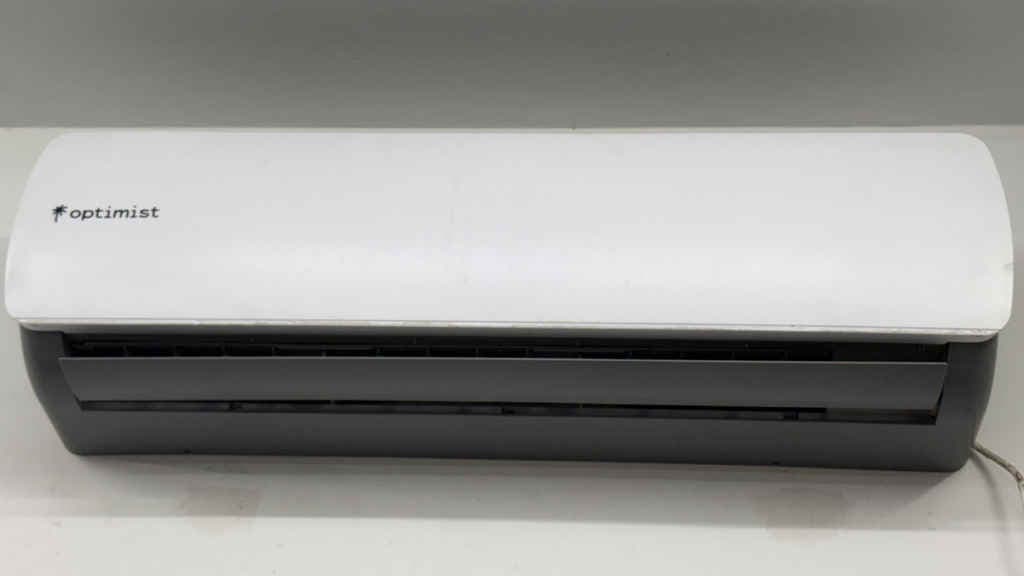
With rising temperatures and humidity, India’s air conditioning market is also growing quickly. Yet for much of the Indian middle class, access to cooling remains constrained by more than just upfront cost. The bigger anxiety is how high the electricity bills will be when the AC is running. This is the gap Gurgaon-based startup Optimist […]
With rising temperatures and humidity, India’s air conditioning market is also growing quickly. Yet for much of the Indian middle class, access to cooling remains constrained by more than just upfront cost. The bigger anxiety is how high the electricity bills will be when the AC is running.
This is the gap Gurgaon-based startup Optimist is trying to address, with a focus on making thermal comfort affordable not just to buy, but to run. In a conversation with Optimist CTO Pranav Chopra, we learned how the company is approaching this problem through engineering rather than feature additions. Rather than adapting globally standardised designs for India, Optimist has gone back to first principles, redesigning components for a market where outdoor temperatures can touch 50°C and humidity renders fans and coolers ineffective for much of the year.
Survey Thank you for completing the survey! Here, you will read about the company’s strategy centred on total cost of ownership, and its use of technologies like microchannel heat exchangers and proprietary algorithms that flag refrigerant loss before it affects cooling. The goal, as Chopra frames it, is straightforward: help tens of millions of households sleep comfortably, without the anxiety of what that comfort will cost them each month.
Optimist is entering a crowded AC market in India. What specific gap did you identify that existing brands are not addressing? When Ashish (Optimist CEO) and I started, we looked at heat stress in India through a climate adaptation lens.
Climate solutions are usually split into mitigation and adaptation. Mitigation, like reducing emissions or using solar, takes time to show results. In the meantime, people have to adapt to rising temperatures and humidity.
Screenshot That is already happening. Heat is not just increasing; humidity is rising as well. Dry heat is manageable, but humid heat at lower temperatures can be dangerous.
This is especially true for the Global South, including India, where conditions are already hot and often humid. So the most critical adaptation becomes cooling. We looked at how cooling works today.
Fans and air coolers have been the default, but they become ineffective in high humidity. Earlier, in cities like Delhi, coolers worked for most of the summer. Now cooling demand has stretched from about six months to eight or nine months, with a shorter dry phase and a longer humid phase.
Last year was a good example. Delhi did not cross 40°C, but it felt extremely uncomfortable because of high wet-bulb temperatures, which combine heat and humidity. It felt closer to Chennai conditions.
In such environments, coolers fail, and the only effective solution becomes an air conditioner, which significantly increases energy demand. Cooling already accounts for about 15% of total energy consumption. At the same time, only around 8% of Indian households have ACs.
As incomes rise, this will increase. If we continue with current inefficiencies, by 2030 or 2035, we will need massive investments in power generation just to meet cooling demand. The grid will struggle, and access will become constrained.
People may be able to buy ACs but not afford to run them reliably. So we focused on access. Access is not just about buying the product; it is about being able to run it.
We approached this from a total cost of ownership perspective. An in-lab unit We also realised that AC technology has largely been designed for temperate markets. In India, most brands focus on adding features or meeting star ratings, rather than fundamentally designing for local comfort needs.
This leads to poor outcomes. ACs either over-dehumidify, making the air too dry, or over-cool the room to remove humidity. Instead of comfort at 25°C, users end up setting 19°C.
We defined our vision as improving access to thermal comfort. In simple terms, success would mean tens of millions of households being able to sleep comfortably, because heat stress directly impacts health and productivity. To understand this better, we spoke to 30 to 50 customers in their homes during the 2024 Delhi summer.
We found that many middle and lower-middle-income households can now afford to buy ACs, typically in the Rs 35,000 to Rs 40,000 range, supported by EMIs and fintech options. Yet many still avoid buying them. The reason was consistent.
People said their neighbour’s electricity bill shot up to around Rs 10,000 after installing an AC. The issue is not just high cost, but unpredictability. They do not know when the bill will spike.
This insight led us to focus on delivering comfort at a much lower energy cost. We also re-examined what comfort means. Many ACs today market minimal airflow, but users told us they prefer strong airflow, often using fans alongside ACs.
With better airflow, you can feel comfortable at 26°C instead of 24°C, which reduces energy use. So we approached the problem in two ways. First, improve the efficiency of the machine. Second, deliver comfort more effec