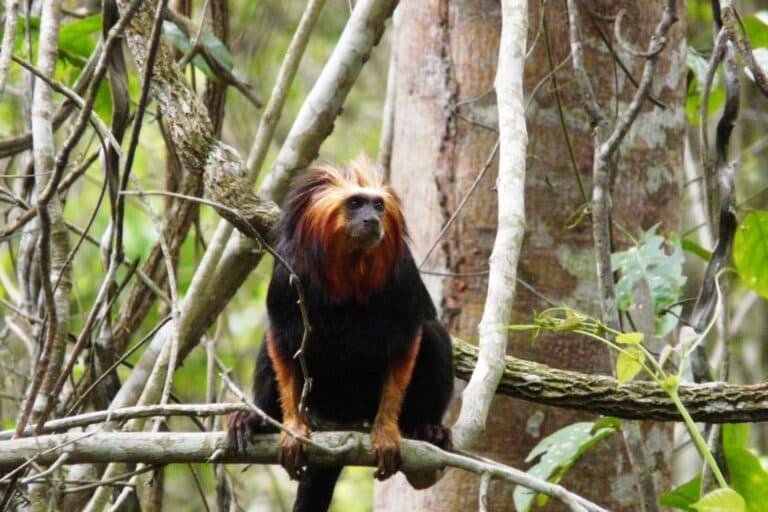
Brazil has opened its first rehabilitation center for golden-headed lion tamarins, an endangered monkey species threatened by urban expansion and the loss of agroforestry farms to monocrop plantations. The tamarins, Leontopithecus chrysomelas, have been filmed in and around Ilhéus, a coastal city in Bahia state, eating fruit inside a supermarket or running across high-voltage electricity […]
Brazil has opened its first rehabilitation center for golden-headed lion tamarins, an endangered monkey species threatened by urban expansion and the loss of agroforestry farms to monocrop plantations. The tamarins, Leontopithecus chrysomelas, have been filmed in and around Ilhéus, a coastal city in Bahia state, eating fruit inside a supermarket or running across high-voltage electricity lines; many have been electrocuted this way. Road strikes have also injured or killed several individuals, as have attacks by domestic dogs.
Until now, there wasn’t any specialized place to take the monkeys and prepare them for reintegration into the wild, according to Leonardo Oliveira, a biologist who has studied the species for more than 20 years. “Often, for the general public seeing these monkeys in their backyard or at the market gives them the false impression that everything is fine: ‘Wow, there are so many of them, they’re even coming into the city.’ No. The city is the one moving into their space,” Oliveira, who will work with the new rehabilitation center, told Mongabay by phone.
A golden-headed lion tamarin on an electricity pole in Ilhéus. Image courtesy of the Tamarin Trust. Golden-headed lion tamarins are found only in Brazil.
From 1992 to 2024, their range shrank by 42%, from an estimated 22,500 square kilometers (8,700 square miles) to 13,000 km2 (5,000 mi2). This resulted in a nearly 60% population decline, from an estimated 50,000 individuals 30 years ago, to fewer than 24,401 individuals today, according to a 2024 population reassessment. A large part…This article was originally published on Mongabay