Texture, fat content, and nutrient-density remain significant obstacles for the vegan cheese sector This article was written by Liam Pritchett on the PBN Website.
Scientists have managed to make a low-fat vegan cheese with ‘superior meltability.’ A group of researchers from Heriot-Watt’s School of Engineering and Physical Sciences in Scotland has been working to tackle vegan cheese’s “big fat problem.” Read more: Swap Processed Meat For Plant-Based Alternatives To Boost Fiber, Say Studies Stephen Euston, a professor of Food & Beverage Science at Heriot-Watt University, has been collaborating with a food innovation company for nearly a decade to make vegan cheese healthier and more sustainable by experimenting with the ingredients. Euston and his team have replaced coconut and palm oils with healthier, UK-grown vegetable fats from sunflower and rapeseed.
To get liquids to behave like solids, the scientists add special molecules called oleogelators to the oil to create a gel. In a new paper published in Food Chemistry, Euston revealed that by using sunflower oil-based “oleogels,” he and his team were able to reduce vegan cheese’s saturated fat content from 28 percent to two percent. Furthermore, the oleogelled vegan cheese samples exhibited “superior meltability,” a major obstacle for the sector.
‘It will be more heart-healthy and greener’ “Meltability is one of the biggest complaints about vegan cheese – it’s not very oozey – so improving that feature is an unintended bonus,” said Euston. “We’ve proved that our recipe, which reduces the saturated fat content of the cheese to as low as 3 percent, works theoretically and in our lab. But we’ve yet to take it to the kitchen and onto a plate.” “We’re hoping to do that within the next 10 months, when it will be presented to a tasting panel,” he said.
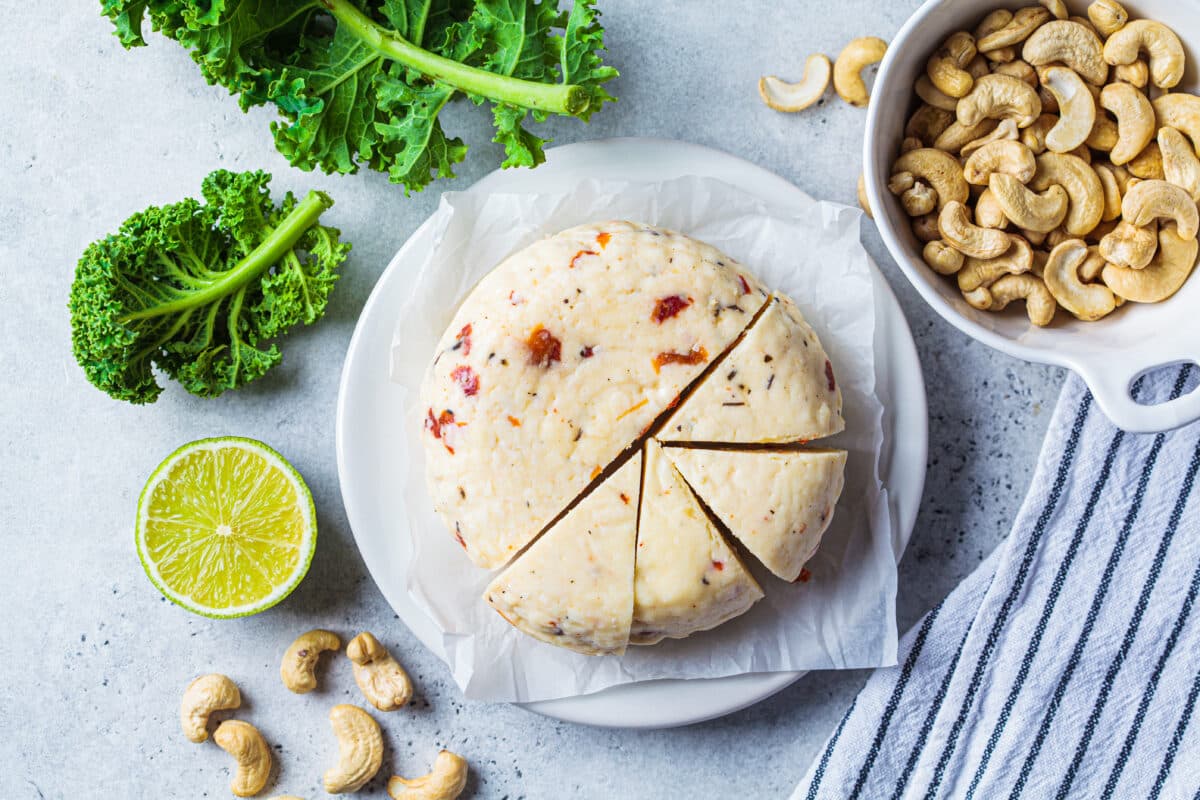
“It won’t taste any better or worse than the current vegan cheese slices on the market, but it will be more heart-healthy and greener.” Read more: Industry Report Suggests Dairy Is ‘Important’ For Health And The Environment, Despite Contrary Evidence Vegan cheese, saturated fat, and health risks Adobe Stock While some artisan and homemade vegan cheeses are made with nuts and other nutrient-dense whole foods, supermarket options typically feature high fat content with relatively little nutritional benefit Mainstream vegan cheeses have mostly moved away from soy and pea protein in favor of coconut or palm oil and starch. Where pea and soy used to add nutrient-density, the combination of fat and starch gives vegan cheese an improved texture.
Coconut and palm oils are high in saturated fat. This means that while modern plant-based cheeses contain less fat overall than dairy options, they can still contain a lot of saturated fat, which is linked to increased risk of heart disease and stroke. In 2021, a scientific review found that “plant-based dairy alternatives have lower, or much lower, impacts in almost all cases.” A separate study found that substituting dairy cheese for a plant-based option reduced emissions by 70 to 80 percent.
Read more: Have you Tried This Vegan Banana Milk Yet? This article was written by Liam Pritchett on the PBN Website.