It remains an uphill climb, but it’s do-able: At the start of the 2026 election cycle, the Senate looked far out of reach for the Democrats. The House always seemed competitive, but retaking the Senate would require flipping at least four Republican-held seats — including at least two seats in states that President Trump won by […] The post The Senate map appeared first on Lawyers, Guns & Money.
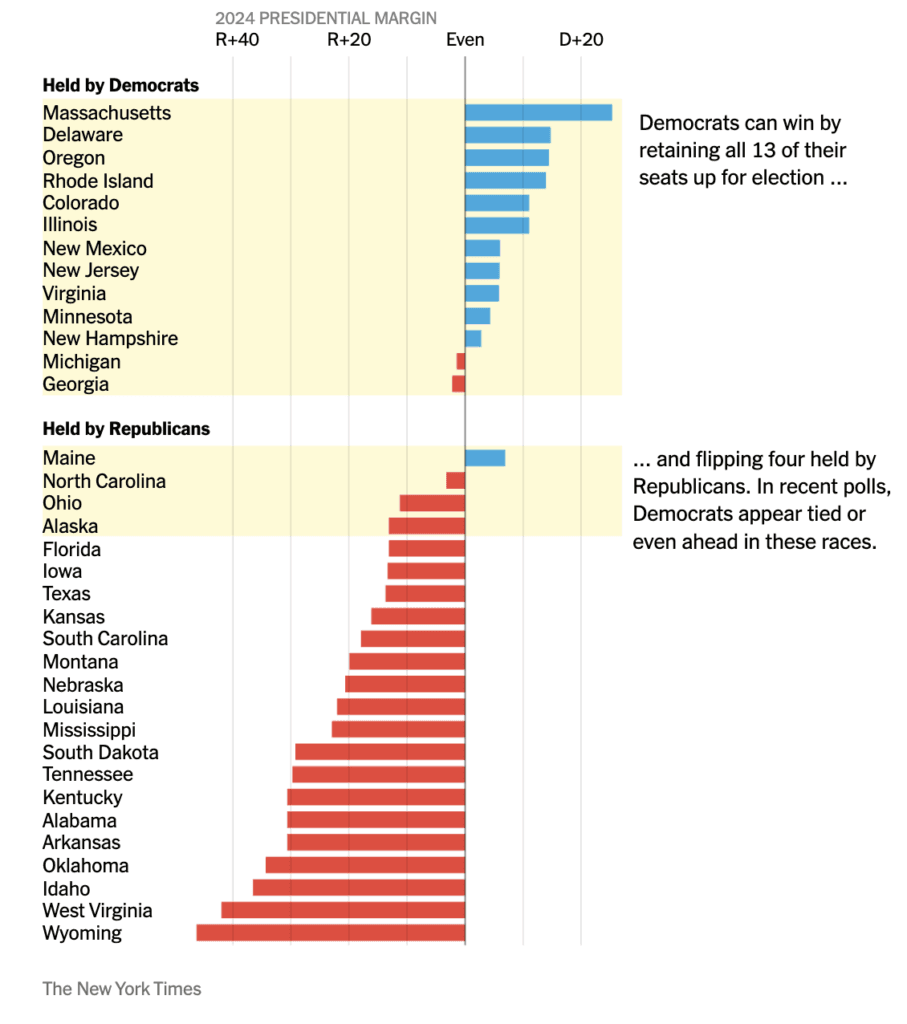
It remains an uphill climb, but it’s do-able: At the start of the 2026 election cycle, the Senate looked far out of reach for the Democrats. The House always seemed competitive, but retaking the Senate would require flipping at least four Republican-held seats — including at least two seats in states that President Trump won by double digits in 2024. In today’s polarized era, Democrats would need everything to break their way.
So far, everything is breaking the Democrats’ way. With Mr. Trump’s approval rating falling and inflation rising, along with the uncertainty of a war in the Middle East, it’s not hard to imagine a Democratic tsunami in November.
A blue wave is not guaranteed, of course, and Democrats would not be assured to flip two reliably Republican states even if it were. But a feasible path for the party to win the Senate is coming into focus. In recent polls, Democrats appear tied or ahead in four Republican-controlled seats — the number they would need to take the Senate.
These include Maine and North Carolina, where the likely Democratic nominees hold clear leads, as well as Ohio and Alaska, where Democrats have recruited strong candidates in states Mr. Trump won by double digits in 2024. There are also signs that Republicans could be in danger in two more states where Mr.
Trump won by double digits: Iowa and Texas. Over the last few weeks, the betting markets have shifted to make the Senate a tossup, though some analysts haven’t gone quite so far. Whether the Senate is a tossup or not, it’s clearly competitive — and that’s something that might have been hard to imagine a year ago.
I have already discussed my misgivings about the presumptive Maine nominee, but given how much Maine has shifted blue since the last election the Democrats don’t need a perfect candidate to win, and while it would be foolish to underestimate Collins as we have learned too many times on the Democratic sign the power of incumbency ain’t what it used to be. And the other candidate recruits are strong. If you’re thinking of giving money, I would recommend Alaska and Iowa instead of Texas. And remember: if there’s any hope of a non-neoconfederate Supreme Court in the foreseeable future, taking the Senate is a non-negotiable first step.