There are plenty of electronic components out there, but the one we tend to forget is the most basic: wire. Sure, PC boards have largely replaced wire with copper traces, but most projects still need some kind of wire somewhere. Once you need any wire, there’s a good bet you will need longer wire, and that means splicing one wire to another.
Simple, right? Not really. There are a variety of ways to splice wires, and which one you use depends on what you want to do and the type of wire you are using.
If the wires touch, good enough, right? Not necessarily. You need enough contact area for the current you are drawing through the wire to flow.
It is also nice if the splice can survive some amount of mechanical strain, vibration, and survive getting hot and cold repeatedly. Usually, after splicing, you’d like to solder the connection, although depending on the application, you don’t always see that. At the very least, you’d want to wrap it in electrical tape, use heat-shrink tubing, or otherwise insulate the bare wires and maybe provide a little mechanical support or strain relief.
Keep in mind that there are connector options, either mechanical, crimped, or soldered, that allow you to avoid splices. Soldering to a terminal strip, for example, or scewing wires into a barrier strip will get the job done. So will a butt connector, a wire nut, or a WAGO connector.
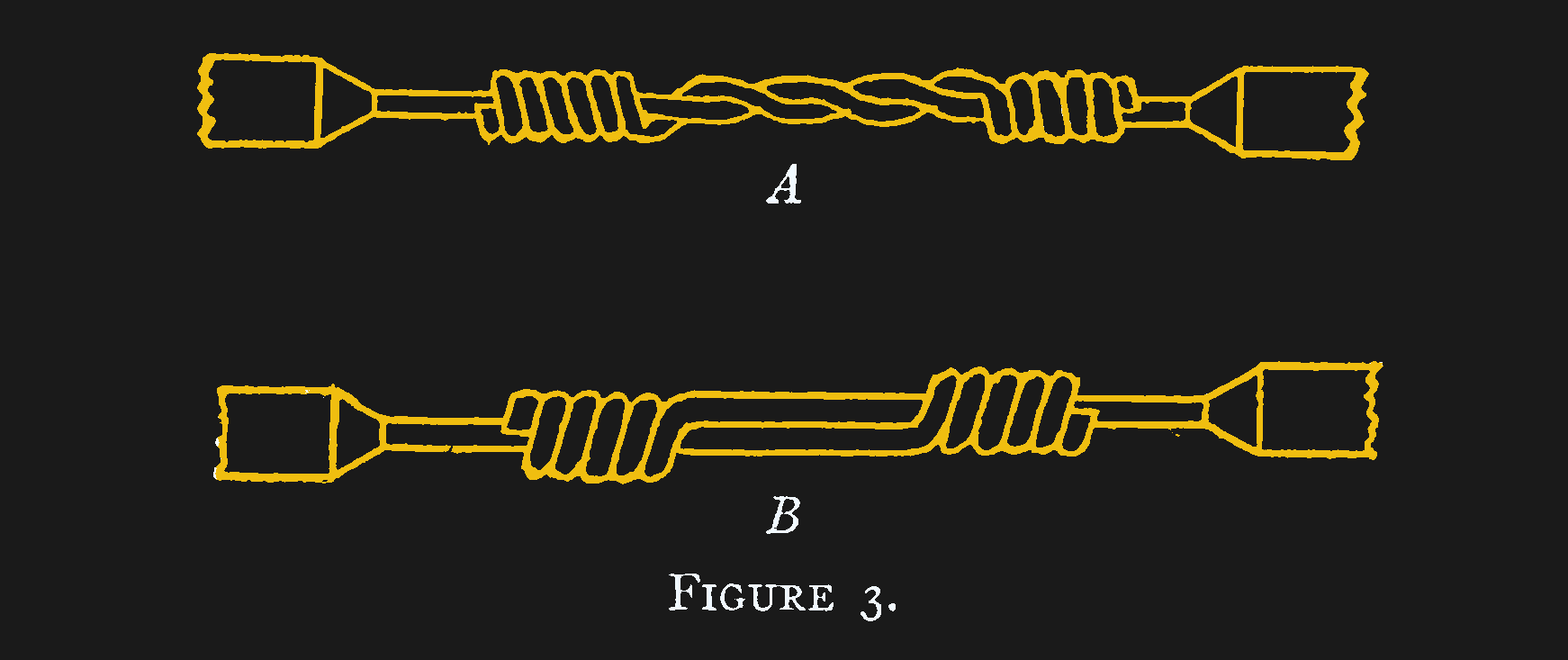
But sometimes, for whatever reason, you just need to attach two wires to each other. It’s been done before. The Gold Standard Arguably, the best way to join two similar-sized solid wires is the Western Union splice, or the lineman’s splice, which goes back to at least 1915 when the book Practical Electric Wiring (PDF) described it.
It will work with stranded wire, too, if you twist it tightly and, even better, tin the wires first. You essentially bend each wire around the other and then tightly wrap each wire around the other wire. There are a few options about how to handle the middle part, as you can see in the adjacent figure.
These aren’t hard to make, but it does depend a bit on the skill and patience of the person making the splice. On the other hand, they are mechanically very robust. NASA’s workmanship document (NASA-STD-8739.3, PDF) urges you to avoid splices and prefer controlled processes like crimps, where a tool produces repeatable connections.
However, in testing, soldered Western Union splices were found to be quite strong, usually stronger than the wire around them. Other Common Splices Perhaps the most common splice is the rat or pig tail splice. That’s where you just twist two wires together.
If you don’t have to survive mechanical tension and you have solid wire, this works ok and is what you often see inside electrical boxes in North America, either made by or topped with a wire nut. These are fast and simple, but without something like a wire nut, a bit suspect. They tend to loosen over time, especially under vibration.
Another problem is when you have very large solid wires that are not practical to twist. That calls for a Britannia splice. Here, you put two presumably thick wires end-to-end and bind them with a smaller wire.
You don’t see these very often, although you may see them in some utility contexts. More often, you’d crimp a butt connector to join two large wires. Note the binding wire wraps around both wires and the common part where the wires touch.
A similar splice is the so-called fixture splice, in which a smaller wire wraps around a larger one. This is another case where you would almost always finish this off with some kind of mechanical connector, like a wire nut. Sometimes you need a splice that isn’t much larger than the original wire.
You can do that with a scarfed splice. This is usually only practical for large, solid wires. You essentially taper each wire to a point (using, for example, a file) and then bond them together much like a scarf joint in carpentry.
Of course, you must solder or somehow fix the wires together, as there is no mechanical connection. This takes a lot of work and also takes skill to get right. Specialty Splices Sometimes, you want a splice into an existing wire to form like a “T” or a tap.
It is possible to create a tap joint by removing insulation from the main conductor and then wrapping wire around the bare metal. Often, you’ll tie a knot it the tap wire before wrapping to try to improve the mechanical hold a bit. However, these are not especially strong, and you have to be careful removing the insulation so as not to nick the main conductor and weaken it or reduce its current capacity.
If the main wire is stranded, another variation is to carefully split the main conductor into two segments and then pass the tap wire through the center before wrapping it as before. While this might be slightly more mechanically advantageous, it is still not a good replacement for a crimp-on tap or a connector to hold three wires. Splicing multiconductor wire can also pose a challenge. Sure, for a l