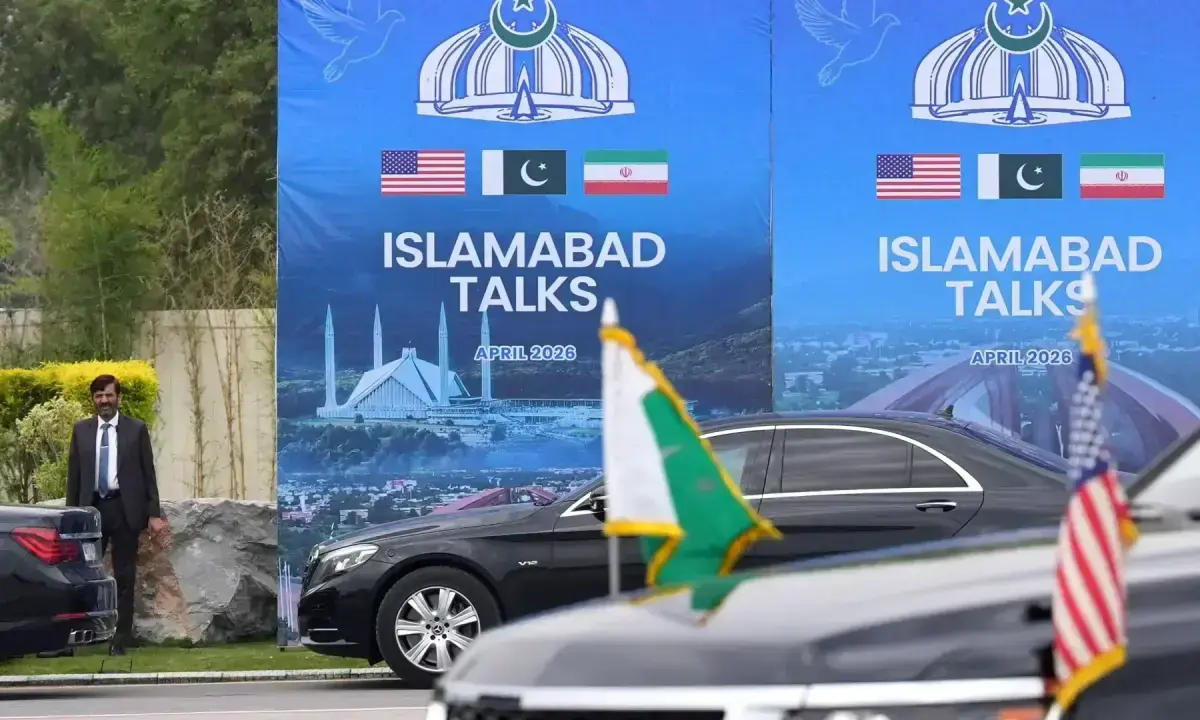
Hours before a ceasefire between the US and Iran was set to end, President Donald Trump announced that he would extend it until Tehran submitted its proposals. Earlier, Iran foreign ministry spokesperson Esmaeil Baghaei told Iranian state TV on Tuesday that Tehran it had not yet made a decision on whether to attend talks with the United States in Pakistan. He said US moves against two Iranian vessels amounted to “piracy at sea and state terrorism” and questioned Washington’s seriousness in negotiating.
“The aggression against Iranian ships and the continued pressure indicate the continuation of the opposing side’s contradictory behaviour,” Baghaei said. While he did not specify the incidents he was referring to, US military said earlier on Tuesday that its forces had boarded a tanker under sanctions for trading with Iran, the Tifani, in an operation that took place “without incident” on Tuesday. According to maritime tracker MarineTraffic, the Tifani was laden with 2 million barrels of crude oil loaded at Kharg Island.
On Sunday, the US Navy targeted and seized an Iranian-flagged ship, claiming it was attempting to evade its blockade of the Iranian ports. Baghaei’s statement came hours after Information Minister Attaullah Tarar said that Pakistan was awaiting a formal response from the Iranian side regarding its participation in the second round of peace talks with the United States. Pakistan remains in constant touch with the Iranian side, but a formal response from Tehran regarding participation in the Islamabad Peace Talks had not been received as of 7.30pm PST, the minister said on the social media platform X.
“The ceasefire ends at 4:50am PST, April 22. A decision from Iran to attend the talks before the end of the two-week ceasefire is critical,” he said. “Pakistan has made sincere efforts to convince the Iranian leadership to participate in the second round of talks, and these efforts continue,” the information minister said.
Earlier, Deputy Prime Minister and Foreign Minister Ishaq Dar had urged the US and Iran to “consider extending the ceasefire and give dialogue and diplomacy a chance”, according to the Foreign Office (FO). He expressed these views in a meeting with US Chargé d’Affaires Natalie Baker, where the two discussed recent regional developments. “DPM/FM underscored Pakistan’s consistent emphasis on dialogue and diplomacy as the only viable means to address challenges and achieve lasting regional peace and stability,” the FO said.
“He stressed the need for engagement between the United States and Iran, urged both sides to consider extending the ceasefire, and to give dialogue and diplomacy a chance,” it said. Meanwhile, Baker conveyed the US’s appreciation for Pakistan’s constructive and positive role in promoting regional peace and facilitating dialogue, it added. Trump expects ‘great deal’ Separately, US President Donald Trump touted the strong negotiation position of the country in talks with Iran to end the Middle East conflict.
“We’re going to end up with a great deal. I think they have no choice… We’re in a very, very strong negotiating position,” Trump told broadcaster CNBC. He also said that he did not want to extend a ceasefire with Iran.
“I don’t want to do that. We don’t have that much time,” Trump said when asked about the possibility of extending the ceasefire. With the prospect of last-ditch further peace talks still up in the air, Trump said the US would resume its attacks on Iran if a deal is not struck with Tehran soon.
“I expect to be bombing because I think that’s a better attitude to go in with. But we’re ready to go. I mean, the military is raring to go,” he said.
The two-week truce between the US and Iran was supposed to expire at 8pm (Eastern) on Tuesday, April 21. But on Tuesday, Trump said it would now end on Wednesday evening US time. Earlier on Wednesday, he also accused Iran of violating the ceasefire “numerous times”. 2nd round of talks?
The developments took place as a US delegation was expected in Islamabad amid anticipation of a second round of talks between Washington and Tehran. The first round of historic direct US-Iran talks, held in Islamabad on April 11 and 12, ended without an agreement, but also without a breakdown, as a Pakistan-brokered ceasefire remained in effect. Pakistan initially positioned itself as a facilitator in the peace process between Tehran and Washington after the US and Israel launched attacks on Iran on February 28, setting off a conflict that gave rise to a global fuel crisis.
Later, the White House and Iran acknowledged it as the “sole mediator” in the process. After the first round of talks, Pakistan’s civil and military leadership engaged in feverish diplomacy, seeking to bring the US and Iran back to the negotiating table. On Monday, CNN reported that US Vice President JD Vance and other top US officials were expected to depart for Islamabad on Tuesday, while an unnamed Iranian official told Reuters that Tehran was considerin