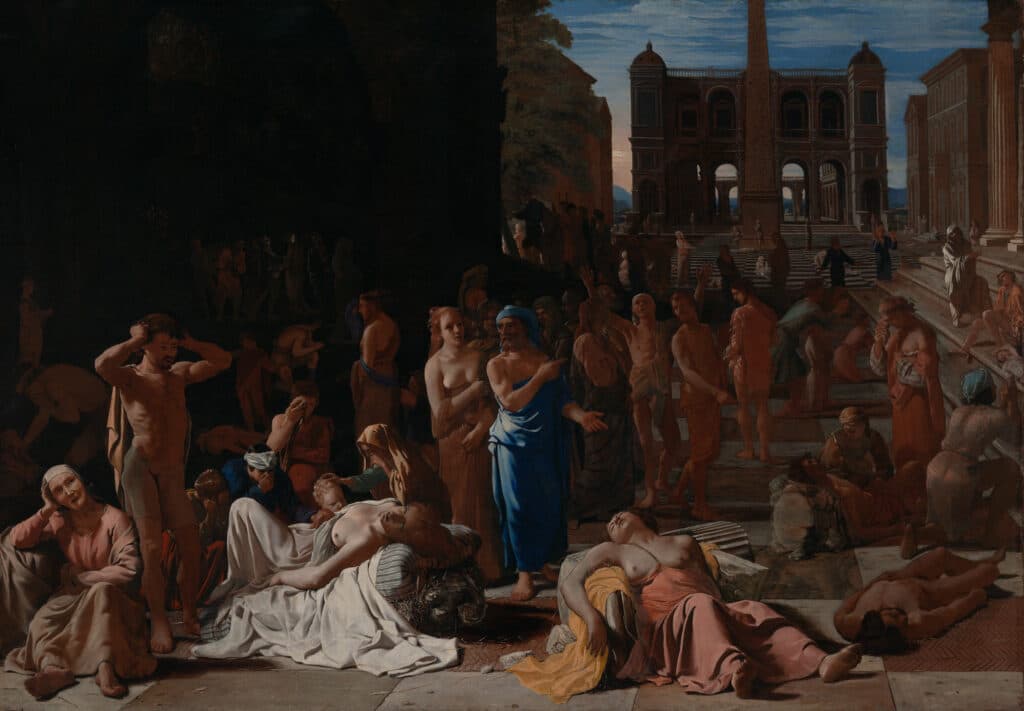
Did these chucklefucks miss the part of Thucydides that involved the massive plague? The War Department is once again restoring freedom to our Joint Force. We are discarding the mandatory flu vaccine requirement, effective immediately. pic.twitter.com/9K5W8g0NsD— Secretary of War Pete Hegseth (@SecWar) April 21, 2026 I feel like T-Diddy would have been a vaccine advocate if he’d had the chance: Not many days after their arrival in Attica the plague first began to show itself among the Athenians.
It was said that it had broken out in many places previously in the neighborhood of Lemnos and elsewhere; but a pestilence of such extent and mortality was nowhere remembered. [2.47.4] Neither were the physicians at first of any service, ignorant as they were of the proper way to treat it, but they died themselves the most thickly, as they visited the sick most often; nor did any human art succeed any better. Supplications in the temples, divinations, and so forth were found equally futile, till the overwhelming nature of the disaster at last put a stop to them altogether. [2.48.1] It first began, it is said, in the parts of Ethiopia above Egypt, and thence descended into Egypt and Libya and into most of the King’s country.note [2.48.2] Suddenly falling upon Athens, it first attacked the population in Piraeus – which was the occasion of their saying that the Peloponnesians had poisoned the reservoirs, there being as yet no wells there – and afterwards appeared in the upper city, when the deaths became much more frequent. [2.48.3] All speculation as to its origin and its causes, if causes can be found adequate to produce so great a disturbance, I leave to other writers, whether lay or professional; for myself, I shall simply set down its nature, and explain the symptoms by which perhaps it may be recognized by the student, if it should ever break out again.
This I can the better do, as I had the disease myself, and watched its operation in the case of others. [2.49.1] That year then is admitted to have been otherwise unprecedentedly free from sickness; and such few cases as occurred all determined in this. [2.49.2] As a rule, however, there was no ostensible cause; but people in good health were all of a sudden attacked by violent heats in the head, and redness and inflammation in the eyes, the inward parts, such as the throat or tongue, becoming bloody and emitting an unnatural and fetid breath. [2.49.3] These symptoms were followed by sneezing and hoarseness, after which the pain soon reached the chest, and produced a hard cough. When it fixed in the stomach, it upset it; and discharges of bile of every kind named by physicians ensued, accompanied by very great distress. [2.49.4] In most cases also an ineffectual retching followed, producing violent spasms, which in some cases ceased soon after, in others much later. [2.49.5] Externally the body was not very hot to the touch, nor pale in its appearance, but reddish, livid, and breaking out into small pustules and ulcers.
But internally it burned so that the patient could not bear to have on him clothing or linen even of the very lightest description; or indeed to be otherwise than stark naked. What they would have liked best would have been to throw themselves into cold water; as indeed was done by some of the neglected sick, who plunged into the rain tanks in their agonies of unquenchable thirst; though it made no difference whether they drank little or much. [2.49.6] Besides this, the miserable feeling of not being able to rest or sleep never ceased to torment them. The body meanwhile did not waste away so long as the distemper was at its height, but held out to a marvel against its ravages; so that when they succumbed, as in most cases, on the seventh or eighth day to the internal inflammation, they had still some strength in them.
But if they passed this stage, and the disease descended further into the bowels, inducing a violent ulceration there accompanied by severe diarrhea, this brought on a weakness which was generally fatal. [2.49.7] For the disorder first settled in the head, ran its course from thence through the whole of the body, and, even where it did not prove mortal, it still left its mark on the extremities; [2.49.8] for it settled in the privy parts, the fingers and the toes, and many escaped with the loss of these, some too with that of their eyes. Others again were seized with an entire loss of memory on their first recovery, and did not know either themselves or their friends. [2.50.1] But while the nature of the distemper was such as to baffle all description, and its attacks almost too grievous for human nature to endure, it was still in the following circumstance that its difference from all ordinary disorders was most clearly shown. All the birds and beasts that prey upon human bodies, either abstained from touching them (though there were many lying unburied), or died after tasting them. [2.50.2] In proof of this, it was noticed that bird