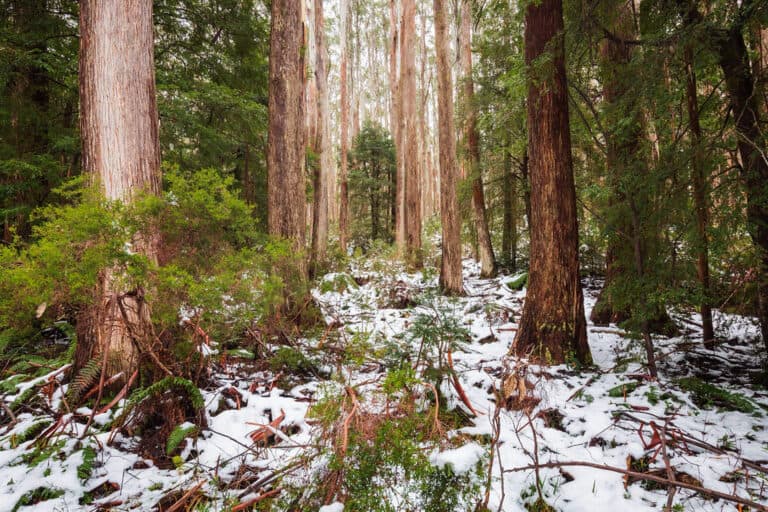
In March, the Australian Government announced that the Alpine Ash forests of mainland Australia have been listed as an Endangered Ecological Community under national environmental law. The Australian Government made the decision based on the recommendations of the independent Threatened Species Scientific Committee, although it has been opposed by logging lobby interests such as the […]
In March, the Australian Government announced that the Alpine Ash forests of mainland Australia have been listed as an Endangered Ecological Community under national environmental law. The Australian Government made the decision based on the recommendations of the independent Threatened Species Scientific Committee, although it has been opposed by logging lobby interests such as the Australian Forest Products Association (AFPA). Australian Alpine Ash forests are extraordinary places; they support trees up to 60 meters tall and provide habitat for a range of threatened species such as the critically endangered Leadbeater’s possum.
Alpine Ash forests have been listed as an Endangered Ecological Community for several key reasons, the primary ones being widespread logging, recurrent high-severity wildfire, and the fact that logged and regenerated forests are more flammable than intact forests. Importantly, young Alpine Ash trees have a prolonged juvenile period during which they do not produce viable seeds. As a result, repeated fires at short intervals have the potential to eliminate stands of Alpine Ash altogether.
Clearfell logging in Alpine Ash forest March 2018, Royston Range, Victoria. Photo by Chris Taylor There is great urgency to protect Alpine Ash forests as an iconic and important ecosystem. Robust ecological science is needed to do this.
An example that underscores this urgency is the Alpine Ash forests in the Central Highlands of Victoria, where only 0.47% of their extent remains as old-growth forest. Extensive logging practices have also resulted in the death of many Alpine Ash trees, which are becoming increasingly rare However,…This article was originally published on Mongabay