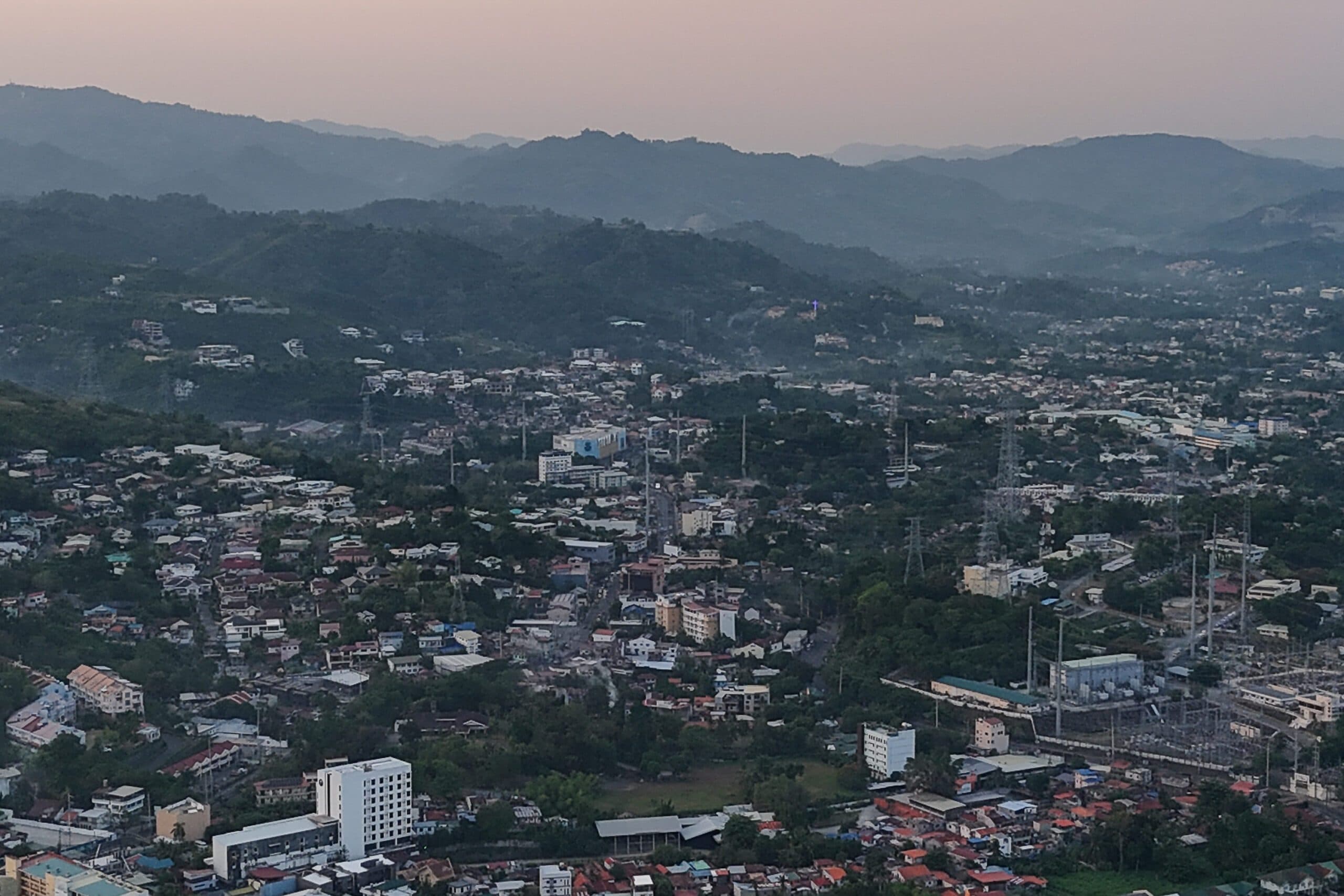
CEBU, Philippines – A stagnant heat has settled over parts of metropolitan Cebu, and with it, a visible haze that has lingered since mid-April. The Department of Environment and Natural Resources-Environmental Management Bureau in Central Visayas said Tuesday, April 21, that weak winds combined with rising temperatures have allowed air pollutants to hang over Cebu, Mandaue, Lapu-Lapu and nearby towns since April 17. What would normally disperse into the atmosphere has instead remained suspended over the urban corridor, forming a persisting haze over daily life in the province’s metropolitan core.
Ranzel Diokno, chief of the DENR-EMB VII’s Environmental Management and Enforcement Division, explained that haze occurs more frequently during the dry season, as hot temperatures cause pollutant particles to be lighter. As a result, fine particles become suspended. Diokno said the lack of wind has caused the pollutants to linger, making residents susceptible to inhaling them.
“[Ang] PM2.5, invisible ni sa atong panan-aw. Microscopic ang particle size, tendency jud niya mu-suspend sa hangin,” Diokno added. (PM 2.5 [fine particulate matter] is invisible. The particle size is microscopic, so there is a tendency for it to be suspended in the air.) Arthur Niño Calupig, senior environmental management specialist at the DENR-EMB VII Ambient Monitoring and Technical Services Section, said Cebu’s current pollutant load makes spikes more likely during the dry months.
He noted short-term increases in pollution during peak traffic hours in Cebu City, particularly from 6 to 7 am and 5 to 7 pm. However, he said that on a 24-hour average basis, air quality generally remains within safe levels. “Ang diperensya lang karon, calm or still ang winds sa Metro Cebu.
Mao na pondo ang mga pollutants sa hangin,” Calupig said. (The difference now is that the winds in Metro Cebu are calm or still. That’s why pollutants stagnate in the air.) Calupig said he hoped that the winds would become stronger and that it would rain soon to help disperse and wash out the pollutants. Diokno cited vehicular emissions and construction activities as the main causes for air pollution.
He also reiterated the Cebu City government’s call to ban daob, the local practice of burning waste. For short-term solutions, Diokno recommended water spraying of unpaved roads and dust suppression measures at construction sites to minimize the spread of pollutants in the air. With vehicular emissions accounting for 60% to 70% of total pollution, Calupig urged wider adoption of electric vehicles, particularly amid rising fuel prices.
He also backed a proposal to upgrade the fuel standard from Euro 4 to Euro 5, which is expected to significantly reduce emissions of particulate matter (PM), sulfur dioxide and nitrogen dioxide. On Tuesday, the DENR-EMB VII declared that Metro Cebu’s Air Quality Index was “Unhealthy for Sensitive Groups” – an improvement from “Very Unhealthy” as reported on April 19 – due to increased winds. While air quality is seen to have improved, EMB representatives still caution residents, especially sensitive groups such as those with chronic illnesses, pregnant women, children, and senior citizens, to stay vigilant as air levels still exceed the safe limit.
“Always wear protective masks when going outdoors,” Calupig said. They recommended the use of K95/N95 masks, as these were specifically designed to filter small particles. They also recommended using a wet cloth to cover the nose as opposed to surgical masks.
Calupig and Diokno also advised the public to stay hydrated and to avoid sidewalks, unpaved roads, and crowded areas. They likewise discouraged outdoor activities such as jogging and walking during this period, particularly during peak hours from 5 pm to 7 pm. – with reports from Gwyneth Antonio/Rappler.com Gwyneth Antonio is a Cebu-based Rappler intern and a senior anthropology student at University of San Carlos.