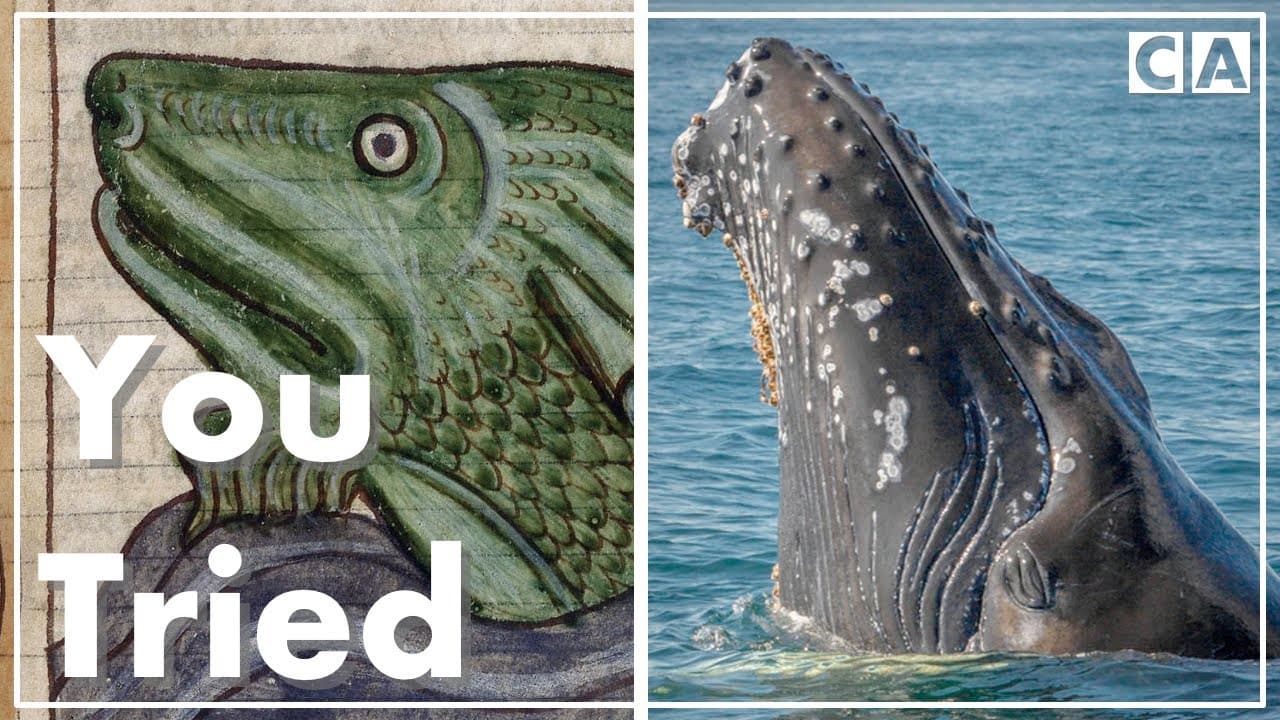
Though you may not hear it every day, chimera remains an evocative word, perhaps even more so for its rarity. It descends from the Greek Khimaira, literally “year-old she-goat,” the name of a mythical fire-breathing creature with a caprine body, sure enough, but also the head of a lion and the tail of a dragon. Today the word broadly refers to any compound, usually bizarre, of parts drawn from disparate sources, a usage that dates back to the Middle Ages.
Look at the illuminated manuscripts from that time, and you’ll find chimeras aplenty, a host of beastly mash-ups that look evocatively funny enough to be converted straight into twenty-first-century internet memes — most of which appear to have originally been intended as depictions of real, individual animals. The video above from Curious Archive presents a gallery of medieval chimeras both intended and not. These include spiked sea turtles, small tigers without stripes, hippopotamuses with dorsal fins, elephants with entire stone castles on their backs, hyenas that resemble carnivorous cows, ostriches eating iron horseshoes, and scorpions with mammalian faces.
Mistakes of this kind were perhaps inevitable, given the difficulty of coming by such exotic animals in medieval Europe, even for artists with access to a royal court. Most would have had to rely on word of mouth or depictions in the Bestiary, a text that functions as both “a natural history and a series of moral and religious lessons,” according to the Metropolitan Museum of Art, and also incorporated “tales about the existence of bizarre and loathsome creatures.” As in so many domains of the pre-Enlightenment world, the real and the fantastical went together in a way we can have trouble understanding today.
We aren’t always aware, for example, that the lore of the time tended to link the lion — an animal locally extinct since before the Middle Ages began — with Jesus Christ. Thus “the symbolic aspects of lions were therefore as important for the artists as their actual physical features,” writes Mental Floss’ Jane Alexander, and in any case, “medieval artists typically weren’t concerned with realism.” At Hyperallergic, Elaine Velie quotes the Met’s associate curator in the Department of Medieval Art Shirin Fozi as observing that, “very often, people think that they’re laughing at the Middle Ages, and they’re actually laughing with the Middle Ages.” It may surprise us to consider that our ancestors, too, had senses of humor — and that the cultural concept of the “funny animal” has been around much longer than we might have imagined.
Related content: Killer Rabbits in Medieval Manuscripts: Why So Many Drawings in the Margins Depict Bunnies Going Bad The Aberdeen Bestiary, One of the Great Medieval Illuminated Manuscripts, Now Digitized in High Resolution & Made Available Online Why Knights Fought Snails in Medieval Illuminated Manuscripts Cats in Medieval Manuscripts & Paintings The Medieval Manuscript That Features “Yoda”, Killer Snails, Savage Rabbits & More: Discover The Smithfield Decretals A Field Guide to Strange Medieval Monsters Based in Seoul, Colin Marshall writes and broadcasts on cities, language, and culture. He’s the author of the newsletter Books on Cities as well as the books 한국 요약 금지 (No Summarizing Korea) and Korean Newtro. Follow him on the social network formerly known as Twitter at @colinmarshall.