Is provenance replacing age statements? Tom Pattinson investigates.
“Behind those hills is where the SAS train,” says my host, James Chase, pointing into the distance. In front of us are freshly sown fields of heritage Marris Otter barley. After a long, wet winter that has replenished the aquifers, this early sunshine bodes well for a strong crop which, come autumn, will be harvested, malted, brewed, distilled, and laid down to become Rosemaund whisky – one of England’s most exclusive single malts.
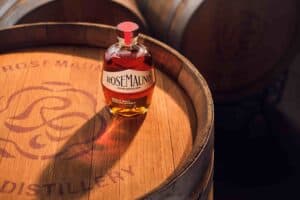
The Chase family has farmed this land for five generations. After diversifying from potatoes into crisps, then into vodka and gin, James, his brother Henry and Henry’s wife Lorna shocked the whisky world in September 2025 by releasing Rosemaund, a 10-year-old spirit that few even knew existed. Priced from £125 (approx. $169), bottles were allocated by ballot.
All 2,700 sold out, and demand for the second release is only building. Helped by backers including Hollywood director Guy Ritchie, what sits behind Rosemaund is not just scarcity or clever marketing. Like a growing number of non-Scottish whisky brands and newer premium players, the focus is shifting away from how something is made, or even for how long it is aged, but towards where it comes from. ©Rosemaund In the glass, I find malted biscuit, green apple, meadow flowers, and a lightly spiced finish, with something that feels distinctly orchard-led in its freshness.
Call it provenance, or perhaps terroir. Terroir describes the interaction of soil, microclimate and topography on a crop. In wine, it has been the dominant language for centuries.
In whisky, it remains contested. After all, whisky is not simply fermented grape juice. Grain is malted, mashed, fermented, distilled, cut, matured in oak, and often influenced heavily by whatever spirit once occupied the cask it sits in for years.
Can the specifics of where barley is grown really survive that process, or is this simply a useful story for younger brands without decades of aged stock? Mark Reynier has spent much of his career arguing that it does matter. After working in wine, he moved into whisky, acquiring the closed Bruichladdich distillery on Islay in 2000 and rebuilding it around the idea of local production.
See also: The Most Exciting Whisky Right Now Isn’t Scottish – It’s English He persuaded farmers to grow barley again on the island for the first time in decades, and at early tastings of new make spirit, he says those farmers could taste differences between crops grown just feet apart. “They started comparing with their neighbors; ‘how come yours is different to mine?’” he recalls. “The farmers rationalized the differences they were exposed to taste organoleptically something they were responsible for.
I remember thinking hallelujah.” Bruichladdich became a cult success, eventually selling to Rémy Cointreau for £58m (approx. $78.4m) in 2012, but Reynier carried on, founding Waterford Distillery in Ireland with the explicit aim of proving terroir in whisky through scientific analysis. “It was a study with labs in Scotland, Ireland, America – three years, two sites, three varieties of barley. It was bulletproof,” he says.
“We were able to demonstrate that there were 2,000 flavor compounds in barley, 60 percent of them influenced by terroir: light intensity, humidity, minerality. We know how it happens and why it happens. No one else had bothered to find out.” ©Rosemaund For Reynier, those compounds persist.
“The 2,000 flavor compounds you put in a barrel are exactly the same as the 2,000 you bring out,” he says. Others are less convinced. Billy Abbott, drinks educator at The Whisky Exchange and a long-time judge at international competitions, is wary of the binary framing.
“My biggest annoyance in the terroir discussion is the obsession with extremes: grain always makes a difference versus it never does,” he says. “Projects like Waterford are geekily comparative rather than necessarily achieving the goal of whisky making, which is creating a tasty drink.” I ask him whether he can reliably identify grain character in blind tastings. “In general, no.” See also: The Secret to Great Finnish Whisky?
It Starts in a Sauna Most whisky, he points out, is designed to eliminate variation rather than highlight it. Consistency is the foundation of the category. “We are trying to mitigate any potential for impact through our own controls,” says Sandy McIntyre, distillery manager at Tamdhu.
Over decades working with barley varieties ranging from Optic to Laureate, he has seen little evidence that origin meaningfully alters the final spirit. “My experience makes me think that the variety and area of growth has little or no impact on distillery character,” he says. For him, differences in grain are something maltsters smooth out, not something distillers amplify. That tension – between eliminating variation and celebrating it – runs through the entire category. ©Rosemaund I travel up to England’s north east coast to see how Spirit of Yorkshire grows, distils and bottles its whi