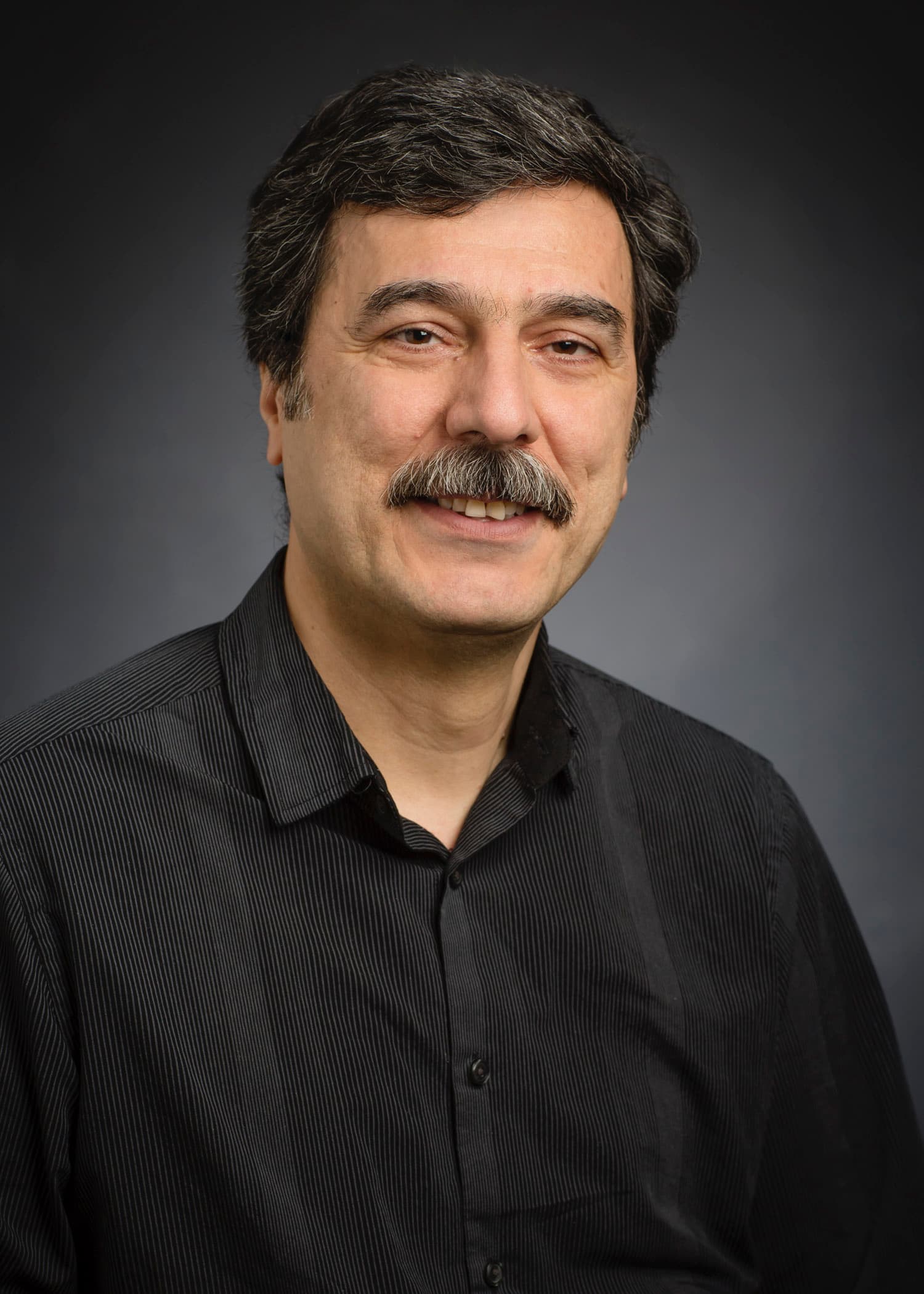
Behrooz Ghamari was imprisoned in a brutal Iranian jail in the 1980s. Despite his suffering, he's against America's war
In 1981, Behrooz Ghamari was condemned to Iran’s notorious Evin prison, which housed the Islamic Republic’s political opponents. Evin had been built for a capacity of 1,500 inmates, but Ghamari estimates there were up to 30,000 when he was there. The cells were brimming, 100 men in a six square metre room.
There were too many to sleep on the floor, so they took shifts: some slept while others stood huddled in a corner. Prisoners were regularly and brutally tortured. Ghamari watched as his cell-mates and sometimes his friends were escorted out, never to return.
Ghamari had been tried four times for being a member of a radical Marxist group plotting to supplant the government. Each time he returned to the same court, with the same judge, and each time the increasingly exasperated judge issued the same sentence: death. He was then diagnosed with cancer, which was left untreated until prison authorities thought it was too late.
In “purgatory”, he awaited execution, growing etiolated as the cancer advanced through his lymph nodes, Iraqi missiles roaring overhead. He called this the “double death row”, he tells me over Zoom, with the smile of someone determined to use distance to make light of it all. “I had no doubts that I would die soon, either from cancer or by firing squad”, he writes in his new book, The Long War on Iran.
Four decades later, on 23 June, 2025, Ghamari, then living in New York, watched as the Israeli weapons did what the Iraqi ones had not, levelling the prison he once inhabited. During his captivity he had fantasised about what he would do if missiles hit the prison – would it be his only chance at escape? Would the sneering guards shoot at them through the debris?
Instead, when Evin was struck, Ghamari saw the political prisoners rummaging through the rubble to rescue their interrogators and other prison staff. Photo by Nancy Castro Ghamari did not die in the 1980s, despite the best efforts of prison officials, who took him to hospital on the back of a motorcycle after being warned by doctors that his immune system would not be able to handle exposure to the elements. He was eventually released, granted medical parole “with the proviso, as the guard clarified it, that my body had to be returned to prison for an official identification”, he details in a thinly-veiled fictionalised autobiography, Remembering Akbar.
From there he was surreptitiously moved to the US with the help of his determined mother, where he saw through the rest of his treatment. He has since become a prominent voice on Iran, as the head of Princeton University’s Center for Iran and Persian Gulf Studies, and most recently, at the University of Toronto. In his 60s now, he sports a Stalin moustache, and is good-natured and jovial – though he admits to many sleepless nights, waking up to agonise over any new developments in Iran.
Some Iranian exiles, and indeed some leftists and liberal commentators, welcomed the war – even celebrating – in the hope that exterminating a violent ayatollah with a vice-like grip would bring about radical regime change, be it the introduction of democracy or the return of the ousted Pahlavi monarchy, which Ghamari considered a US “client state”. After Khamenei’s death, Trump urged Iranians to seize the moment and launch a popular revolution. When Ghamari decries the war, he says, “people who don’t know my history say: ‘oh, you know, people have suffered under this regime, and you have no idea what goes on.’ I say: ‘you don’t know the meaning of suffering’.” In fact, Ghamari is more familiar than most with the repression and terror of the Iranian government.
He was only 18 during the 1979 revolution, but he was active in the Marxist and socialist urban guerrilla groups jockeying for a share of the power. He saw how the regime survived both the external threat of Iraq and the internal threat of the Marxist Militant group, the Mujahedin-e Khalq (MEK), whose bombing campaigns killed dozens. “The state reaction was mass arrest of anybody who was known to them as members of the opposition, and mass execution of anybody who was a member of MEK, and also of the different communist organisations involved,” Ghamari tells me.
“You became a member of these groups with the expectation that you have six months to live.” The regime had enlisted students to rat out the communists within their ranks, and they obliged, with the knowledge that their classmates would be killed. Ghamari had been in hiding, but he got sick, and could no longer stow himself away. He was captured in October 1981.
“I was 100 per cent certain that I was going to get executed.” Despite US and Israeli insistence they are seeking to rescue Iranians from a state that suppresses their civil liberties, Ghamari says those countries “couldn’t care less about repression in Iran. They care about a form of government in Iran whose policies are consistent with American and Israeli interests in the region.” He argues that the US and Israel – dubbed b