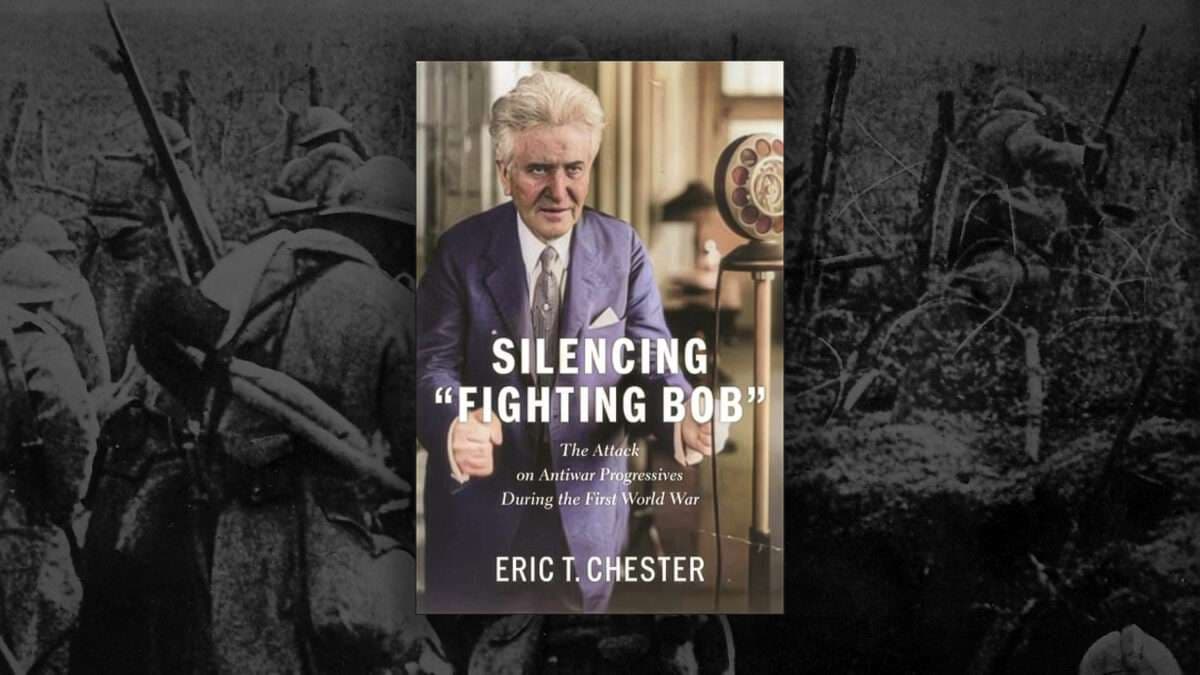
Silencing "Fighting Bob" details how the government targeted anti-war critics like Sen. Robert La Follette.
Silencing "Fighting Bob": The Attack on Antiwar Progressives During the First World War, by Eric T. Chester, NYU Press, 216 pages, $24 When Sen. Robert "Fighting Bob" La Follette Sr. opposed American entry into the Great War, the Wisconsin Republican warned that intervention abroad would carry consequences at home.
What he did not anticipate was that he himself would be the target of a government-organized propaganda campaign designed to end his political career. Eric T. Chester's Silencing "Fighting Bob" reconstructs how that campaign unfolded—and how it extended far beyond a single senator during the fraught months between the debate over intervention and the height of U.S. mobilization in 1918.
By illustrating the reach of wartime state power, this unsettling work of history resonates in an era of both continual foreign interventions and renewed domestic dissent. Organized into four chapters, the book examines the federal government's campaign against three left-leaning social groups and one progressive politician. Drawing on press coverage, speeches, pamphlets, and private correspondence, Chester reconstructs what he describes as "open and covert operations directed at suppressing progressives and the social democratic left."
The book makes a valuable contribution to the literature on repression during the First World War, a period when American civil liberties contracted with remarkable speed. The book unfolds as a story of two sides in a domestic propaganda war: those targeted by the federal government and those who carried out the targeting, principally through the Committee on Public Information (CPI), a wartime propaganda agency established by executive order, and the Bureau of Investigation, a forerunner of today's FBI. Each chapter centers on a specific target of federal pressure: the largely antiwar Jewish community of New York's Lower East Side, the People's Council of America for Democracy and the Terms of Peace (PCA), the Midwestern-based Nonpartisan League (NPL), and La Follette.
While Chester's coverage of these figures is clearly sympathetic, it is not without nuance. Progressive opinion on the war was not monolithic, and Chester shows how sectional divides within the labor movement, along with ethnic and political tensions within New York's Jewish community, complicated antiwar organizing and offered openings for government exploitation. Nor are his protagonists portrayed as figures of unbending courage.
Once intervention became a political reality, many toned down their rhetoric or outright supported the war effort while redirecting their energies toward shaping the postwar peace. A prime example is La Follette himself. When legal avenues for silencing him proved limited, Chester writes, the government "opted to discredit La Follette by initiating a coordinated effort to malign him through a covert operation of psychological warfare," carried out through the CPI and nominally private allied organizations.
The CPI worked through a prowar advocacy group, the American Defense Society, by providing them access to confidential government documents, consulted with the group on its fundraising efforts, and coordinated with them on their anti–La Follette messaging—for example, getting The New York Times to publish the group's claim that the senator's stance on negotiated peace with the Germans meant he was "disloyal to the government" and "giving aid and comfort to the public enemy." Chester contends that the campaign succeeded. "Under the impact of this assault, La Follette retreated into silence," he argues.
The episode serves as a chilling example of how even elected officials operating at the highest levels of government can be pushed into self-censorship. While the targets of Chester's study were largely on the political left, so too were many of those directing the repression. Power, not partisanship, drove the state's abuses.
A recurring figure in the book is George Creel, the progressive muckraking journalist who headed the CPI. Chester shows how Creel directed—and often micromanaged—the propaganda campaign against the war's opponents. One question the book leaves underexplored is why figures such as Creel and Wilson supported American intervention while many of their fellow progressives did not.
This would have been a good opportunity to grapple with progressivism's internal divide over war and empire—an intriguing if imperfect preface to the modern intra-left struggles over foreign policy. Chester's trim volume concentrates on the mechanics of repression—how the federal government and the CPI waged a campaign of legal prosecution and propaganda against the antiwar left. Chester provides the nuts and bolts of how the federal government infiltrated and co-opted these groups, and of how CPI officials went offense shopping to its limits to justify federal charges or to get targets to self-censor. While the Espionage Act was already egregious, as it criminalized First Amendment–protected sp