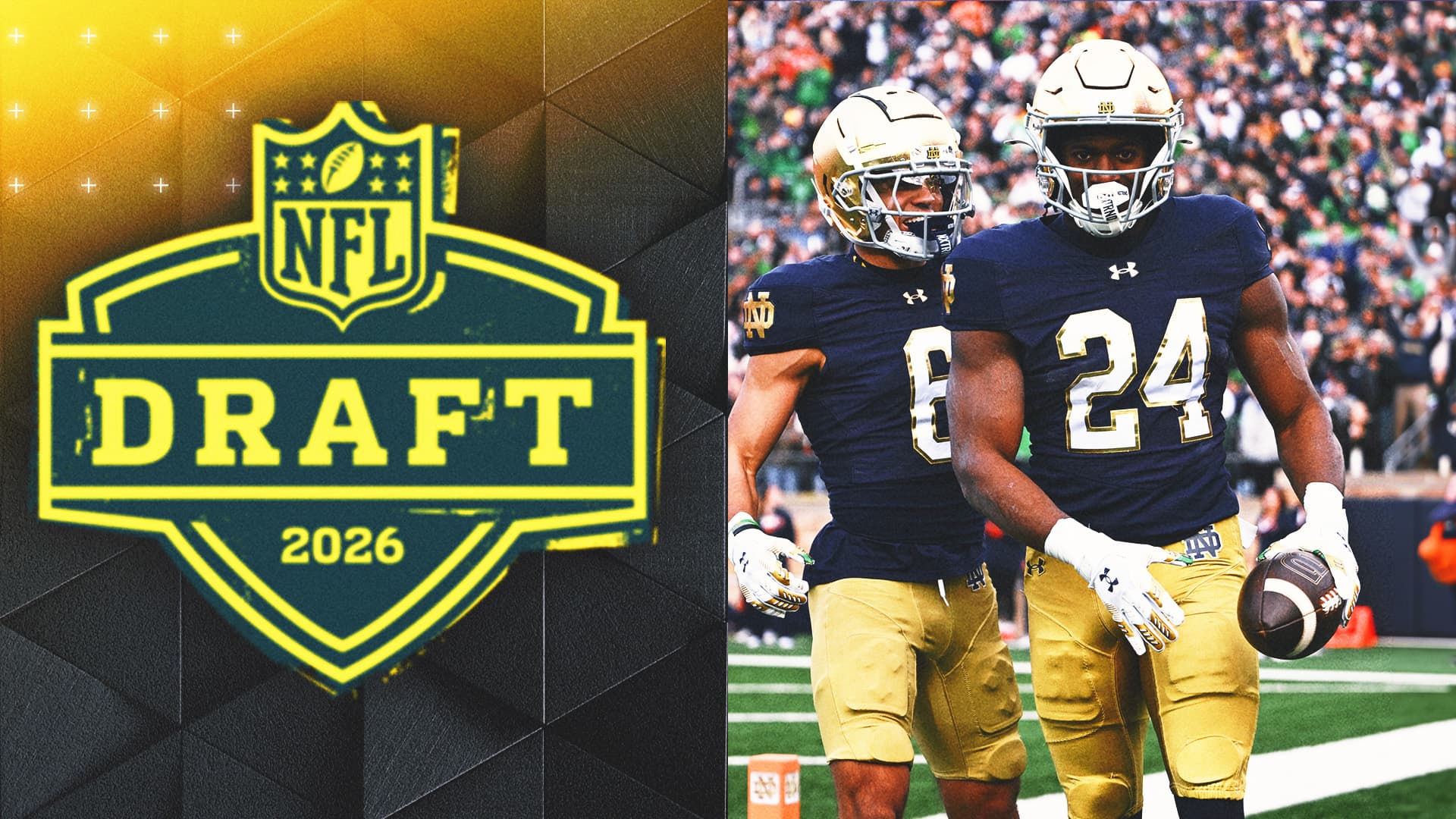
Notre Dame's Jadarian Price never started a college game and never had more than 15 touches in a game. Yet, there's a strong chance he'll be the second running back taken in the 2026 NFL Draft. All the spotlight is on Jeremiyah Love, who could go as high as third overall, but Price is an exceptional back, choosing to stay at a time when most talented backups would find another home through the transfer portal.
"Not many people can do what both of us did, both in the success we had on the field but also being able to handle it mentally and emotionally off the field," Price, who rushed for 1,692 yards and 21 touchdowns in three years, told me. "I had less opportunities, but even [Love] had less opportunities. The only thing we can control is the way we approach the game every day, and the past two seasons, we did amazing together."
Notre Dame has a chance to have the first literal 1-2 punch at running back in any draft in the Super Bowl era, where the top two backs off the board are from the same school. Not only did two of FOX Sports' three final NFL mock drafts have Price being the second running back taken, but they also have the Notre Dame standout going to the Seattle Seahawks with the No. 32 overall pick. If that happens, Price would officially be considered a first-round talent, making him a rare first-round pick who spent his college career as a backup.
Price, who is 5-foot-11 and 203 pounds, said NFL teams have asked him a lot why he didn't transfer and chose to stay at Notre Dame rather than leave for a school where he could get twice as many carries as a featured back. "I'm super thankful I did it, because now I'm standing as potentially the No. 2 back off the board," Price said. "That shows you how trusting your gut, trusting God's plan can really save your future.
I made it a challenge to myself to stay at Notre Dame and finish my degree [in sociology], finish my fourth year with the guys I've done it with who have made me better. I truly believe in commitment and love this place." Three times, a school has had two of the top three backs drafted.
Auburn had Ronnie Brown and Cadillac Williams as the first and third running backs selected in the 2005 draft, when both players went in the top-five (Texas' Cedric Benson was sandwiched between them). Arkansas had Darren McFadden and Felix Jones go as the first and third running backs selected in the 2008 draft, with Oregon's Jonathan Stewart going between them. Alabama had Derrick Henry and Kenyan Drake as the second and third running backs taken in the 2016 draft, The idea of two running backs from the same school making a splash as rookies isn't anything new, though.
Quinshon Judkins and TreVeyon Henderson were both drafted early out of Ohio State in the second round last year as the third and fourth backs taken. They both finished in the top three in rushing yards among rookies, trailing only Ashton Jeanty of the Las Vegas Raiders. The shared backfield is something you see in the NFL — see the Lions in recent years with Jahmyr Gibbs and David Montgomery — and that plan came from running backs coach Deland McCullough, who coached Price and Love from 2022-24 and has worked in the same role with the NFL's Chiefs and Raiders.
"I've sat in those rooms in the NFL, and I've never heard a GM or scout say 'God, I wish that guy had 200 more carries,'" McCullough, now running backs coach at Oklahoma, told me. "But I've heard them say, 'I wish this guy didn't have as many as he did.' If you can show more with less, that was valuable."
So Price, who missed his freshman year recovering from a torn Achilles tendon in 2022, had just 280 carries in college. Most prospects are closer to 500, and Penn State's Kaytron Allen, another top draft prospect, has 769. It's like the old Indiana Jones line — "It's not the years, honey, it's the mileage" — that could be a plus for Price in the NFL.
"That was by design. It was very deliberate," McCullough said. "It was for the development of the entire room. It was about identifying things JD could really do well while you continued to work on the other things.
In the NFL, it wasn't a situation where you needed to see a guy do pass protection 100 times. All you need to know is he can do it. You don't need to see him run with power 95 times.
It's not that at all. JD was a heck of a complementary player. He embraced the role he had." An added skill Price brings to the NFL is success on kickoff returns, having taken three for touchdowns while at Notre Dame.
College football still has the traditional return model, but he said his ability to make people miss will translate to the new NFL kickoff format. "It's the same mindset: treat it just like running back: you've got to make somebody miss," he said. "If you look at all of my touchdowns, there wasn't one where I was untouched.
In the NFL, it's really just one level, so if you can hit a seam and make one guy miss, it's to the house." One aspect of Price's game he didn't get to show m