NICOSIA, Cyprus — It’s not often that EU leaders head to a famous party town, but that’s what’s happening Thursday when a dinner that kicks off their next summit takes place in the resort of Ayia Napa. Sadly, the prime ministers and presidents won’t (we think) be heading down to Senior Frog’s Party Bar for cocktails as they also have a day of talks on Friday on a range of subjects, from helping the bloc navigate the war in the Middle East to making progress on the bloc’s next long-term budget. It will also be the first time that the leaders have gathered since Viktor Orbán’s election defeat.
After the dinner in Ayia Napa, closed-door talks kick off on Friday, followed by a sit-down with Egypt, Jordan, Lebanon, Syria and the Gulf nations to discuss regional security. POLITICO will be following all the developments throughout the summit on our live blog. Here’s what to look out for.
All eyes on Iran With the war launched by the U.S. and Israel stretching into its eighth week, leaders will discuss prospects for peace — and how to weather the economic consequences of the closure of the Strait of Hormuz, which has sparked a sharp rise in global energy prices. “First, we must discuss our response to this rapidly evolving situation,” European Council President António Costa said in his invitation letter to attendees. “This includes Europe’s contribution to de-escalation and peace in the region, as well as to the freedom of navigation.” But national capitals are split over what, if anything, they can and should do.
France and Germany have expressed disagreement over whether to get involved in policing the shipping lanes. Earlier this month, French President Emmanuel Macron hosted talks with leaders of “non-belligerent countries” to plan a “strictly defensive” mission to secure the Strait of Hormuz once fighting stops. Those talks did not include the U.S.
However, German Chancellor Friedrich Merz said while Germany is “fundamentally ready” to help secure shipping routes (under strict conditions), he also wanted to “discuss the participation of U.S. Armed Forces” in the initiative. Lacking energy One thing all EU leaders can agree on is the need to do more to bring down energy bills, in the wake of the crisis prompted by the closure of the Strait of Hormuz.
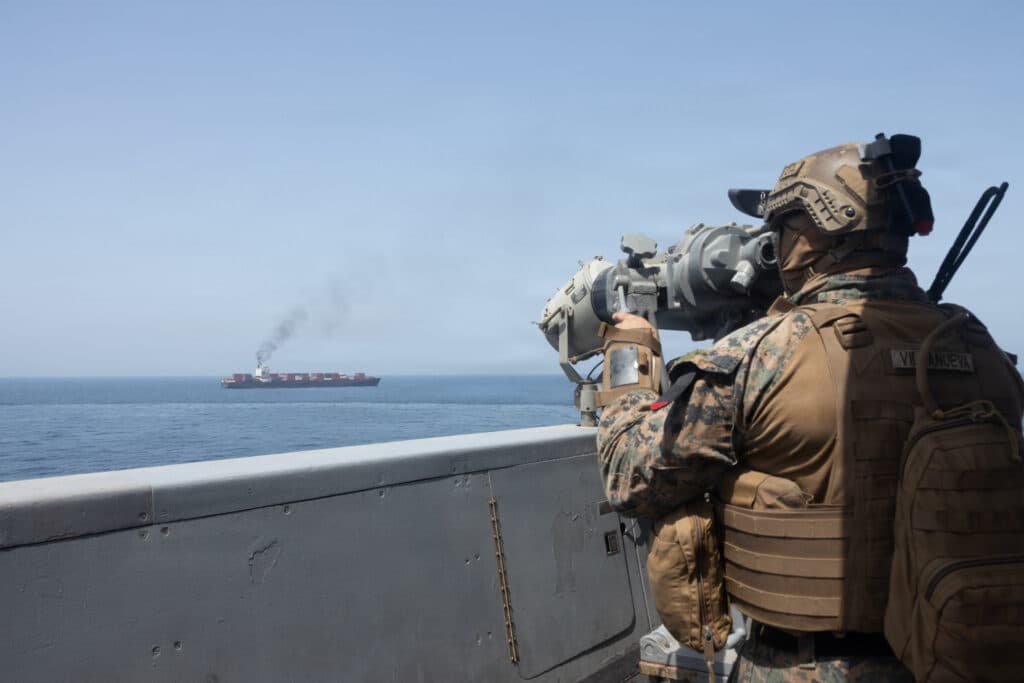
On Wednesday, the European Commission presented a series of measures designed to protect consumers, including changes to state aid rules; accelerating action on electrification, grids and energy taxation; mobilizing private investment; and making more EU-level funding available. U.S. forces patrol the Arabian Sea near M/V Touska on April 20, 2026, after firing upon the Iranian-flagged vessel that the U.S. accused of attempting to violate the naval blockade of Iranian ports near the Strait of Hormuz. | U.S. Navy via Getty Images This will be the first chance for national leaders to speak directly to one another on whether these plans go far enough.
Money matters While geopolitics has (once again) crashed the agenda for an EU summit, the Cyprus meeting was supposed to focus primarily on economic affairs — including the EU’s €1.8 trillion long-term budget. Costa is pushing EU leaders to accelerate talks on the financial framework, setting aside two hours of Friday’s session for doing just that. His goal is to finalize a deal on the seven-year budget by the end of this year, amid fears that the far right could win France’s April 2027 elections and upend negotiations.
“The longer things go on, the less bold any changes to the budget will be,” said an EU diplomat, granted anonymity to speak frankly. “The clock is ticking.” If a leaders reach a deal on that timetable, it would be unusually fast by EU standards. Any breakthrough will depend on how much governments are willing to compromise.
Talks on the budget are always tortuous, with wealthier governments in Northern Europe reluctant to pay more into the budget and skeptical about handing the European Commission more powers to impose taxes. Countries in Southern and Eastern Europe, by contrast, tend to back a bigger budget and broadly oppose cuts to farm subsidies and regional funding, traditionally the two biggest sections of the cash pot. To complicate matters further, the EU is due to start repaying €25 billion a year from 2028 on the joint debt it issued to cushion the economic fallout from the Covid pandemic.
And there’s increasing pressure to connect the budget to geopolitics, with the Iran war potentially limiting how much the bloc will have to spend. Kata Tüttő, the president of the Committee of the Regions, told POLITICO she “could imagine” some countries calling for a smaller budget, but insisted that was unworkable when the economic impact of the Iran conflict is “still … about around 1 per cent of the European GDP,” rather than a much larger share. All for one? The war has also tested the EU’s crisis planning, with Cyprus among those calling for clarity on how the bloc’s mutual assistance clause would work i