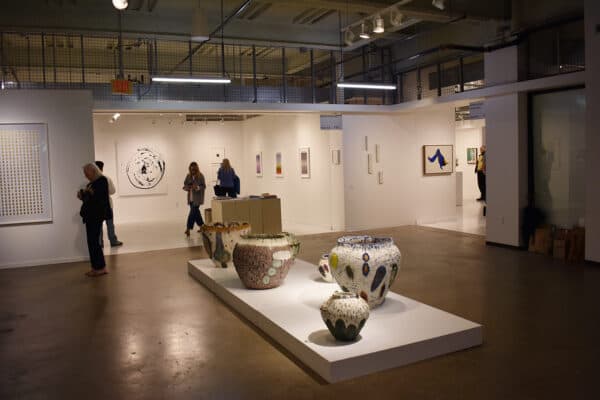
Dallas Art Fair, 2026. Photo: Anika Sultana Despite the rain and gloomy weather blanketing DFW this weekend, the 2026 Dallas Art Fair (DAF) saw a busy turnout, with the two-story Fashion Industry Gallery bustling with action. As a first-time attendee of the fair, I felt out of my element when I first stepped in.
Although I saw a diverse crowd — including people my age and people “dressed down” in jeans — I also saw visitors in their Sunday’s best (or Saturday’s best, more accurately) frequenting the space in tour groups and admiring work just as I was. More shockingly, some visitors were soliciting the price of the art on display. As a broke graduate student, I already knew I didn’t have the budget to own any of these pieces, but I think the reality of things really set in when I overheard a gallery attendant say, “This one is $12,000.” I took my mom with me as my plus-one, and upon seeing a piece listed at $135,000, she exclaimed, “That’s enough to buy a house!” I do not know how mortgages work (and I am too scared to ask), but that is too many dollars for me to visualize.
An obligatory mention: Hollis Taggart and Perrotin also boasted pieces from known names like Basquiat and Murakami, of which I was honored to even breathe around. Nonetheless, even with their daunting price tags, the work on display was strong and bold. Hosting galleries from near and far, from Dallas to New York to Tokyo, Dublin and Uruguay, one consistent motif I noticed artists playing with across galleries at DAF was representational art — or, rather, the lack thereof.
Pure, unhindered shapes, colors, textures, and lines all caught my eye in art that crossed the line of nonrepresentation, calling attention to the artist’s choice of canvas and manipulation of these features rather than to the subject itself. Below are some of the top picks from galleries that resonated with me — and that I hope will resonate with you, too. Triptych of works by Sho Shibuya on view at Bienvenue Steinberg & C at the Dallas Art Fair.
Photos: Anika Sultana Murielle White, “Heat on the shore,” 2018, oil and mixed media on canvas, 36 x 36 inches. On view at Pencil on Paper Gallery at the Dallas Art Fair. Photo: Anika Sultana Murielle White, “Under the Cycladic Sun,” 2018, oil and mixed media on canvas, 65.6 x 45 inches.
On view at Pencil on Paper Gallery at the Dallas Art Fair. Photo: Anika Sultana Deborah Tarr, “The Helford,” 2025, oil on linen, 39 x 51 inches. On view at Cadogan at the Dallas Art Fair.
Photo: Anika Sultana Pieces from artists like Deborah Tarr, Murielle White and Sho Shibuya are deceivingly simple, but manipulate formal features well. The gradients in Shibuya’s triptych (Bienvenue Steinberg & C) pair well with the New York Times headers to catch the eye in minimalist compositions. Unlike the triptych, however, the pops of color in the works by White (Pencil on Paper Gallery) complement the contours used to create unintelligible suggestions of … well, something.
The lines and colors combined potentially read like flora to me, though I’m sure interpretations will vary. But, the uncertainty of the subject matter is where pieces like these find their beauty. Similarly, Tarr’s work seems to be the most “traditional” painting out of this sampling, drawing upon earth tones with hints of royal blue, golden yellow, and terracotta red, but rather than focus on a clear, explicit subject, the purity of colors is what drew me to this piece.
Katherine Bernhardt, “Dreamer,” 2025, acrylic and spray paint on canvas. On view at CANADA at the Dallas Art Fair. Photo: Anika Sultana Zoe Walsh, “Pleasure is a Reason,” 2025, acrylic on canvas-wrapped panel, 66 x 65 x 1 3/8 inches.
On view at Yossi Milo at the Dallas Art Fair. Photo: Anika Sultana While passing through the fair’s winding halls, the deeper I went in, the more disoriented I felt. Aptly, when I saw Bernhardt and Walsh’s works, I felt as if they captured a sense of otherworldliness.
Bernhardt’s title, Dreamer, is accurate and applicable to both works: though they err more on the side of representation, these pieces feel trancelike and almost hallucinatory in nature with how they use amalgamations of bright tones and shapes. I am a digital artist, not a painter. How these artists are able to render such saturated, clear expressions of color, line, and shape in traditional, analog media is beyond my wheelhouse, but will forever receive my awe and respect.
With that in mind, some of the other pieces that sought my attention at DAF were, ironically enough, black-and-white. Alison Rossiter, “Darko Velvet, expired October 1915, processed 2021, 2023,” 3 gelatin silver prints, 15 x 29 1/4 inches. On view at Yossi Milo at the Dallas Art Fair.
Photo: Anika Sultana Alison Rossiter, “Haloid Rito, expired July 17, 1925, processed 2023,” 12 gelatin silver prints, 12 3/4 x 10 inches. On view at Yossi Milo at the Dallas Art Fair. Photo: Anika Sultana Alison Rossiter, “Density 1941-1945,” 2020, 5 gelatin silver pr