As we approach Freedom Day, we are invited, once again, to celebrate the triumph of a nation that chose the ballot over the bullet, reconciliation over revenge and hope over despair. It is a day that reminds us of what is possible when a people refuse to be defined by their past. Yet, beneath the symbolism and ceremony, there remains a quieter, more unsettling question: What does freedom mean for those who are searching?
For families who do not know where their loved ones lie? For a country where the disappeared have not all been returned home? Freedom, in such a context, feels incomplete.
Not absent but unfinished. Recently, on my show, Power Week, I had the privilege of hosting Madeleine Fullard, the head of the Missing Persons Task Team in the National Prosecuting Authority. It was a conversation that did not simply inform; it unsettled.
It opened wounds I had convinced myself had long been dealt with. Wounds buried under time, under progress, under the narrative of a nation that struggles with “moving on”. Fullard’s work sits at the intersection of memory and justice.
It is the painstaking labour of locating the remains of those who disappeared during apartheid, identifying them and returning them to their families. She spoke of more than 2 000 people who vanished into the machinery of the state and the chaos of resistance. People who disappeared in exile.
People who were executed through the death penalty and buried in unmarked graves, their bodies claimed by the state even in death. People whose names exist in fragments, whose stories remain incomplete. Listening to her, I realised that disappearance is not just about physical absence.
It is about suspended grief. About families unable to mourn fully because there is no body to bury, no grave to visit, no ritual to complete. It is about a nation carrying ghosts it has not fully acknowledged.
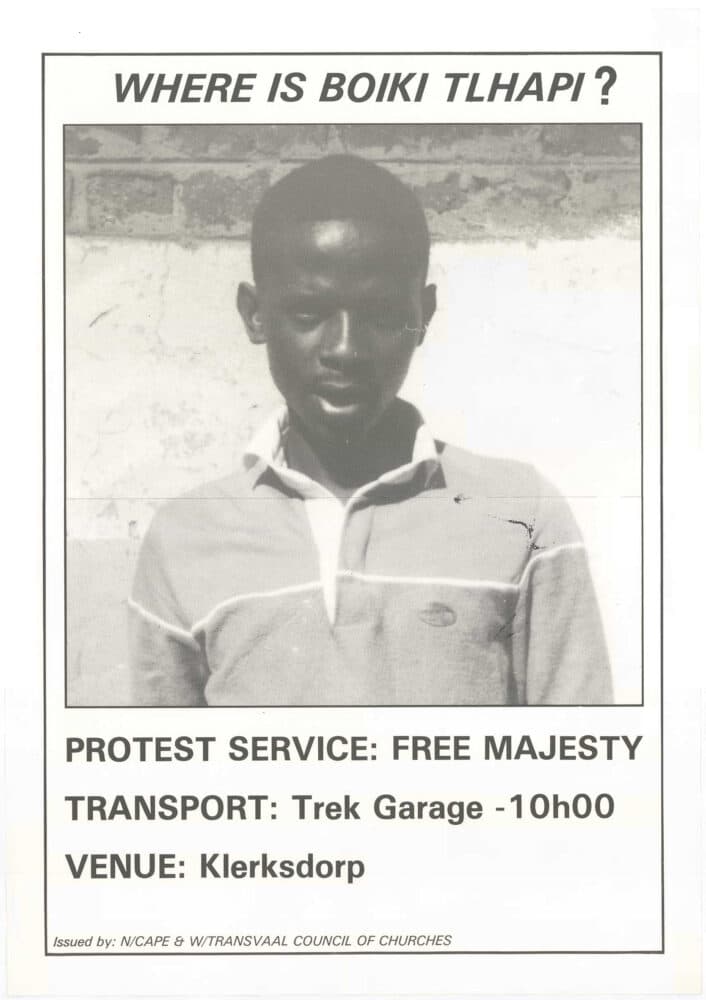
As I reflected with Fullard, I came to the conclusion that the pain of the disappeared is not that they are gone but that they have not been returned. The interview transported me back to stories I grew up with, stories that were not history lessons but lived realities in my township of Khuma. Ramatua Nicholas Tlhapi, also known as “Boiki”.
Photo: South African History Online One such story is that of Boiki Tlhapi, a young man from Ikageng whose body was dumped in a mine shaft in Stilfontein. His disappearance was not just an act of violence; it was an attempt to erase him entirely. His name, however, was never erased.
It lived in whispered conversations, in the quiet anger of a community that knew but could not prove. It lived in the unresolved grief of a family carrying that loss decades later. Then there is George Mbatha, a man whose story reflects the cost of truth-telling in a society not always ready to hear it.
A former South African Police Service officer from Stilfontein, Mbatha became a whistleblower, exposing apartheid-era police crimes, including the killing of Boiki Tlhapi. For this, he paid dearly. He was framed, imprisoned for 18 months without a valid case or even a prison number in 1991.
Suspended, denied work and left to fight for recognition for more than three decades. Thirty-six years later, he is still seeking justice, waiting for acknowledgment, haunted by what he knows. What does it do to a man to carry such knowledge?
To know where bodies were disposed of, to know the truth and yet to live in a society that has not fully confronted it? Mbatha is haunted not only by the crimes he exposed but by the failure to bring closure. By the knowledge that families are still waiting.
Haunted by ghosts that refuse to be buried. Fullard spoke of moments of breakthrough, when remains are found, when DNA matches, when a family is finally able to say: “He is home.” But she also spoke of the many cases where that closure remains elusive. Where hope rises, only to be dashed again.
I was reminded of a ceremony I once attended in Mamelodi. It was a graveside process led by Fullard and her team. Families of members of Poqo, the armed wing of the PAC, had gathered.
I do not remember the speeches. What remains etched in my memory are the faces. Faces carrying decades of waiting. Faces searching for something beyond words.
Faces that held hope and fear in equal measure. There was something almost sacred in that space. A quiet acknowledgment that this was not just a procedural exercise but a deeply human moment.
A moment where history, grief and dignity converged. Among the many stories of loss is that of Tsotetsi Seakgwa. His elderly mother is waiting for closure through the reparations process.
She knows where he is buried. And yet, knowing has not brought peace. When his coffin was being carried, it fell and cracked as apartheid police chased those carrying it.
That image, of a cracked coffin, is more than a moment in time. It is a metaphor for our society. A coffin that could not hold its dignity.
A burial interrupted. A final act of violence even in death